We use Google Analytics to understand how visitors use this site. Analytics cookies are only activated with your consent. For details, read our Privacy Policy.
Profile lensThe same player, read from a different angle.
Athletic80
Acceleration
85
Pace
79
Agility
85
Strength
74
Balance
74
Jumping
71
Stamina
89
Fitness
84
Technical74
Dribbling
73
Short Passing
75
Long Passing
77
Finishing
62
Shot Accuracy
58
Shot Power
79
Shooting Technique
61
Heading
62
Tackling
78
Crossing
78
Free Kick
65
Penalties
66
First Touch
74
Mental80
Composure
76
Aggression
78
Consistency
85
Creativity
68
Leadership
78
Work Rate
83
Tactical78
Vision
71
Off the Ball
68
Defensive Positioning
84
Teamwork
79
Anticipation
85
Marking
78
Attacking66
Crossing
78
Finishing
62
Heading Accuracy
62
Shot Accuracy
58
Off the Ball
68
Technique71
Dribbling
73
Free Kick
65
Short Passing
75
Long Passing
77
First Touch
74
Shot Technique
61
Movement81
Acceleration
85
Pace
79
Agility
85
Balance
74
Physicality79
Shot Power
79
Jumping
71
Stamina
89
Strength
74
Fitness
84
Defending80
Marking
78
Tackling
78
Def. Positioning
84
Mentality & Game Reading77
Aggression
78
Composure
76
Penalties
66
Vision
71
Leadership
78
Work Rate
83
Teamwork
79
Anticipation
85
Consistency
85
Creativity
68
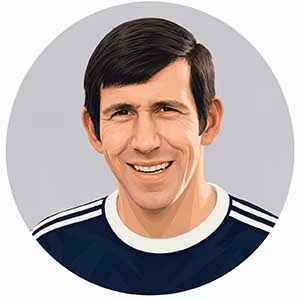
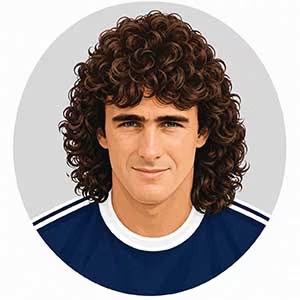
Scotland - Left BackAlbiston, Arthur
Few defenders in Manchester United’s modern history occupied their flank with such steady, unheralded permanence as Arthur Albiston, who quietly locked down the left side of the Old Trafford defense across fourteen seasons and nearly 500 competitive appearances. Scouted out of Edinburgh as a schoolboy, Albiston was thrust into senior prominence in the most demanding scenario imaginable: stepping into the 1977 FA Cup final as an emergency nineteen-year-old replacement for the injured Stewart Houston to help thwart Liverpool’s treble bid. Standing at five-foot-ten with a sturdy, balanced frame, his game was free of modern overlapping vanity, built instead on textbook British full-back fundamentals. He was a disciplined positional defender who rarely got caught upfield, using crisp lateral movement, clean sliding tackles along the touchline, and reliable low-risk distribution into midfield. Though primarily a defensive stabilizer, he possessed a dependable left foot capable of driving crosses into the box and stepping up under pressure, famously netting a crucial semi-final winner against Liverpool in the 1985 FA Cup replay. A loyal stalwart under Tommy Docherty, Dave Sexton, and Ron Atkinson, Albiston collected three FA Cup winner's medals (1977, 1983, 1985) and represented Scotland across 14 caps, featuring in the squad for the 1986 World Cup in Mexico before concluding his top-flight career with West Bromwich Albion and Aberdeen.
Mentally and emotionally, Albiston was the quintessential low-maintenance professional whose quiet dependability made him an indispensable anchor across turbulent managerial transitions. Unfazed by the intense scrutiny and celebrity circus that often surrounded Manchester United in the late 1970s and 1980s, he approached his job with an understated, blue-collar Scottish work ethic, never seeking personal headlines or generating dressing-room friction. On the pitch, his temperament was calm, steady, and unfailingly reliable; while more flamboyant teammates captured public imagination, Albiston provided the tactical reassurance that allowed wingers like Steve Coppell and Jesper Olsen the freedom to attack without fear of defensive exposure. Inside the locker room, he was a well-liked, dry-witted, and stabilizing veteran presence whose consistency in daily training set a benchmark for younger academy graduates, including a young Mark Hughes. Under high-friction cup final pressure or hostile away atmospheres across the First Division, his concentration remained rock-solid, sticking faithfully to his basic marking duties for ninety minutes. Toward referees and aggressive opposing wingers, Albiston maintained a straightforward, honest sporting standard: engaging in firm, full-blooded physical challenges without cynical malice, leaving a legacy as one of the most durable, selfless, and respected servants in Manchester United's post-Busby era


 All Time ScotlandNT