We use Google Analytics to understand how visitors use this site. Analytics cookies are only activated with your consent. For details, read our Privacy Policy.
Profile lensThe same player, read from a different angle.
Athletic83
Acceleration
85
Pace
80
Agility
84
Strength
76
Balance
77
Jumping
77
Stamina
92
Fitness
91
Technical78
Dribbling
78
Short Passing
78
Long Passing
77
Finishing
74
Shot Accuracy
72
Shot Power
80
Shooting Technique
76
Heading
79
Tackling
77
Crossing
74
Free Kick
74
Penalties
76
First Touch
80
Mental78
Composure
78
Aggression
78
Consistency
76
Creativity
75
Leadership
81
Work Rate
76
Tactical83
Vision
84
Off the Ball
74
Defensive Positioning
77
Teamwork
88
Anticipation
85
Marking
73
Player Traits
Attacking75
Crossing
74
Finishing
74
Heading Accuracy
79
Shot Accuracy
72
Off the Ball
74
Technique77
Dribbling
78
Free Kick
74
Short Passing
78
Long Passing
77
First Touch
80
Shot Technique
76
Movement82
Acceleration
85
Pace
80
Agility
84
Balance
77
Physicality83
Shot Power
80
Jumping
77
Stamina
92
Strength
76
Fitness
91
Defending76
Marking
73
Tackling
77
Def. Positioning
77
Mentality & Game Reading80
Aggression
78
Composure
78
Penalties
76
Vision
84
Leadership
81
Work Rate
76
Teamwork
88
Anticipation
85
Consistency
76
Creativity
75
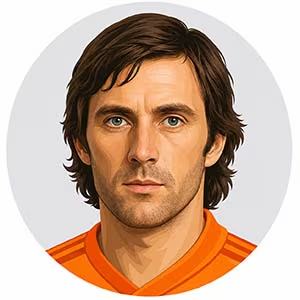
Netherlands - Centre MidfielderWinter, Aron
On 9 July 1994, the Netherlands were 2–1 down to Brazil in the World Cup quarter-final in Dallas when Marc Overmars swung a corner into the penalty area. Aron Winter, only 1.76 metres tall and surrounded by larger defenders, moved across the six-yard box, rose between them and headed the equaliser. Brazil eventually won 3–2, but the goal captured something essential about Winter. He was rarely the player for whom an attack was designed, yet he repeatedly understood where the game required him to be. Against superior size, under World Cup pressure and from a role primarily associated with midfield work, he found the space and performed the unfamiliar task.
Winter was an exceptionally complete central midfielder whose usefulness came from combining technique with continual movement and tactical obedience without becoming merely destructive. Developed at Ajax under Johan Cruyff, he learned to receive under pressure, circulate the ball quickly and react immediately when possession was lost. He could operate as a holding midfielder, a box-to-box player, a wider midfielder or the more mobile member of a central pair. Strong for his size, quick across short distances and equipped with considerable stamina, he covered defensive spaces, pressed, supported possession and made delayed runs beyond the forwards. His shooting from distance added another dimension, particularly during his first Ajax period, when he scored regularly for a midfielder. Winter made his Ajax debut in 1986 and won the Cup Winners’ Cup, two Dutch Cups, the 1989–90 Eredivisie and the 1991–92 UEFA Cup before moving to Lazio. Serie A demanded a more positionally cautious and physically rigorous interpretation of midfield, and he adapted across four productive seasons in Rome. He joined Inter in 1996, initially enduring a less natural tactical role before becoming more effective again centrally and winning another UEFA Cup in 1998. He returned to Ajax in 1999, later spent a season on loan at Sparta Rotterdam and retired in 2003. For the Netherlands he earned 84 caps and scored six goals. He belonged to the Euro 1988-winning squad without appearing during the tournament, then played at three World Cups and three subsequent European Championships, remaining involved internationally until Euro 2000.
Versatility could also conceal the absence of one overwhelming speciality. Winter could defend, pass, run and arrive in attacking positions, but he was neither an elite creative organiser nor a dominant ball-winner, and teams using him far from central midfield could reduce his influence. His first Inter season exposed that problem when assignments away from his preferred areas limited what he could contribute. Against physically dominant midfield units he compensated through movement and timing rather than imposing himself directly, while advancing too frequently could leave space behind if the surrounding structure did not balance his runs. His game also depended heavily on endurance: once his athletic range declined, the advantage created by covering several functions inevitably narrowed. He was most valuable to teams that needed connective tissue between specialists, less so when asked to become the single player around whom possession or defensive control revolved.
Winter’s behavioural record makes adaptability more than a tactical description. When he arrived at Lazio in 1992, racist hostility preceded him: slogans demanding his departure appeared around the city and sections of the support protested against the signing. Winter initially answered questions about it, then told journalists that he would stop allowing the subject to dominate every conversation and would instead let his football speak. More than thirty years later, he described the underlying response clearly: when resistance appeared, his instinct was to fight harder rather than allow himself to be pushed away. He remained four seasons, performed consistently enough to become popular with the same broader support that had initially contained hostile factions, and later described earning recognition as a footballer as the objective. The episode is valuable because hostility increased determination without producing documented retaliation against spectators, officials or teammates. His transition from Ajax to Italy showed the same practical response to discomfort. Winter has explained that Italian pre-seasons were longer and more physically demanding and that defensive expectations differed substantially; instead of rejecting those methods, he used them to improve his endurance and defensive understanding. He credits very different coaches with adding elements to his game and says he continually tried to become a complete player while never believing he had finished developing. At Ajax, he recalled earning acceptance from established senior players through work rather than demanding status as a talented youngster. Failure did not always disappear cleanly: he missed his penalty in Inter’s 1997 UEFA Cup final shoot-out defeat to Schalke, yet remained with the club, continued contributing the following season and was part of the side that returned to the final and won the competition in 1998. Even later he spoke positively of Roy Hodgson despite criticism surrounding the coach, suggesting that collective disappointment did not automatically become personal blame. Winter was not entirely frictionless — conflict with Co Adriaanse eventually contributed to his loan from Ajax to Sparta — but this appears exceptional rather than characteristic. His prevailing response to pressure was neither withdrawal nor confrontation. He worked, adapted and attempted to make himself useful in whatever function the environment demanded.