We use Google Analytics to understand how visitors use this site. Analytics cookies are only activated with your consent. For details, read our Privacy Policy.
Profile lensThe same player, read from a different angle.
Athletic78
Acceleration
73
Pace
74
Agility
73
Strength
77
Balance
77
Jumping
78
Stamina
84
Fitness
86
Technical77
Dribbling
75
Short Passing
80
Long Passing
77
Finishing
52
Shot Accuracy
60
Shot Power
74
Shooting Technique
75
Heading
77
Tackling
84
Crossing
72
Free Kick
62
Penalties
67
First Touch
80
Mental79
Composure
78
Aggression
77
Consistency
78
Creativity
74
Leadership
76
Work Rate
85
Tactical82
Vision
78
Off the Ball
64
Defensive Positioning
83
Teamwork
91
Anticipation
85
Marking
79
Attacking65
Crossing
72
Finishing
52
Heading Accuracy
77
Shot Accuracy
60
Off the Ball
64
Technique75
Dribbling
75
Free Kick
62
Short Passing
80
Long Passing
77
First Touch
80
Shot Technique
75
Movement74
Acceleration
73
Pace
74
Agility
73
Balance
77
Physicality80
Shot Power
74
Jumping
78
Stamina
84
Strength
77
Fitness
86
Defending82
Marking
79
Tackling
84
Def. Positioning
83
Mentality & Game Reading79
Aggression
77
Composure
78
Penalties
67
Vision
78
Leadership
76
Work Rate
85
Teamwork
91
Anticipation
85
Consistency
78
Creativity
74
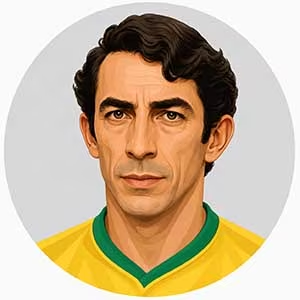
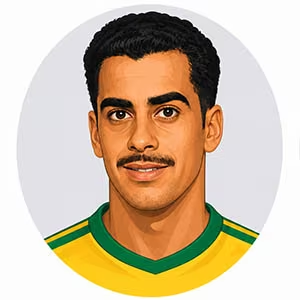
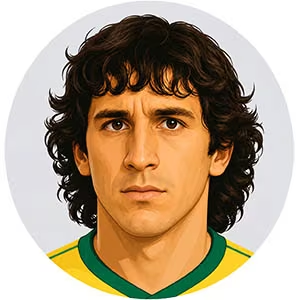
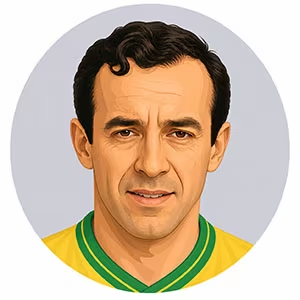
Brazil - Defensive MidfielderPiazza, Wilson
Mário Zagallo’s revolutionary tactical gamble in early 1970 required converting Cruzeiro’s premier midfield orchestrator into an emergency central defender, and Wilson da Silva Piazza executed the transition with such cerebral brilliance that he anchored Brazil to world supremacy. Piazza was the intelligent, ball-playing anchor and spiritual captain of Cruzeiro’s historic golden era alongside Tostão and Dirceu Lopes. Blessed with pristine spatial awareness, immaculate timing on ground interceptions, and a cultured distribution range, he could dictate tempo from deep midfield or step out from the backline with his head held high to initiate attacks with laser-accurate passing. Across 566 matches for Cruzeiro between 1964 and 1977, he collected ten Campeonato Mineiro titles, the 1966 Taça Brasil (dismantling Santos in historic fashion), and captained the side to the 1976 Copa Libertadores championship. For Brazil, across 52 caps, he was an irreplaceable starter across two World Cups: playing every minute as the central defensive partner to Brito in Mexico 1970, and returning to his natural midfield holding role at the 1974 tournament in West Germany.
However, Piazza’s converted defensive role carried natural physical risks against brute force. Standing five-foot-nine with a lean build, he lacked towering aerial height; when confronted by massive, six-foot-three European target men who pinned him inside the six-yard box under heavy aerial bombardments, he had to rely entirely on positional anticipation, body leverage, and aerial timing rather than physical dominance. Furthermore, in open-field footraces against lightning-fast transitional forwards, his recovery speed could be tested if his initial anticipation was bypassed.
Aristocratic, noble, and carrying natural diplomatic gravitas, Piazza was a natural leader of men both on and off the turf. He commanded matches through intellectual superiority and calm tactical adjustments rather than crude intimidation, famously serving as a key founder and president of Brazil's first professional football players' union to fight for athletes' rights. On the pitch, his presence radiated serene composure: subduing chaos inside his own half and directing teammates with subtle hand signals. Inside the Cruzeiro and Seleção locker rooms, his word carried immense moral weight—a trusted lieutenant to Zagallo and an untouchable patriarch to his peers, cementing an eternal legacy as one of the most versatile, intelligent, and influential figures in Brazilian football history.