We use Google Analytics to understand how visitors use this site. Analytics cookies are only activated with your consent. For details, read our Privacy Policy.
Profile lensThe same player, read from a different angle.
Athletic78
Acceleration
70
Pace
72
Agility
74
Strength
86
Balance
77
Jumping
85
Stamina
66
Fitness
91
Technical43
Dribbling
49
Short Passing
52
Long Passing
55
Shot Accuracy
44
Shot Power
87
Shooting Technique
42
Heading
49
Free Kick
44
Penalties
44
First Touch
50
Mental83
Composure
84
Consistency
80
Leadership
86
Goalkeeping87
Reflexes
90
Positioning
90
Handling
84
Kicking
83
Goalkeeping87
Reflexes
90
Positioning
90
Handling
84
Kicking
83
Attacking47
Heading Accuracy
49
Shot Accuracy
44
Technique49
Dribbling
49
Free Kick
44
Short Passing
52
Long Passing
55
First Touch
50
Shot Technique
42
Physicality83
Shot Power
87
Jumping
85
Stamina
66
Strength
86
Fitness
91
Movement73
Acceleration
70
Pace
72
Agility
74
Balance
77
Mentality & Game Reading74
Composure
84
Penalties
44
Leadership
86
Consistency
80
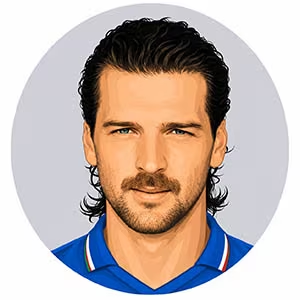
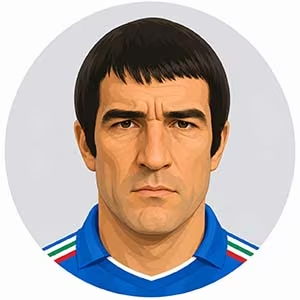
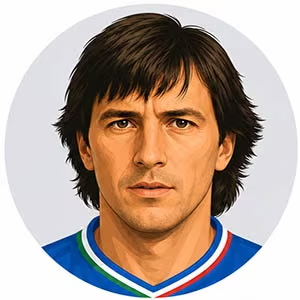
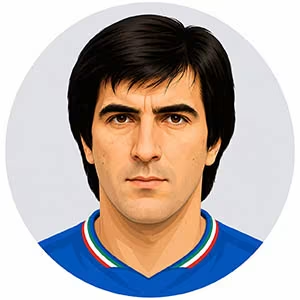
Italy - GoalkeeperTacconi, Stefano
Replacing the legendary Dino Zoff between the posts of Juventus in 1983 was widely regarded as a mission impossible, yet an outspoken, chain-smoking shot-stopper from Perugia stepped onto the Stadio Comunale pitch and simply conquered the entire continent. Stefano Tacconi was the explosive, hyper-athletic guardian who anchored Giovanni Trapattoni’s side through the golden European apex of the 1980s. Standing six-foot-two with exceptional horizontal spring, razor-sharp reflexes on close-range volleys, and a commanding, fearless presence on high crosses, Tacconi became one of only six goalkeepers in history to win all three major UEFA club competitions (the 1984 European Cup Winners' Cup, the tragic 1985 European Cup at Heysel, and the 1990 UEFA Cup), alongside two Scudetti, the 1990 Coppa Italia, and the 1985 Intercontinental Cup in Tokyo against Argentinos Juniors. For Italy, across seven caps, he spent his international career as the primary, undisputed deputy to Walter Zenga, earning bronze at the 1990 World Cup on home soil.
Underneath the acrobatic brilliance, however, Tacconi’s style carried era-typical constraints. He was not a sweeping, modern distributor who ventured outside his box to act as an auxiliary outfield player, sticking strictly to long, direct drop-kicks under back-pass pressure. Furthermore, his hyper-aggressive charges on crosses occasionally resulted in high-risk collisions and mistimed punches in congested six-yard boxes.
Flamboyant, fiercely rebellious, and utterly allergic to diplomatic filter, Tacconi approached goalkeeping as a high-wire performance. He actively thrived on pressure and controversy: sporting a trademark mustache, chain-smoking before finals, and publicly challenging managers and rivals with sharp, sarcastic wit. On the pitch, his presence was explosive and authoritarian, barking merciless commands at stoppers like Sergio Brio and Antonio Cabrini to maintain defensive compactness. Inside the Juventus dressing room, he was a massive, charismatic leader who captained the side in the late 1980s and took the emotional brunt of high-stakes matches on his broad shoulders. Opposing forwards found his physical bravado deeply intimidating, cementing his standing as one of the most athletic, successful, and colorful goalkeepers in Italian history.