We use Google Analytics to understand how visitors use this site. Analytics cookies are only activated with your consent. For details, read our Privacy Policy.
Profile lensThe same player, read from a different angle.
Athletic80
Acceleration
87
Pace
82
Agility
83
Strength
76
Balance
74
Jumping
78
Stamina
82
Fitness
80
Technical83
Dribbling
86
Short Passing
77
Long Passing
82
Finishing
84
Shot Accuracy
85
Shot Power
84
Shooting Technique
79
Heading
82
Tackling
45
Crossing
78
Free Kick
73
Penalties
76
First Touch
85
Mental79
Composure
82
Aggression
78
Consistency
77
Creativity
85
Leadership
80
Work Rate
77
Tactical79
Vision
82
Off the Ball
85
Defensive Positioning
45
Teamwork
80
Anticipation
79
Marking
38
Attacking83
Crossing
78
Finishing
84
Heading Accuracy
82
Shot Accuracy
85
Off the Ball
85
Technique80
Dribbling
86
Free Kick
73
Short Passing
77
Long Passing
82
First Touch
85
Shot Technique
79
Movement82
Acceleration
87
Pace
82
Agility
83
Balance
74
Physicality80
Shot Power
84
Jumping
78
Stamina
82
Strength
76
Fitness
80
Defending43
Marking
38
Tackling
45
Def. Positioning
45
Mentality & Game Reading80
Aggression
78
Composure
82
Penalties
76
Vision
82
Leadership
80
Work Rate
77
Teamwork
80
Anticipation
79
Consistency
77
Creativity
85
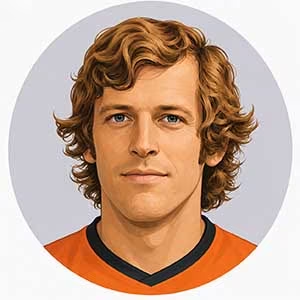
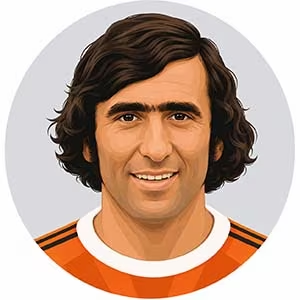
Netherlands - Right WingerSwart, Sjaak
At Wembley on 2 June 1971, Ajax led Panathinaikos 1–0 in the European Cup final when Rinus Michels removed Sjaak Swart at half-time. Swart had played throughout the campaign and was almost never substituted. Years later he still remembered the decision as deeply disappointing. Michels had originally assigned him defensive responsibility on the Greek left-back, but Swart became absorbed in the match and, according to the coach, stopped performing the task consistently. Michels replaced him while trying to protect the lead; Ajax eventually won 2–0. Swart did not rewrite the episode as painless obedience. He remembered being hurt, remembered discussing it with Michels afterwards and maintained that Michels later admitted he had handled it wrongly. ([champions-journal.com](https://www.champions-journal.com/1000/ajax-71?utm_source=chatgpt.com)) The scene is unusually useful for a player whose identity would eventually become almost synonymous with his club. Swart could experience exclusion as personal injury without converting it into detachment from Ajax itself. Loyalty and grievance remained simultaneously available.
Swart was a right winger whose football combined orthodox width with considerably more scoring threat than the role sometimes implies. Quick over short distances, technically secure and comfortable attacking a defender repeatedly, he could go outside to cross or move diagonally towards goal. His output reflects that elasticity: 174 league goals in 463 Eredivisie appearances and a club-record 603 competitive matches across seventeen seasons. ([ajax.nl](https://english.ajax.nl/articles/ajax-and-sjaak-swart-75-years-of-an-unbreakable-bond/?utm_source=chatgpt.com)) The street football of his childhood had developed close control and shooting from unusual angles, while Ajax’s later tactical transformation required much more than isolated wing play. Michels imposed pressing, positional interchange and a dramatic increase in professionalism; Swart later recalled the coach effectively telling the squad that anyone unwilling to accept discipline and harder training could leave. Swart stayed and eventually described Michels as the best coach he ever had. ([uefa.com](https://www.uefa.com/uefachampionsleague/news/0253-0d7ff54908f6-5927d0a16600-1000--the-greatest-teams-of-all-time-ajax-1971-73/?utm_source=chatgpt.com)) His adaptability helped him survive Ajax’s evolution from Dutch champion to European hegemon while younger, faster players progressively entered the side.
That longevity had limits. Swart’s game still depended heavily on acceleration, repeated one-against-one engagement and the ability to arrive in attacking zones quickly enough to exploit space. As those margins narrowed with age, the emergence of Johnny Rep made succession increasingly unavoidable. Swart himself did not agree with the timing. Before his 1973 farewell he trained obsessively because he wanted to demonstrate that he could still perform at the highest level; Ajax’s own retrospective records that he pushed himself so hard preparing for the testimonial that he suffered a thigh injury. More painfully, no coach or director initially wanted to tell him directly that the first-team place was effectively being handed to Rep; former teammate Henk Groot eventually delivered the message. ([ajax.nl](https://www.ajax.nl/archief-2018-2019/8-augustus-1973-swart-je-zal-maar-zon-carriere-hebben-gehad/?utm_source=chatgpt.com)) This was not graceful voluntary retirement. Swart believed he could continue. The degradation condition was therefore partly physical but also hierarchical: a role that had remained his for nearly two decades was disappearing faster than his own assessment of his ability.
Psychologically, Swart is best defined by **possessive belonging without institutional submission**. Ajax was not simply an employer to him; it became part of his identity, and that attachment survived disappointment precisely because it was stronger than individual decisions made by coaches or directors. Yet he was not passive inside it. The 1971 substitution remained a grievance because Swart believed his contribution had been misjudged, and the 1973 retirement hurt because he did not accept the club’s assessment that succession had arrived. His response was not withdrawal but an attempt to prove the assessment wrong through additional training. That distinction is important: perceived rejection increased self-demonstration before it produced acceptance. The same competitive edge appears in lighter but revealing recollections. Swart has openly admitted enjoying occasions when Ajax had already become champions before facing Feyenoord or PSV because rivals then had to acknowledge them formally, while Ajax’s own retrospective describes an “iron will to win” developed from childhood competition. ([ajaxshowtime.com](https://www.ajaxshowtime.com/bijzaken-en-geruchten/swart-had-bijzondere-gewoonte-als-speler-van-ajax-dan-moesten-ze-ons-een-hand-geven?utm_source=chatgpt.com)) This should not be confused with emotional aggression. Evidence for persistent referee confrontation, revenge fouling or teammate-directed blame is insufficient. The stronger pattern is **identity-protected competitiveness**: Swart could argue with decisions made inside Ajax while never treating those decisions as equivalent to Ajax itself. Authority could disappoint him; belonging survived authority.


 All Time AjaxClub