We use Google Analytics to understand how visitors use this site. Analytics cookies are only activated with your consent. For details, read our Privacy Policy.
Profile lensThe same player, read from a different angle.
Athletic85
Acceleration
84
Pace
79
Agility
86
Strength
76
Balance
85
Jumping
83
Stamina
92
Fitness
92
Technical74
Dribbling
73
Short Passing
77
Long Passing
73
Finishing
52
Shot Accuracy
63
Shot Power
75
Shooting Technique
64
Heading
73
Tackling
86
Crossing
65
Free Kick
60
Penalties
64
First Touch
73
Mental88
Composure
87
Aggression
93
Consistency
92
Creativity
60
Leadership
82
Work Rate
95
Tactical81
Vision
75
Off the Ball
64
Defensive Positioning
83
Teamwork
82
Anticipation
87
Marking
89
Player Traits
Attacking63
Crossing
65
Finishing
52
Heading Accuracy
73
Shot Accuracy
63
Off the Ball
64
Technique70
Dribbling
73
Free Kick
60
Short Passing
77
Long Passing
73
First Touch
73
Shot Technique
64
Movement84
Acceleration
84
Pace
79
Agility
86
Balance
85
Physicality84
Shot Power
75
Jumping
83
Stamina
92
Strength
76
Fitness
92
Defending86
Marking
89
Tackling
86
Def. Positioning
83
Mentality & Game Reading82
Aggression
93
Composure
87
Penalties
64
Vision
75
Leadership
82
Work Rate
95
Teamwork
82
Anticipation
87
Consistency
92
Creativity
60
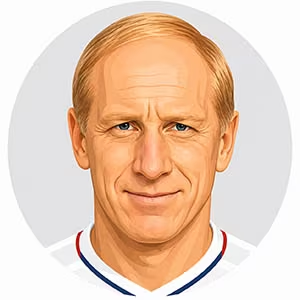
England - Defensive MidfielderStiles, Nobby
Relentless territorial harassment, missing front teeth, and a ferocious low-center-of-gravity tackling technique made Norbert Peter Stiles the definitive destructive pivot of English football during the 1960s. Formed in Manchester United’s academy under Matt Busby, Stiles stood just five-foot-six and suffered from severe myopia, yet he turned physical limitations into an intimidating defensive art form. Stationed in front of the back four as an uncompromising ball-winner, he specialized in early predatory anticipation: stepping in front of opposing inside-forwards, executing bone-shattering ground challenges with immaculate timing, and immediately laying off simple, unpretentious five-yard passes into the stride of Bobby Charlton and George Best. At Old Trafford, his destructive labor anchored United to two First Division championships (1964–65, 1966–67) and the historic 1968 European Cup against Benfica. His international zenith occurred at the 1966 World Cup across 28 caps for England: deployed by Alf Ramsey with a specific, ruthless man-marking brief against Portugal's Eusébio in the semi-final, Stiles completely suffocated the tournament’s most explosive forward without committing a single foul inside the penalty box, paving the way for England’s solitary world championship.
An unassuming, deeply religious, and modest family man away from the pitch, Stiles transformed the moment he crossed the touchline into a feral, toothless enforcer whose total commitment to the team knew no boundaries. He possessed no personal ego regarding creative stardom; his entire professional identity was built on absolute loyalty to his manager’s tactical commands and the physical protection of his creative teammates. When Busby and Ramsey asked him to neutralize generational playmakers, he accepted the assignment with grim, Spartan dedication, completely indifferent to hostile away crowds or negative media portrayals of his aggressive tackling style. Inside the locker room, his legendary post-1966 final dance with the Jules Rimet trophy captured his authentic, joyful, and deeply unifying character—a player universally adored by peers for his selflessness and infectious spirit. Under high-friction physical combat, his mental focus was spotless; he never allowed himself to be intimidated by larger, more athletic forwards, relying on razor-sharp anticipation and raw bravery to win 50-50 duels. Toward referees and opposing stars, Stiles was tough, unyielding, and direct: he committed hard tactical fouls when the system broke down, but he operated without calculated malice, cementing an immortal legacy as one of the most effective, selfless, and iconic ball-winners in British football history.