We use Google Analytics to understand how visitors use this site. Analytics cookies are only activated with your consent. For details, read our Privacy Policy.
Profile lensThe same player, read from a different angle.
Athletic82
Acceleration
91
Pace
87
Agility
88
Strength
76
Balance
77
Jumping
72
Stamina
82
Fitness
82
Technical83
Dribbling
92
Short Passing
78
Long Passing
77
Finishing
86
Shot Accuracy
84
Shot Power
84
Shooting Technique
80
Heading
77
Tackling
48
Crossing
72
Free Kick
77
Penalties
76
First Touch
85
Mental79
Composure
85
Aggression
86
Consistency
75
Creativity
79
Leadership
79
Work Rate
75
Tactical79
Vision
79
Off the Ball
87
Defensive Positioning
43
Teamwork
77
Anticipation
82
Marking
44
Player Traits
Attacking81
Crossing
72
Finishing
86
Heading Accuracy
77
Shot Accuracy
84
Off the Ball
87
Technique82
Dribbling
92
Free Kick
77
Short Passing
78
Long Passing
77
First Touch
85
Shot Technique
80
Movement86
Acceleration
91
Pace
87
Agility
88
Balance
77
Physicality79
Shot Power
84
Jumping
72
Stamina
82
Strength
76
Fitness
82
Defending45
Marking
44
Tackling
48
Def. Positioning
43
Mentality & Game Reading79
Aggression
86
Composure
85
Penalties
76
Vision
79
Leadership
79
Work Rate
75
Teamwork
77
Anticipation
82
Consistency
75
Creativity
79
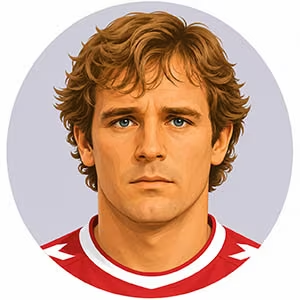
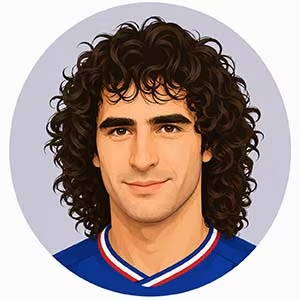
France - Right WingerRocheteau, Dominique
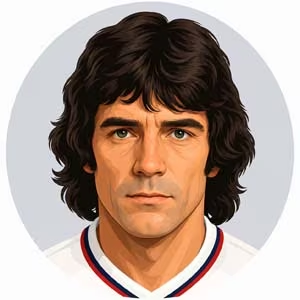
Long, curly black hair flowing in the wind and a sudden swerve along the right touchline earned a 20-year-old from Charente-Maritime the poetic moniker L'Ange Vert (The Green Angel) during AS Saint-Étienne’s unforgettable 1976 march to the European Cup final in Glasgow. Dominique Rocheteau was French football’s original counter-cultural idol of the late 1970s and 1980s, combining blistering acceleration with an elusive, snaking dribbling style. Whether stationed on the wide right wing or deployed as a fluid, mobile central attacker, Rocheteau used razor-sharp hip feints to unbalance full-backs before driving directly into the penalty box to deliver pinpoint cutbacks or clinical, placed finishes. Across a glittering domestic career spanning Saint-Étienne (three Division 1 crowns, one Coupe de France), Paris Saint-Germain (capturing the 1982 and 1983 Coupes de France and the historic 1985–86 league championship), and Toulouse, he notched over 150 top-flight goals. For France, across 49 caps and 15 goals, he was a pivotal forward across three World Cups (1978, 1982, 1986) and started in the triumphant Euro 1984 campaign on home soil.
However, Rocheteau’s graceful, lightweight frame proved perpetually fragile in the brutal physical duels of his era. A succession of severe hamstring tears, ankle sprains, and knee ailments frequently disrupted his momentum at critical junctures—most notably limiting him to a brief substitute appearance in the 1976 European Cup final and ruling him out of the 1982 World Cup semi-final against West Germany in Seville. Tactically, he offered minimal aerial resistance against towering center-backs and lacked the raw upper-body power to hold up long, isolated balls when his team was pinned deep.
Introspective, politically engaged, and wholly allergic to the superficial glitter of modern celebrity, Rocheteau approached the sport with the quiet sensitivity of an artist. He never chased personal glory or media headlines, preferring classic rock records and literature to footballing politics. On the pitch, his body language was clean, fair, and free of cynicism; he absorbed heavy cynical fouls without rolling on the turf or demanding bookings from referees. Inside the Saint-Étienne, PSG, and French locker rooms, he was an understated, deeply respected presence whose natural technical flair and unselfish movement created vital attacking lanes for superstars like Michel Platini and Safet Sušić. Opposing defenders found his sudden changes of pace nearly impossible to read without fouling, cementing his standing as one of the most beloved, elegant, and culturally iconic French forwards of his generation.


 All Time FranceNT