We use Google Analytics to understand how visitors use this site. Analytics cookies are only activated with your consent. For details, read our Privacy Policy.
Profile lensThe same player, read from a different angle.
Athletic74
Acceleration
73
Pace
72
Agility
77
Strength
78
Balance
71
Jumping
82
Stamina
60
Fitness
78
Technical42
Dribbling
48
Short Passing
52
Long Passing
52
Shot Accuracy
44
Shot Power
74
Shooting Technique
44
Heading
47
Free Kick
45
Penalties
45
First Touch
53
Mental84
Composure
86
Consistency
86
Leadership
70
Goalkeeping87
Reflexes
88
Positioning
90
Handling
85
Kicking
85
Goalkeeping87
Reflexes
88
Positioning
90
Handling
85
Kicking
85
Attacking46
Heading Accuracy
47
Shot Accuracy
44
Technique49
Dribbling
48
Free Kick
45
Short Passing
52
Long Passing
52
First Touch
53
Shot Technique
44
Physicality74
Shot Power
74
Jumping
82
Stamina
60
Strength
78
Fitness
78
Movement73
Acceleration
73
Pace
72
Agility
77
Balance
71
Mentality & Game Reading72
Composure
86
Penalties
45
Leadership
70
Consistency
86
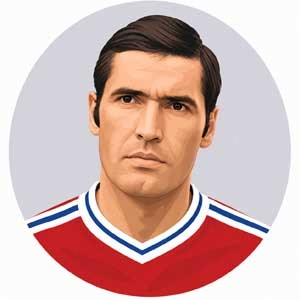
France - GoalkeeperCarnus, Georges
Carnus was a relatively compact goalkeeper, around 1.80 metres, whose value rested less on overwhelming physical dimensions than on reactions, movement and the quality of his conventional goalkeeping. He had learned the position partly through his father, himself an amateur goalkeeper, then developed through Aix and Stade Français before Saint-Étienne recruited him in 1967. There he became the goalkeeper of the dominant French side of the period, winning three consecutive league titles and two French Cups before adding another league-and-cup double with Marseille in 1972. His individual reputation was equally substantial: France Football named him French Player of the Year in both 1970 and 1971, an exceptional achievement for a goalkeeper. With France, however, his path was less secure. He debuted against Brazil in 1963, conceding three goals to Pelé, and eventually accumulated 36 caps, but competition with Marcel Aubour repeatedly interrupted his position as first choice. Carnus was fundamentally a shot-stopper rather than an auxiliary playmaker: his effectiveness came when the goalkeeper’s task remained recognisably goalkeeping—setting himself, reacting, covering the goal and making interventions—rather than constructing attacks through extensive possession.
His most revealing limitation was not an inability to survive sustained pressure but difficulty maintaining the same concentration when there was too little of it. A contemporary Le Monde profile from October 1967 made precisely this observation. At Stade Français, Carnus had played behind a permeable defence that kept him continuously involved; after moving to Saint-Étienne, Bosquier, Mitoraj and the rest of the defensive unit often reduced him to prolonged inactivity. The newspaper suggested that this relative idleness produced lapses of concentration, citing two occasions in which Carnus had recently been beaten unexpectedly by shots from roughly twenty-five to thirty metres. Those mistakes directly harmed his competition with Aubour for the French goal. That is a particularly useful degradation condition because it runs against the standard goalkeeper narrative. Carnus did not necessarily require protection from high event volume; frequent involvement could help keep him activated. Conversely, a dominant team could create a dangerous rhythm of waiting followed by one sudden action. His limitations should therefore not be rewritten simply as “inconsistency”: the surviving contemporary description points more specifically toward vigilance decay under low involvement. His height also provided less natural reach than larger goalkeepers, increasing the cost whenever positioning or reaction was even slightly delayed.
Psychologically, Carnus is distinguished by autonomy under reputational pressure combined with vulnerability to low-stimulus concentration. The 1971 transfer affair shows the first element unusually clearly. Carnus did not deny negotiating with Marseille and defended the new fixed-term contract system on principle, arguing that a footballer should be able to choose his employer according to salary and personal affinities just as a professional could in other industries. He also explained that moving south would bring him closer to his family. This was not rebellion for its own sake; it was a claim to decision-making authority over his own career. When Rocher interpreted that autonomy as disloyalty and removed him from the team, Carnus did not publicly renounce the move to restore institutional favour. More importantly, the resulting hostility did not produce documented long-term competitive degradation: he immediately became Marseille’s goalkeeper, won the double and retained enough individual standing to receive a second consecutive French Player of the Year award. The Bordeaux collapse nevertheless prevents romanticising him as psychologically impermeable. Under suspicion, he made visible technical errors in an extremely charged match; what cannot be established is whether emotion caused them. The earlier 1967 evidence points toward another mechanism—loss of vigilance during inactivity—which is independently documented. Evidence for retaliatory aggression, systematic referee conflict, teammate blame or sensitivity to individual provocation is insufficient and should remain unknown. Carnus therefore presents an unusually clean separation: institutional hostility and reputational attack did not clearly break his professional functioning, whereas insufficient competitive stimulation could measurably reduce his concentration.