We use Google Analytics to understand how visitors use this site. Analytics cookies are only activated with your consent. For details, read our Privacy Policy.
Profile lensThe same player, read from a different angle.
Athletic80
Acceleration
77
Pace
76
Agility
72
Strength
85
Balance
82
Jumping
85
Stamina
80
Fitness
79
Technical77
Dribbling
74
Short Passing
73
Long Passing
75
Finishing
58
Shot Accuracy
55
Shot Power
74
Shooting Technique
60
Heading
84
Tackling
87
Crossing
61
Free Kick
58
Penalties
55
First Touch
74
Mental79
Composure
76
Aggression
88
Consistency
78
Creativity
66
Leadership
84
Work Rate
81
Tactical80
Vision
73
Off the Ball
58
Defensive Positioning
87
Teamwork
76
Anticipation
85
Marking
84
Player Traits
Attacking63
Crossing
61
Finishing
58
Heading Accuracy
84
Shot Accuracy
55
Off the Ball
58
Technique69
Dribbling
74
Free Kick
58
Short Passing
73
Long Passing
75
First Touch
74
Shot Technique
60
Movement77
Acceleration
77
Pace
76
Agility
72
Balance
82
Physicality81
Shot Power
74
Jumping
85
Stamina
80
Strength
85
Fitness
79
Defending86
Marking
84
Tackling
87
Def. Positioning
87
Mentality & Game Reading76
Aggression
88
Composure
76
Penalties
55
Vision
73
Leadership
84
Work Rate
81
Teamwork
76
Anticipation
85
Consistency
78
Creativity
66
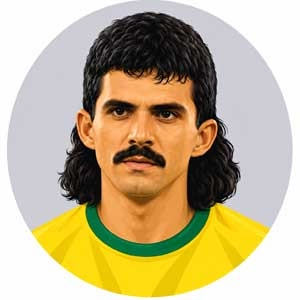
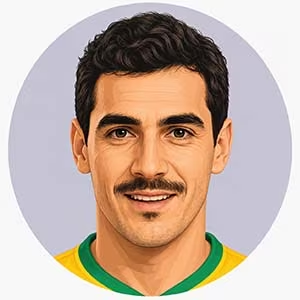
Brazil - Centre-backRocha, Ricardo
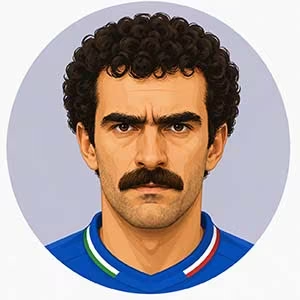
Sporting a thick, impeccably groomed mustache and radiating the calm assurance of a master chess player, a center-back from Recife redefined Brazilian defending in the late 1980s by proving that a zagueiro could dominate through anticipation and geometric positioning rather than sheer brute force. Ricardo Roberto Rocha—known throughout the Americas and Europe as Ricardo Rocha, and reverently dubbed O Xerife (The Sheriff)—was the benchmark of the elegant, cerebral sweeper-stopper hybrid: a defender whose impeccable reading of trajectories, clean slide-tackling, and refined passing range provided the tactical spine for championship sides across two continents.
Rocha functioned as the defensive director who made complex containment look effortless. Whether operating as a traditional sweeper behind a physical marker or as the right-sided anchor in a flat back four, he relied on an uncanny sense of spatial awareness, stepping across attacking lanes to extinguish counter-attacks before danger materialized. Once in possession, he bypassed the opposition's first line of pressure with crisp, line-breaking ground passes or composed diagonal switches into the channels. Starting at Santa Cruz and Guarani, his domestic peak arrived at São Paulo FC under Telê Santana between 1989 and 1991, captaining the Tricolor Paulista to the 1991 Campeonato Brasileiro title (and securing the prestigious Bola de Ouro as Brazil's player of the year). That triumph earned him a high-profile move to Real Madrid (1991–1993), where he won the 1992–93 Copa del Rey and 1993 Supercopa de España, before returning to South America for successful spells with Santos, Vasco da Gama (lifting the 1994 Campeonato Carioca), Fluminense, and Newell's Old Boys. For Brazil, across 38 caps between 1987 and 1994, he was a key figure under Sebastião Lazaroni and Carlos Alberto Parreira: he featured at the 1990 World Cup in Italy and started as the defensive linchpin in the opening match of the victorious 1994 World Cup in the United States against Russia, before a cruel hamstring injury after 69 minutes sidelined him for the remainder of the tournament.
That refined, anticipatory approach was not without its specific vulnerabilities. Rocha was an economy-of-movement defender who preferred to avoid physical slugfests; when isolated in wide, uncovered 1v1 footraces against dynamic, low-gravity wingers with sudden lateral burst, his moderate top-end speed over thirty yards could be exploited if his midfield failed to compress the central channels. Furthermore, because he trusted his technique implicitly when executing sweeping passes out from the six-yard box, heavy pressing in slippery conditions occasionally forced him into high-risk distribution choices. Later in his career, chronic muscular strains in his calves and hamstrings took a noticeable toll on his acceleration.
Psychologically, Rocha was a paragon of serene gravitas, natural diplomacy, and unflinching moral authority. He earned the nickname O Xerife not through violent intimidation or explosive fury, but through an aura of quiet respect that kept dressing rooms unified during the most volatile campaigns. When his 1994 World Cup on-pitch role was abruptly cut short by injury, he refused to sulk or detach himself; instead, he transformed into the Seleção's most vital off-pitch emotional pillar, serving as an unofficial assistant coach, mentor to younger teammates like Aldair and Márcio Santos, and the psychological heartbeat on the bench throughout the run to the trophy in Pasadena. On the pitch, his posture was upright and watchful: surveying the pitch with calm vigilance, orchestrating the defensive line with subtle hand signals, and timing his interventions with pristine surgical precision. Inside the dressing rooms of Morumbi, the Santiago Bernabéu, and the Brazilian national team, his stature was undisputed—a consummate gentleman-defender whose tactical intellect, technical grace, and selfless leadership made him an indelible icon of modern Brazilian football.