We use Google Analytics to understand how visitors use this site. Analytics cookies are only activated with your consent. For details, read our Privacy Policy.
Profile lensThe same player, read from a different angle.
Athletic82
Acceleration
82
Pace
80
Agility
80
Strength
81
Balance
84
Jumping
87
Stamina
84
Fitness
80
Technical82
Dribbling
77
Short Passing
79
Long Passing
76
Finishing
85
Shot Accuracy
83
Shot Power
84
Shooting Technique
78
Heading
86
Tackling
44
Crossing
68
Free Kick
62
Penalties
71
First Touch
82
Mental77
Composure
79
Aggression
75
Consistency
77
Creativity
73
Leadership
76
Work Rate
76
Tactical81
Vision
77
Off the Ball
84
Defensive Positioning
36
Teamwork
80
Anticipation
85
Marking
40
Player Traits
Attacking81
Crossing
68
Finishing
85
Heading Accuracy
86
Shot Accuracy
83
Off the Ball
84
Technique76
Dribbling
77
Free Kick
62
Short Passing
79
Long Passing
76
First Touch
82
Shot Technique
78
Movement82
Acceleration
82
Pace
80
Agility
80
Balance
84
Physicality83
Shot Power
84
Jumping
87
Stamina
84
Strength
81
Fitness
80
Defending40
Marking
40
Tackling
44
Def. Positioning
36
Mentality & Game Reading77
Aggression
75
Composure
79
Penalties
71
Vision
77
Leadership
76
Work Rate
76
Teamwork
80
Anticipation
85
Consistency
77
Creativity
73
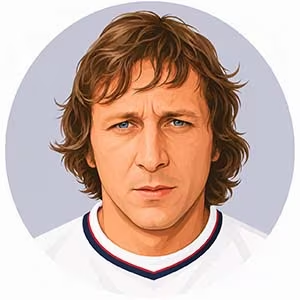
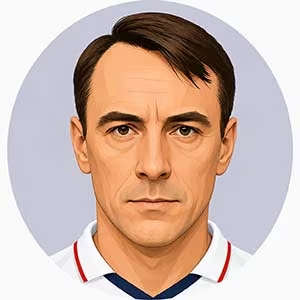
England - StrikerRadford, John
Born in Hemsworth, Yorkshire, in 1947, Radford made his Arsenal debut at seventeen and stayed for more than a decade, becoming one of the club's most enduring post-war forwards. He was a physical, old-fashioned target man: strong in the air, difficult to dispossess with his back to goal, and effective at holding up long balls and bringing quicker, more inventive forwards — George Graham, later Charlie George and Ray Kennedy — into the game around him. He was not a natural finisher in the elegant sense, relying on strength, positioning and persistence rather than technique, but he scored consistently across a long career and remains among Arsenal's higher goalscorers of the era, contributing to the 1970 Inter-Cities Fairs Cup win and the historic 1970–71 double. He later moved to West Ham United for the closing years of his career. His England recognition was minimal relative to his club output — a small number of caps — reflecting a period when England had several strikers of similar profile competing for limited places.
His limitations were the predictable cost of the role. Radford offered little in the way of individual flair or dribbling, depended on service into the channels or crosses into the box to be effective, and against well-organised defences that denied him aerial ball and physical space to work in, his influence could shrink considerably. He was not the kind of forward capable of manufacturing a goal alone, and his output was consistently a function of the players around him rather than of a threat he generated independently.
Temperamentally he was steady, unassuming and entirely without the demand for individual credit that so often accompanies a goalscorer. Radford played the target-man role for years without visible frustration at the more celebrated forwards who benefited from his hold-up work, and he was remembered by teammates as a reliable, hardworking professional rather than a dressing-room personality. He was not a vocal presence, did not seek the captaincy or the spotlight, and there is little record of conflict with coaches, teammates or officials across his career — a quiet, functional longevity rather than a dramatic one. His discipline appears to have been unremarkable in the best sense, with no notable pattern of cards or controversy. Away from football his profile remained low throughout and after his career, consistent with a player whose value was always in service of the collective structure rather than in personal visibility. Sturdy, selfless and largely unheralded, Radford belonged to the category of player a great side is built on top of rather than around.