We use Google Analytics to understand how visitors use this site. Analytics cookies are only activated with your consent. For details, read our Privacy Policy.
Profile lensThe same player, read from a different angle.
Athletic80
Acceleration
76
Pace
77
Agility
75
Strength
84
Balance
77
Jumping
82
Stamina
82
Fitness
88
Technical78
Dribbling
72
Short Passing
76
Long Passing
75
Finishing
58
Shot Accuracy
58
Shot Power
82
Shooting Technique
69
Heading
86
Tackling
87
Crossing
69
Free Kick
64
Penalties
60
First Touch
77
Mental82
Composure
85
Aggression
87
Consistency
87
Creativity
65
Leadership
70
Work Rate
87
Tactical83
Vision
73
Off the Ball
60
Defensive Positioning
90
Teamwork
80
Anticipation
86
Marking
90
Player Traits
Attacking66
Crossing
69
Finishing
58
Heading Accuracy
86
Shot Accuracy
58
Off the Ball
60
Technique72
Dribbling
72
Free Kick
64
Short Passing
76
Long Passing
75
First Touch
77
Shot Technique
69
Movement76
Acceleration
76
Pace
77
Agility
75
Balance
77
Physicality84
Shot Power
82
Jumping
82
Stamina
82
Strength
84
Fitness
88
Defending89
Marking
90
Tackling
87
Def. Positioning
90
Mentality & Game Reading78
Aggression
87
Composure
85
Penalties
60
Vision
73
Leadership
70
Work Rate
87
Teamwork
80
Anticipation
86
Consistency
87
Creativity
65
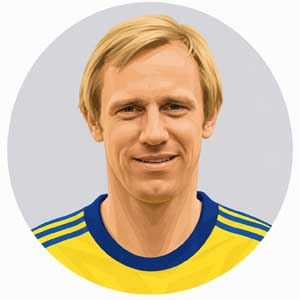
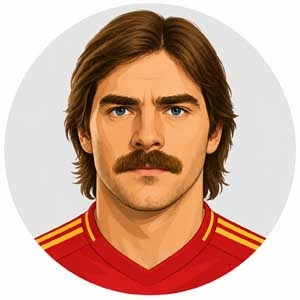
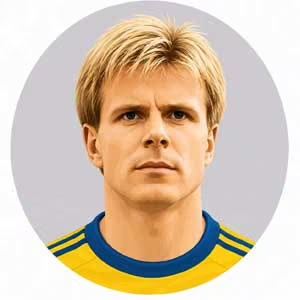
Sweden - Centre-backNordqvist, Björn
Björn Nordqvist captained Sweden in 92 of his 115 international appearances, played across three consecutive World Cups spanning nearly a decade, and never once scored for his country — a genuinely strange statistical footnote for a tall, strong header of the ball, and one that says something specific about a career built entirely around not being the story.
Born in Hallsberg in 1942, Nordqvist was a stable, tackle-safe centre-back who came to embody the archetype of the loyal, dependable team player in Swedish football memory. He broke through at IFK Norrköping, where he spent over a decade and won two league titles before a genuinely late move abroad — at twenty-nine, already with more than 250 domestic matches and over sixty caps behind him — took him to PSV Eindhoven, where he won the Dutch title and the KNVB Cup and was regarded, in his three seasons there, as one of the finest defenders in Europe. He closed his career with IFK Göteborg, a stint with the Minnesota Kicks in the NASL, and spells at smaller Swedish clubs into his forties. He was named Sweden's Footballer of the Year in 1968, and for the national team he won 115 caps between 1963 and 1978, appearing at the 1970, 1974 and 1978 World Cups and holding, at the time of his retirement, the world record for international appearances.
His limitations are hard to establish in detail from the available record, which is heavier on statistics and reputation than on specific tactical or physical weaknesses; what does survive consistently describes him as tough and tactically astute rather than gifted going forward, a defender whose value was entirely in what he prevented rather than what he created — reflected precisely in the complete absence of international goals across 115 caps despite being, by contemporary accounts, a genuinely capable header of the ball.
Temperamentally the surviving descriptions converge on stability, reliability and an almost complete absence of controversy across a public career spanning two decades. He was entrusted with the captaincy for the overwhelming majority of his international appearances under multiple coaches, a pattern that suggests consistent trust rather than an isolated honor, and he competed at a high level in ice hockey and bandy alongside football, an unusually broad athletic range for the era. After retiring he moved into acting in Swedish film and television, a second public life pursued without apparent controversy. Durable, trusted with leadership across an unusually long international career, and defined by steadiness rather than by any single dramatic episode, Nordqvist represents a category the corpus has seen before — the reliable pillar around whom more expressive teammates could operate — though the documentary record on him is thinner than on most players of comparable stature, and this profile should be treated with correspondingly lower confidence.

 All Time SwedenNT