We use Google Analytics to understand how visitors use this site. Analytics cookies are only activated with your consent. For details, read our Privacy Policy.
Profile lensThe same player, read from a different angle.
Athletic81
Acceleration
81
Pace
78
Agility
77
Strength
85
Balance
78
Jumping
84
Stamina
83
Fitness
78
Technical76
Dribbling
75
Short Passing
77
Long Passing
75
Finishing
52
Shot Accuracy
60
Shot Power
81
Shooting Technique
67
Heading
82
Tackling
87
Crossing
72
Free Kick
60
Penalties
60
First Touch
75
Mental81
Composure
86
Aggression
86
Consistency
78
Creativity
67
Leadership
78
Work Rate
86
Tactical78
Vision
73
Off the Ball
62
Defensive Positioning
83
Teamwork
81
Anticipation
83
Marking
87
Player Traits
Attacking66
Crossing
72
Finishing
52
Heading Accuracy
82
Shot Accuracy
60
Off the Ball
62
Technique72
Dribbling
75
Free Kick
60
Short Passing
77
Long Passing
75
First Touch
75
Shot Technique
67
Movement79
Acceleration
81
Pace
78
Agility
77
Balance
78
Physicality82
Shot Power
81
Jumping
84
Stamina
83
Strength
85
Fitness
78
Defending86
Marking
87
Tackling
87
Def. Positioning
83
Mentality & Game Reading78
Aggression
86
Composure
86
Penalties
60
Vision
73
Leadership
78
Work Rate
86
Teamwork
81
Anticipation
83
Consistency
78
Creativity
67
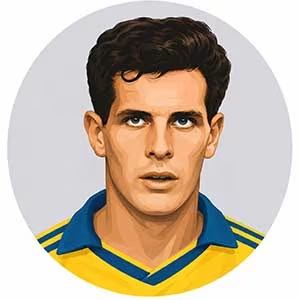
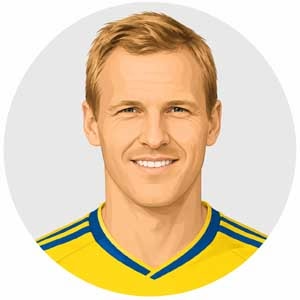
Sweden - Right BackBergmark, Orvar
Defending the flank through pure positional integrity and athletic timing, Ernst Orvar Bergmark established himself as the benchmark right-back of Nordic football throughout the 1950s and early 1960s. A multi-sport phenomenon who also represented Sweden at the highest international level in bandy, Bergmark spent the majority of his club career anchoring Örebro SK, with a brief, high-level foreign spell in Italy at AS Roma during the 1962–63 campaign. Standing just under six feet tall with an upright, balanced posture and sharp recovery pace over short distances, he avoided reckless, desperate sliding lunges; his defensive superiority was built on reading the winger’s body shape, cutting off inside passing lanes, and stripping possession cleanly with well-timed standing tackles. In an era when full-backs were strictly tasked with destructive marking, Bergmark was unusually tidy on the ball, initiating simple, secure forward distributions out from the back four. The absolute pinnacle of his career arrived at the 1958 World Cup on home soil: earning 94 caps for Sweden throughout his international tenure, he delivered an immaculate tournament performance, shutting down elite left-wingers throughout the knockout stages and being named the Best Right-Back of the tournament alongside Nilton Santos and Didi.
Quiet, intensely disciplined, and governed by a deep sense of fair play, Bergmark embodied the finest traditions of Scandinavian amateurism adapted to the elite stage. He approached high-leverage international fixtures with total emotional equilibrium, never allowing the suffocating tension of a home World Cup campaign to disrupt his technical execution or positional focus. On the pitch, his leadership was completely non-verbal and steady; he led through flawless marking assignments, unyielding physical courage in 50-50 duels, and an absolute refusal to resort to cynical shirt-pulling or tactical simulation. Inside the national team locker room, he was an indispensable pillar of stability, bridging the divide between domestic home-based players and the glamorous, returning Italian-based professionals like Liedholm, Gren, and Skoglund with effortless humility. Even when confronted by the explosive, elusive genius of a seventeen-year-old Pelé and Garrincha in the 1958 World Cup Final, Bergmark competed with stoic dignity, absorbing the defeat without bitter excuses or frustration. Referees and opposing wingers held him in the highest regard as an honest, immovable gentleman of the defensive line, cementing his legacy as Sweden’s greatest and most honorable orthodox full-back.


 All Time SwedenNT