We use Google Analytics to understand how visitors use this site. Analytics cookies are only activated with your consent. For details, read our Privacy Policy.
Profile lensThe same player, read from a different angle.
Athletic78
Acceleration
85
Pace
82
Agility
86
Strength
66
Balance
74
Jumping
76
Stamina
78
Fitness
76
Technical81
Dribbling
85
Short Passing
81
Long Passing
80
Finishing
82
Shot Accuracy
76
Shot Power
82
Shooting Technique
77
Heading
58
Tackling
33
Crossing
83
Free Kick
80
Penalties
87
First Touch
85
Mental79
Composure
82
Aggression
83
Consistency
76
Creativity
81
Leadership
78
Work Rate
79
Tactical78
Vision
82
Off the Ball
83
Defensive Positioning
42
Teamwork
76
Anticipation
81
Marking
40
Player Traits
Attacking76
Crossing
83
Finishing
82
Heading Accuracy
58
Shot Accuracy
76
Off the Ball
83
Technique81
Dribbling
85
Free Kick
80
Short Passing
81
Long Passing
80
First Touch
85
Shot Technique
77
Movement82
Acceleration
85
Pace
82
Agility
86
Balance
74
Physicality76
Shot Power
82
Jumping
76
Stamina
78
Strength
66
Fitness
76
Defending38
Marking
40
Tackling
33
Def. Positioning
42
Mentality & Game Reading81
Aggression
83
Composure
82
Penalties
87
Vision
82
Leadership
78
Work Rate
79
Teamwork
76
Anticipation
81
Consistency
76
Creativity
81
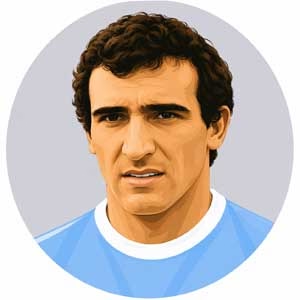
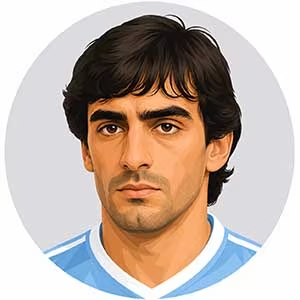
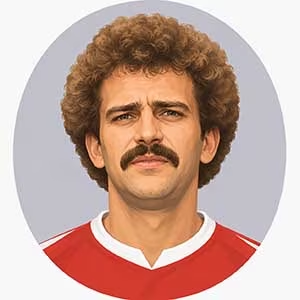
Uruguay - Left WingerMorales, Julio
Operating primarily along the left touchline or cutting inward onto his favored foot, Morales was a nightmare for opposing full-backs in isolated wide channels. He combined sudden acceleration from a standing start with an exceptional ability to strike the ball cleanly on the run, generating wicked curl on crosses to supply target-men like Luis Artime or unleashing direct, dipping drives from distance. Rising through Racing Club de Montevideo, his first legendary chapter at Nacional spanned from 1965 to 1972, where he was a foundational pillar of Washington Etchamendi's all-conquering side that captured five Uruguayan Primera División titles (1966, 1969, 1970, 1971, 1972), the 1971 Copa Libertadores, the 1971 Intercontinental Cup over Panathinaikos, and the 1972 Copa Interamericana. In 1973, he crossed the Atlantic to become an idol at Austria Wien across six seasons, lifting two Austrian Bundesliga titles (1975–76, 1977–78), two Austrian Cups, and reaching the 1977–78 European Cup Winners' Cup final against Anderlecht. Returning to Nacional in 1979, he orchestrated a sensational second era, captaining the team to another domestic title in 1980, the 1980 Copa Libertadores over Internacional, and the 1980 Intercontinental Cup against Nottingham Forest in Tokyo, becoming one of the exceedingly rare players to win world titles with the same club a decade apart. For Uruguay, across 24 official caps and 11 goals, he featured prominently at the 1970 World Cup in Mexico and was a key attacking protagonist during the historic 1980 Mundialito (Copa de Oro de Campeones Mundiales) triumph on home soil.
That explosive, left-sided firepower, however, lived within clear functional boundaries. Morales was almost entirely one-footed; while his left boot was a lethal weapon, defenders who successfully anticipated his tendency to cut back or who forced him tightly onto his right foot could reduce his crossing threat. His game was built on sudden, direct vertical surges and crossing from wide areas rather than patient, intricate short passing through congested central midfield zones. Furthermore, against ultra-physical stoppers who sought to intimidate him with cynical hacking along the touchline, his temperament could flare, occasionally pulling him out of his tactical rhythm if the referee permitted rough tackling.
Emotionally, Morales was an intoxicating mix of streetwise grit, competitive malice, and unshakeable loyalty to his colors. He possessed a fierce, rebellious swagger on the pitch, actively relishing the hostility of rival grounds like the Centenario in Old Firm derbies or away cauldrons in Buenos Aires and Rio de Janeiro. He was a natural locker-room leader who led by example, demanding maximum intensity from younger teammates and never hesitating to confront referees or opponents in defense of his side. On the pitch, his body language was unmistakably sharp and defiant: socks pushed low, eyes fixed on the defender's hips, and striking set-pieces with a cold, haughty precision that radiated absolute confidence. Inside the Nacional, Austria Wien, and Uruguayan dressing rooms, his longevity, unyielding character, and astonishing double-intercontinental crown established him as an immortal, untouchable figure in the history of the Tricolor.