We use Google Analytics to understand how visitors use this site. Analytics cookies are only activated with your consent. For details, read our Privacy Policy.
Profile lensThe same player, read from a different angle.
Athletic81
Acceleration
74
Pace
76
Agility
74
Strength
80
Balance
87
Jumping
84
Stamina
86
Fitness
86
Technical88
Dribbling
87
Short Passing
91
Long Passing
97
Finishing
78
Shot Accuracy
77
Shot Power
84
Shooting Technique
86
Heading
87
Tackling
79
Crossing
92
Free Kick
77
Penalties
77
First Touch
90
Mental90
Composure
92
Aggression
75
Consistency
91
Creativity
85
Leadership
88
Work Rate
86
Tactical88
Vision
94
Off the Ball
82
Defensive Positioning
78
Teamwork
97
Anticipation
80
Marking
72
Player Traits
Attacking83
Crossing
92
Finishing
78
Heading Accuracy
87
Shot Accuracy
77
Off the Ball
82
Technique88
Dribbling
87
Free Kick
77
Short Passing
91
Long Passing
97
First Touch
90
Shot Technique
86
Movement78
Acceleration
74
Pace
76
Agility
74
Balance
87
Physicality84
Shot Power
84
Jumping
84
Stamina
86
Strength
80
Fitness
86
Defending76
Marking
72
Tackling
79
Def. Positioning
78
Mentality & Game Reading87
Aggression
75
Composure
92
Penalties
77
Vision
94
Leadership
88
Work Rate
86
Teamwork
97
Anticipation
80
Consistency
91
Creativity
85
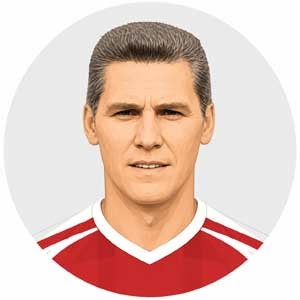
Austria - Centre MidfielderOcwirk, Ernst
Wembley, November 1951. England had never been beaten at home by a continental side, and Austria arrived with a centre-half who did not defend in any sense the English understood. Ernst Ocwirk spent ninety minutes standing between his own defence and his own attack, receiving the ball with his back to pressure, turning out of it, and redistributing play with a calm that visibly unsettled a crowd expecting a stopper. The match finished 2–2. The English press, searching for a description of a man who played a position they had abolished twenty years earlier, settled on one: Clockwork. It stuck for the rest of his career, and it was as much about his temperament as his passing.
Born in Vienna in 1926, Ocwirk was the last great attacking centre-half in European football — the classical Mitteleuropa Mittelläufer, a survivor of the Austrian Wunderteam tradition operating in an era when the rest of the continent had converted the role into pure destruction. At 1.80m he was tall, upright and physically strong, and his game rested on positional intelligence, two-footed technical security and an exceptional passing range, long and short, delivered without backlift or hurry. He tackled cleanly when required and dominated the air, but his function was construction: he set the tempo of the entire team from a position most nations used to break it. He spent a decade at FK Austria Wien, winning three Austrian championships and two cups, then moved in 1956 to Sampdoria, where he became one of the first foreign stars of the Italian post-war game and played four seasons in Genoa before returning to Vienna for a final title in 1961. He won 62 caps for Austria and captained the side that finished third at the 1954 World Cup, including the extraordinary 7–5 quarter-final against Switzerland in Lausanne, and he was selected for the Rest of Europe XI against Great Britain in 1953 and 1955.
His limitations were those of a role already being overtaken. Ocwirk was not quick, and against sides that attacked through pace and directness rather than possession he was pulled into positions the system had not been designed to cover; the 7–5 in Lausanne, played in extreme heat with his team conceding three goals in three minutes, exposed exactly that. He did not score often, offered little in the penalty area, and depended on a team willing to build patiently through him. In matches that became chaotic he could organize but not accelerate.
The nickname was earned mostly by his manner. Ocwirk was unfailingly composed — he did not shout, did not gesture theatrically, and captained Austria for years by presence and positioning rather than by instruction, which teammates described as an almost calming influence on younger players. He was famous for clean play in a physically brutal era, rarely fouling and almost never protesting to referees, and opponents who tried to provoke him found no response available; he simply moved away and asked for the ball again. Behind the calm was considerable stubbornness. He argued with the Austrian federation over the terms of his move to Italy, a transfer that made him briefly unselectable and cost him caps at the peak of his career, and he refused to modify his style when Italian football demanded that his position become defensive, holding to a conception of the game that was disappearing around him. Away from the pitch he was reserved, courteous and popular in Genoa, where he learned Italian quickly and lived without incident or scandal, a professional of conspicuously conventional habits in a city that offered other options. Elegant, imperturbable and quietly immovable, Ocwirk was the last man to prove that the centre of a football team could be its brain rather than its wall.