We use Google Analytics to understand how visitors use this site. Analytics cookies are only activated with your consent. For details, read our Privacy Policy.
Profile lensThe same player, read from a different angle.
Athletic79
Acceleration
82
Pace
76
Agility
84
Strength
76
Balance
73
Jumping
78
Stamina
82
Fitness
82
Technical82
Dribbling
83
Short Passing
85
Long Passing
85
Finishing
78
Shot Accuracy
77
Shot Power
85
Shooting Technique
79
Heading
76
Tackling
52
Crossing
83
Free Kick
83
Penalties
82
First Touch
84
Mental82
Composure
86
Aggression
77
Consistency
81
Creativity
82
Leadership
79
Work Rate
79
Tactical79
Vision
84
Off the Ball
80
Defensive Positioning
52
Teamwork
86
Anticipation
77
Marking
49
Attacking79
Crossing
83
Finishing
78
Heading Accuracy
76
Shot Accuracy
77
Off the Ball
80
Technique83
Dribbling
83
Free Kick
83
Short Passing
85
Long Passing
85
First Touch
84
Shot Technique
79
Movement79
Acceleration
82
Pace
76
Agility
84
Balance
73
Physicality81
Shot Power
85
Jumping
78
Stamina
82
Strength
76
Fitness
82
Defending51
Marking
49
Tackling
52
Def. Positioning
52
Mentality & Game Reading81
Aggression
77
Composure
86
Penalties
82
Vision
84
Leadership
79
Work Rate
79
Teamwork
86
Anticipation
77
Consistency
81
Creativity
82
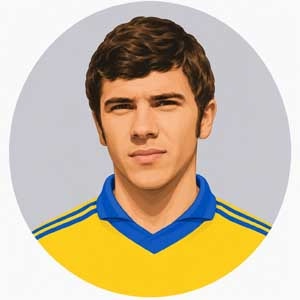
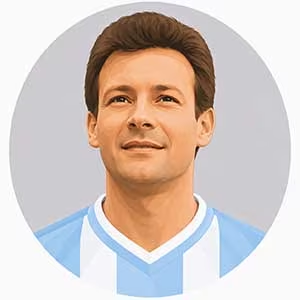
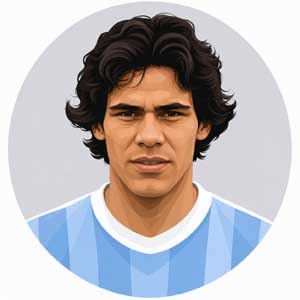
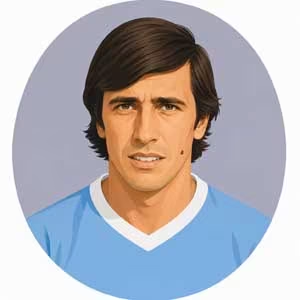
Uruguay - Centre MidfielderManeiro, Ildo
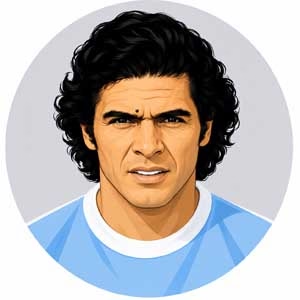
In the brutal furnace of South American football at the turn of the 1970s, where matches often descended into attritional trench warfare, an unassuming conductor from Mercedes treated the ball with the delicate touch of a master jeweler handling fine crystal. Ildo Enrique Maneiro Ghezzi was the supreme deep-lying brain of Uruguay’s golden generation: a playmaking central midfielder whose legacy was built on exquisite spatial navigation, ambidextrous distribution, and an uncanny ability to dictate the tempo of continental finals without breaking into a frantic sprint.
Maneiro was the cerebral fulcrum around whom dynamic teams rotated. Deployed as a central organizer, deep distributor, or attacking connector, he operated with a permanent radar in his mind, taking the sting out of aggressive pressing by releasing the ball on a single touch or using deceptive hip feints to evade lunging tacklers. At Club Nacional de Football between 1965 and 1973, he served as the creative compass of the immortal side coached by Washington Etchamendi, capturing four consecutive Uruguayan Primera División titles (1969–1972), the 1971 Copa Libertadores over Estudiantes, the 1971 Intercontinental Cup against Panathinaikos, and the 1972 Copa Interamericana. In 1973, he crossed the Atlantic to anchor Olympique Lyonnais, orchestrating their midfield for three seasons and reaching the 1976 Coupe de France final, before returning home to Peñarol to lift two further domestic championships in 1978 and 1979. For Uruguay, across 24 official caps and three goals between 1970 and 1979, he was the tactical engine of their fourth-place finish at the 1970 World Cup in Mexico, starting every match and scoring a decisive strike against Israel.
That pristine, economical style, however, operated within strict physical parameters. Maneiro was neither an explosive runner nor a crunching ball-winner; he lacked raw linear acceleration and avoided physical collisions, requiring combative enforcers like Julio Montero Castillo at Nacional or Dagoberto Fontes with the national team to provide physical insulation and regain possession. When opposing sides implemented tight, aggressive man-to-man marking that eliminated his passing lanes on heavy, chewed-up pitches, his creative output could be curtailed if his wingers remained static.
Psychologically, Maneiro was a figure of understated dignity, quiet intellect, and serene competitive maturity. He never engaged in performative showmanship or on-pitch petulance, preferring to command respect through technical precision and spotless tactical execution. In moments of extreme tension—such as the volatile second legs of the Copa Libertadores—he remained unflappable, absorbing the hostility of foreign stadiums with cool detachment. On the pitch, his posture was upright, watchful, and elegant: head swiveling constantly, directing teammates with brief pointing motions, and delivering forty-yard cross-field diagonals with effortless technique. Inside the Nacional, Lyon, and Uruguayan dressing rooms, his quiet authority made him a deeply respected strategist whose vision and composure established him as one of the purest playmakers in the history of the Celeste.


 All Time UruguayNT