We use Google Analytics to understand how visitors use this site. Analytics cookies are only activated with your consent. For details, read our Privacy Policy.
Profile lensThe same player, read from a different angle.
Athletic81
Acceleration
82
Pace
79
Agility
82
Strength
79
Balance
83
Jumping
75
Stamina
86
Fitness
80
Technical88
Dribbling
90
Short Passing
90
Long Passing
87
Finishing
88
Shot Accuracy
86
Shot Power
84
Shooting Technique
90
Heading
78
Tackling
48
Crossing
82
Free Kick
85
Penalties
88
First Touch
91
Mental85
Composure
91
Aggression
74
Consistency
83
Creativity
83
Leadership
81
Work Rate
84
Tactical85
Vision
87
Off the Ball
89
Defensive Positioning
44
Teamwork
85
Anticipation
85
Marking
44
Player Traits
Attacking85
Crossing
82
Finishing
88
Heading Accuracy
78
Shot Accuracy
86
Off the Ball
89
Technique89
Dribbling
90
Free Kick
85
Short Passing
90
Long Passing
87
First Touch
91
Shot Technique
90
Movement82
Acceleration
82
Pace
79
Agility
82
Balance
83
Physicality81
Shot Power
84
Jumping
75
Stamina
86
Strength
79
Fitness
80
Defending45
Marking
44
Tackling
48
Def. Positioning
44
Mentality & Game Reading84
Aggression
74
Composure
91
Penalties
88
Vision
87
Leadership
81
Work Rate
84
Teamwork
85
Anticipation
85
Consistency
83
Creativity
83
Finland - ForwardLitmanen, Jari
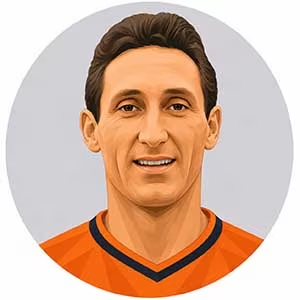
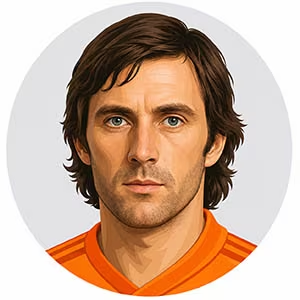
Louis van Gaal used to say that Dennis Bergkamp had the finest technique, but the quiet Finn he brought from HJK Helsinki possessed something far rarer: an absolute, geometric comprehension of space. Jari Olavi Litmanen—hailed in Amsterdam simply as Kuningas (The King)—was the cerebral crown jewel and false-ten orchestrator of Ajax’s mid-1990s golden side, transforming first-time layoffs and blind-side penalty-box arrivals into a masterclass of total football.
Operating in the pocket behind Patrick Kluivert, Litmanen was impossible to track because he never lingered in one place long enough to be marked. He played with a minimalist elegance: taking one touch to control, a second to kill the game with a disguised through-ball, and striking volleys off either boot with pinpoint accuracy. Across 255 matches and 133 goals in his primary spell with Ajax between 1992 and 1999, he swept four Eredivisie titles, three KNVB Cups, the 1994–95 UEFA Champions League, and the 1995 Intercontinental Cup in Tokyo, finishing as top scorer of the Champions League in 1995–96 and claiming third place in the 1995 Ballon d'Or. His European journey later added silverware at Barcelona and Liverpool, where he contributed to the 2000–01 treble. For Finland, across a record 137 caps and 32 goals spanning four distinct decades (1989–2010), he remains the undisputed greatest player in the nation's history.
That footballing intellect, however, was perpetually betrayed by extreme physical fragility. Dubbed The Man of Glass by frustrated medical staffs, a cruel litany of recurring hamstring tears, ankle reconstructions, and calf strains severely fragmented his seasons at Camp Nou and Anfield, preventing him from maintaining ninety-minute match rhythm across long winter campaigns. Furthermore, Litmanen was not a dynamic, long-striding linear sprinter; in chaotic, end-to-end transition battles that bypassed the midfield passing network, his deliberate pace could leave him isolated from the flow of play.
Monastic, deeply analytical, and carrying himself with the serene modesty of a chess grandmaster, Litmanen was the ultimate dressing-room professional. He never engaged in public theatrics or petulant gestures, earning the profound affection of tactical purists and supporters alike. On the pitch, his body language was all quiet observation: turning his head constantly to scan passing lanes, ghosting into the six-yard box unannounced, and celebrating goals with an understated raise of the hand. Inside the locker room, he was an untouchable elder statesman whose tactical advice on spatial movement was sought by managers and teenage prodigies alike, leaving an enduring legacy as one of the most intelligent and elegant attacking midfielders Europe has ever seen.


 All Time AjaxClub