We use Google Analytics to understand how visitors use this site. Analytics cookies are only activated with your consent. For details, read our Privacy Policy.
Profile lensThe same player, read from a different angle.
Athletic79
Acceleration
83
Pace
77
Agility
88
Strength
68
Balance
76
Jumping
72
Stamina
90
Fitness
80
Technical88
Dribbling
87
Short Passing
90
Long Passing
91
Finishing
82
Shot Accuracy
77
Shot Power
83
Shooting Technique
85
Heading
66
Tackling
42
Crossing
87
Free Kick
93
Penalties
84
First Touch
88
Mental78
Composure
87
Aggression
76
Consistency
75
Creativity
88
Leadership
70
Work Rate
75
Tactical83
Vision
90
Off the Ball
84
Defensive Positioning
45
Teamwork
82
Anticipation
75
Marking
38
Player Traits
Attacking79
Crossing
87
Finishing
82
Heading Accuracy
66
Shot Accuracy
77
Off the Ball
84
Technique89
Dribbling
87
Free Kick
93
Short Passing
90
Long Passing
91
First Touch
88
Shot Technique
85
Movement81
Acceleration
83
Pace
77
Agility
88
Balance
76
Physicality79
Shot Power
83
Jumping
72
Stamina
90
Strength
68
Fitness
80
Defending42
Marking
38
Tackling
42
Def. Positioning
45
Mentality & Game Reading80
Aggression
76
Composure
87
Penalties
84
Vision
90
Leadership
70
Work Rate
75
Teamwork
82
Anticipation
75
Consistency
75
Creativity
88
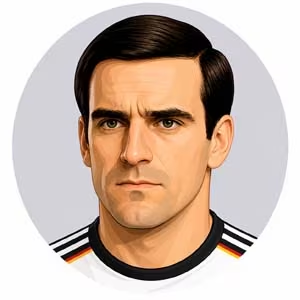
Germany - Attacking MidfielderHassler, Thomas
A low center of gravity at five-foot-five, lightning-quick hip shifts, and a velcro-like first touch in congested central corridors turned Thomas Häßler into one of the most elusive playmaking pocket-dynamos in modern German football history. Developing at 1. FC Köln under Christoph Daum—where he finished as Bundesliga runner-up twice and earned the 1989 German Footballer of the Year award—Icke was the ultimate micro-space navigator. Operating as a free-roaming central attacking midfielder or inverted wide playmaker, Häßler possessed a deceptive burst of initial acceleration, exceptional bilateral control that allowed him to slip between double-teams, and a devastating dead-ball repertoire, curling free-kicks with vicious dip over defensive walls. After a high-profile, single-season stint at Juventus, he became a beloved tactical cornerstone in the capital with AS Roma and later Karlsruher SC, dragging the provincial German outfit to the semi-finals of the 1993–94 UEFA Cup and winning his second German Footballer of the Year award in 1992. For Germany across 101 caps and 11 goals, he was a fixture of their international golden run: capturing the 1990 World Cup in Italy (scoring the crucial qualifying winner against Wales), dazzling at Euro 1992 where he was named in the Team of the Tournament, and orchestrating the midfield to claim the Euro 1996 title in England.
Tactically and physically, however, Häßler’s micro-profile had distinct limitations. He lacked top-end linear sprint speed over forty yards, offered almost zero aerial presence on defensive set pieces, and struggled when games turned into direct, high-friction aerial dogfights where technical dribbling was bypassed. His subsequent late-career spells at Borussia Dortmund, 1860 Munich, and SV Salzburg saw his impact wane as his trademark agility slowed down, leaving him vulnerable to heavy, physical ball-winners who crowded his immediate turning radius.
Unassuming, soft-spoken, and deeply attached to his working-class Berlin roots, Häßler was the anti-diva of the German golden generation. He possessed zero interest in self-promotion or media posturing, letting his delicate touches and dead-ball mastery do the talking. On the pitch, his body language was earnest and relentless; when surrounded by three taller, more physical opponents, Häßler used his low balance to absorb bumps, spin away from challenges, and immediately look for the vertical channel. Inside the German national team and Roma dressing rooms, he was an universally adored, low-maintenance figure—quietly humorous, deeply respected by dominant personalities like Lothar Matthäus and Jürgen Klinsmann for his spotless work rate, and completely devoid of ego. When targeted with rough fouls by frustrated defenders unable to read his sudden feints, Häßler dusted off his shorts without theatrical protest, stepped up to the spot, and whipped the resulting free-kick toward the top corner. Referees found him remarkably fair and non-confrontational, leaving an enduring legacy as one of the most technically gifted, beloved, and resilient playmakers in German football history.



 All Time RomaClub