We use Google Analytics to understand how visitors use this site. Analytics cookies are only activated with your consent. For details, read our Privacy Policy.
Profile lensThe same player, read from a different angle.
Athletic81
Acceleration
88
Pace
85
Agility
82
Strength
78
Balance
82
Jumping
74
Stamina
83
Fitness
76
Technical81
Dribbling
85
Short Passing
81
Long Passing
78
Finishing
83
Shot Accuracy
77
Shot Power
82
Shooting Technique
81
Heading
74
Tackling
44
Crossing
76
Free Kick
70
Penalties
70
First Touch
85
Mental76
Composure
81
Aggression
82
Consistency
74
Creativity
82
Leadership
73
Work Rate
72
Tactical76
Vision
74
Off the Ball
82
Defensive Positioning
44
Teamwork
81
Anticipation
76
Marking
44
Player Traits
Attacking78
Crossing
76
Finishing
83
Heading Accuracy
74
Shot Accuracy
77
Off the Ball
82
Technique80
Dribbling
85
Free Kick
70
Short Passing
81
Long Passing
78
First Touch
85
Shot Technique
81
Movement84
Acceleration
88
Pace
85
Agility
82
Balance
82
Physicality79
Shot Power
82
Jumping
74
Stamina
83
Strength
78
Fitness
76
Defending44
Marking
44
Tackling
44
Def. Positioning
44
Mentality & Game Reading77
Aggression
82
Composure
81
Penalties
70
Vision
74
Leadership
73
Work Rate
72
Teamwork
81
Anticipation
76
Consistency
74
Creativity
82
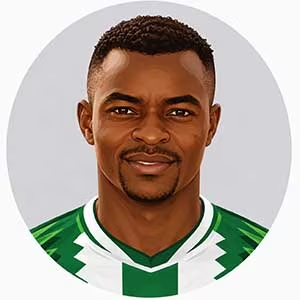
Nigeria - Right WingerFinidi, George
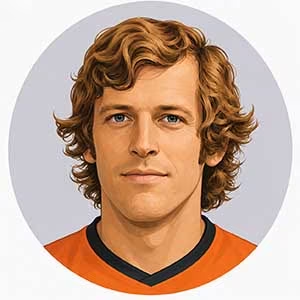
The Olympic Stadium in Munich on May 24, 1995, witnessed an electric Nigerian winger stretching AC Milan's legendary backline to its absolute limit, providing the tactical width that carried Louis van Gaal’s Ajax to European Champions League glory. Finidi George was the textbook archetype of the elite orthodox touchline winger of the mid-1990s, combining blistering linear sprint speed with sublime ball control and an uncanny crossing delivery off his right foot. Deployed on the right wing with the mandate to hug the chalk, Finidi tore full-backs apart: timing his runs onto deep diagonal balls, leaving markers trailing over thirty yards, and whipping curling balls directly onto the laces of Patrick Kluivert and Jari Litmanen. Across three dominant seasons in Amsterdam between 1993 and 1996, he collected three consecutive Eredivisie titles, the 1994–95 UEFA Champions League, and the 1995 Intercontinental Cup in Tokyo, before moving to Spain to become an iconic talisman for Real Betis, dragging them to the 1997 Copa del Rey final. For Nigeria, across 62 caps and six goals, he was an indispensable creative pillar of the Super Eagles golden era, capturing the 1994 Africa Cup of Nations and starring across two World Cups (1994, 1998).
Yet Finidi’s game operated within specific tactical and physical parameters. He was an outside-lane specialist who rarely thrived when forced into congested central corridors, requiring space down the touchline to build up sprinting speed. Furthermore, his defensive contributions were strictly limited to positional pressing within the opponent's third, offering modest support when his full-back was doubled-up in deep defensive situations. When confronted by ultra-aggressive, physical left-backs who fouled him before he could face forward, his offensive output could be slowed if his midfield failed to switch play rapidly.
Graceful, soft-spoken, and playing with infectious joy, Finidi was a crowd favorite whose explosive wing play illuminated European football. He approached high-stakes finals without fear, famously celebrating his iconic 1994 World Cup goal against Greece with an eccentric goalmouth celebration that became an instant global snapshot. On the pitch, his body language was light, fluid, and upright: taking heavy fouls without rolling on the turf and immediately getting up to demand the next pass. Inside the Ajax, Betis, and Nigerian locker rooms, he was an understated, highly professional figure whose selfless team-first attitude and technical precision earned the deep respect of tactical purists like Van Gaal, leaving an enduring legacy as one of the most effective, elegant, and dynamic wingers of the 1990s.


 All Time AjaxClub