We use Google Analytics to understand how visitors use this site. Analytics cookies are only activated with your consent. For details, read our Privacy Policy.
Profile lensThe same player, read from a different angle.
Athletic72
Acceleration
66
Pace
74
Agility
64
Strength
89
Balance
66
Jumping
65
Stamina
80
Fitness
74
Technical83
Dribbling
88
Short Passing
84
Long Passing
76
Finishing
85
Shot Accuracy
82
Shot Power
76
Shooting Technique
84
Heading
73
Tackling
44
Crossing
71
Free Kick
68
Penalties
74
First Touch
91
Mental77
Composure
84
Aggression
66
Consistency
69
Creativity
87
Leadership
74
Work Rate
77
Tactical81
Vision
80
Off the Ball
85
Defensive Positioning
45
Teamwork
80
Anticipation
82
Marking
33
Player Traits
Attacking79
Crossing
71
Finishing
85
Heading Accuracy
73
Shot Accuracy
82
Off the Ball
85
Technique82
Dribbling
88
Free Kick
68
Short Passing
84
Long Passing
76
First Touch
91
Shot Technique
84
Movement68
Acceleration
66
Pace
74
Agility
64
Balance
66
Physicality77
Shot Power
76
Jumping
65
Stamina
80
Strength
89
Fitness
74
Defending41
Marking
33
Tackling
44
Def. Positioning
45
Mentality & Game Reading77
Aggression
66
Composure
84
Penalties
74
Vision
80
Leadership
74
Work Rate
77
Teamwork
80
Anticipation
82
Consistency
69
Creativity
87
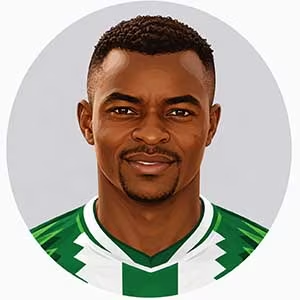
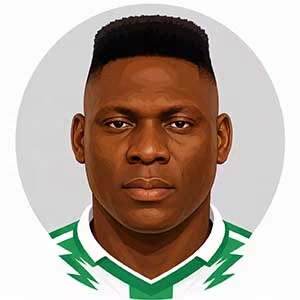
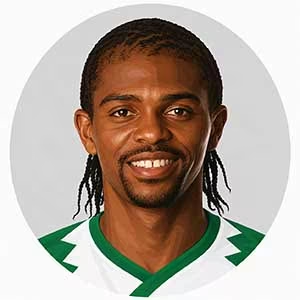
Nigeria - StrikerKanu, Nwankwo
Stamford Bridge on October 23, 1999, was frozen in disbelief as a six-foot-five Nigerian forward with loose limbs and silk in his boots scored a fifteen-minute hat-trick on a waterlogged pitch, culminating in an improbable, curling finish from an impossible angle near the corner flag to seal a 3–2 comeback for Arsenal. Nwankwo Christian Kanu was a technical phenomenon who defied traditional positional categorization through extraordinary close control, panoramic vision, and deceptive elasticity. Operating as a second striker, roaming playmaker, or fluid forward, Kanu possessed a unique, unorthodox gait: pausing in tight pockets, slipping nutmegs past lunging center-halves, and delivering disguise backheels that dissected compact low blocks. Across an extraordinary career spanning Ajax (winning three Eredivisie titles and the 1994–95 Champions League), Inter Milan (lifting the 1997–98 UEFA Cup), Arsenal (claiming two Premier League titles, including the 2003–04 Invincibles, and two FA Cups), and Portsmouth (scoring the match-winning goal in the 2008 FA Cup final), he won virtually every major prize in club football. Crowned African Footballer of the Year twice (1996, 1999), he captained Nigeria’s Dream Team to Olympic Gold in Atlanta 1996 and earned 86 caps across three World Cups.
However, Kanu’s languid, low-friction style came with clear mechanical limitations. He lacked explosive top-end sprint speed and direct physical aggression, struggling when asked to run forty yards in open transitions or lead an aggressive, high-tempo defensive press. Furthermore, a serious congenital heart defect diagnosed in 1996 required major corrective valve surgery at the peak of his youth, permanently limiting his capacity for ninety-minute physical marathons and casting him frequently as a devastating impact substitute rather than an every-minute workhorse.
Charismatic, deeply spiritual, and carrying an infectious, childlike smile, Kanu was universally beloved across global football. He played the game as a joyous puzzle of spatial improvisation: baffling defenders with unorthodox body feints and celebrating clutch goals with wide, sweeping arm gestures. On the pitch, his body language was relaxed, unhurried, and unflappable, completely immune to stadium whistling or aggressive hacking. Inside the Arsenal, Portsmouth, and Nigerian dressing rooms, he was an adored elder statesman whose philanthropic heart foundation off the field matched his generous spirit on it, leaving behind an immortal legacy as one of the most gifted, unpredictable, and beloved African football icons in history.


 All Time ArsenalClub