We use Google Analytics to understand how visitors use this site. Analytics cookies are only activated with your consent. For details, read our Privacy Policy.
Profile lensThe same player, read from a different angle.
Athletic81
Acceleration
74
Pace
77
Agility
74
Strength
86
Balance
80
Jumping
86
Stamina
82
Fitness
85
Technical77
Dribbling
73
Short Passing
73
Long Passing
72
Finishing
60
Shot Accuracy
66
Shot Power
74
Shooting Technique
68
Heading
89
Tackling
89
Crossing
67
Free Kick
65
Penalties
60
First Touch
75
Mental86
Composure
86
Aggression
85
Consistency
88
Creativity
65
Leadership
85
Work Rate
91
Tactical84
Vision
70
Off the Ball
60
Defensive Positioning
91
Teamwork
86
Anticipation
87
Marking
91
Player Traits
Attacking68
Crossing
67
Finishing
60
Heading Accuracy
89
Shot Accuracy
66
Off the Ball
60
Technique71
Dribbling
73
Free Kick
65
Short Passing
73
Long Passing
72
First Touch
75
Shot Technique
68
Movement76
Acceleration
74
Pace
77
Agility
74
Balance
80
Physicality83
Shot Power
74
Jumping
86
Stamina
82
Strength
86
Fitness
85
Defending90
Marking
91
Tackling
89
Def. Positioning
91
Mentality & Game Reading80
Aggression
85
Composure
86
Penalties
60
Vision
70
Leadership
85
Work Rate
91
Teamwork
86
Anticipation
87
Consistency
88
Creativity
65
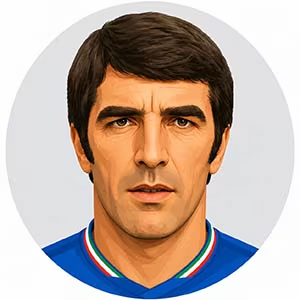
Italy - Centre-backFerrara, Ciro
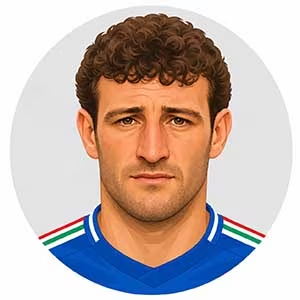
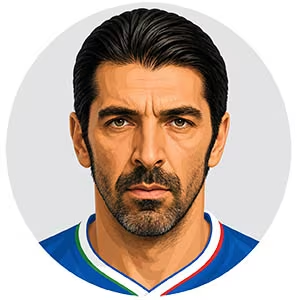
A bone-crunching, perfectly legal sliding tackle on the edge of the eighteen-yard box in 1980s Naples belonged to a local teenager who made life miserable for the greatest forwards on the planet. Ciro Ferrara was the uncompromising defensive cornerstone of two historic dynasties: Diego Maradona’s rebellious Napoli and Marcello Lippi’s all-conquering Juventus. Whether deployed as a relentless, man-marking right-back or a dominant central stopper, Ferrara married an exceptional vertical leap with aggressive front-foot anticipation and textbook tackling fundamentals. Across nearly 500 Serie A appearances, his medal collection was immense: two historic Scudetti (1987, 1990), the 1987 Coppa Italia, and the 1989 UEFA Cup at Napoli, followed by six league titles, the 1995–96 UEFA Champions League, and the 1996 Intercontinental Cup in Turin. For Italy, across 49 caps, he was a pivotal squad member at Euro '88 and the 1990 World Cup, though cruel, ill-timed injuries frequently disrupted his international tournament momentum.
Yet Ferrara’s classical Italian stopper profile came with defined limitations. He was an orthodox defensive destroyer rather than a modern, ball-playing distributor; his build-up passing under heavy pressing was functional and risk-averse, and when dragged into forty-yard footraces against lightning-fast wide forwards in open transitions, his recovery sprint speed could be tested if his initial physical contact was bypassed.
Combative, loyal, and radiating natural Neapolitan warmth, Ferrara was the ultimate warrior-gentleman. He never indulged in cowardice or petty off-the-ball malice, taking pride in neutralizing superstars through relentless focus and honest physical friction. On the pitch, his body language was authoritative and unshakeable: chest out, eyes fixed on the ball, organizing his defensive partners with sharp, decisive commands. Inside the dressing rooms of Napoli and Juventus, he was an indispensable cultural pillar—adored by Maradona, trusted implicitly by Lippi, and revered as a captain who set the physical standard for every training session, leaving an eternal legacy as one of the finest, most durable man-markers in Italian football history.