We use Google Analytics to understand how visitors use this site. Analytics cookies are only activated with your consent. For details, read our Privacy Policy.
Profile lensThe same player, read from a different angle.
Athletic79
Acceleration
85
Pace
79
Agility
85
Strength
72
Balance
76
Jumping
79
Stamina
82
Fitness
77
Technical87
Dribbling
86
Short Passing
86
Long Passing
85
Finishing
85
Shot Accuracy
85
Shot Power
86
Shooting Technique
84
Heading
72
Tackling
44
Crossing
86
Free Kick
86
Penalties
88
First Touch
90
Mental79
Composure
86
Aggression
76
Consistency
74
Creativity
90
Leadership
77
Work Rate
72
Tactical82
Vision
82
Off the Ball
87
Defensive Positioning
46
Teamwork
77
Anticipation
83
Marking
44
Player Traits
Attacking83
Crossing
86
Finishing
85
Heading Accuracy
72
Shot Accuracy
85
Off the Ball
87
Technique86
Dribbling
86
Free Kick
86
Short Passing
86
Long Passing
85
First Touch
90
Shot Technique
84
Movement81
Acceleration
85
Pace
79
Agility
85
Balance
76
Physicality79
Shot Power
86
Jumping
79
Stamina
82
Strength
72
Fitness
77
Defending45
Marking
44
Tackling
44
Def. Positioning
46
Mentality & Game Reading81
Aggression
76
Composure
86
Penalties
88
Vision
82
Leadership
77
Work Rate
72
Teamwork
77
Anticipation
83
Consistency
74
Creativity
90
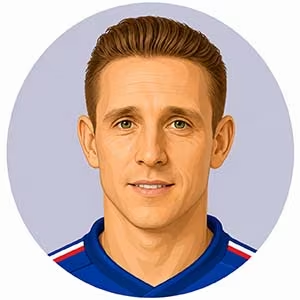
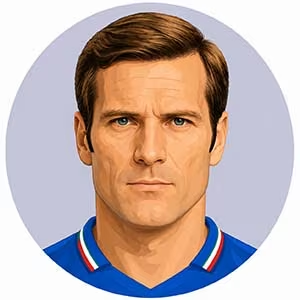
France - Attacking MidfielderDjorkaeff, Youri
Technically, Djorkaeff was a hybrid attacker: part second striker, part attacking midfielder, part roaming creator. He could receive between lines, turn quickly, shoot from distance, finish inside the box and combine at one or two touches without needing to dictate every possession. His acceleration was good rather than overwhelming; the sharper weapon was the speed of his technical decision once he had found a pocket. He could attack centrally, drift into either half-space and appear as the final runner rather than the initial organiser. At Monaco he became Ligue 1’s joint top scorer in 1993–94 with 20 goals; at PSG he won the Cup Winners’ Cup; with Inter he added the UEFA Cup in 1998, while France used him throughout the World Cup–Euro cycle that culminated in 1998 and 2000. The FFF records 82 caps and 28 goals. His portability was central to that longevity: Djorkaeff could coexist with more dominant creators because he did not require the entire attacking structure to be reorganised around him. At Bolton, even in his mid-thirties, he remained useful because he could still interpret where the game needed an extra connection or late attacking presence.
The limitations are easier to see once that versatility is stripped of mythology. Djorkaeff was not a pure playmaker capable of controlling tempo for ninety minutes, nor a winger who could repeatedly destabilise a defence through touchline one-against-one play. His game could become intermittent when the spaces between midfield and defence disappeared and when the team required constant ball progression from him rather than selective intervention. His scoring instincts sometimes encouraged him to vacate zones that a more orthodox midfielder would protect, while his defensive contribution depended more on tactical participation than on sustained ball-winning. Treccani’s contemporary profile explicitly noted that his talent was accompanied by uneven continuity at club level. The later career also shows environmental dependence. At Kaiserslautern his relationship with Andreas Brehme deteriorated severely: he failed to report for training, criticised the coach and was fined, with the club openly considering separation. That episode should not be retrofitted as general inconsistency. He had previously functioned under strong coaches and demanding tactical structures. The more precise degradation condition is that his contribution became less stable when positional ambiguity ceased to feel purposeful and instead became attached to deteriorating trust or unclear status.
Psychologically, Djorkaeff is best defined by functional flexibility combined with strong symbolic belonging. He could accept considerable tactical ambiguity when he believed the structure made sense. Under Jacquet, France’s hybrid system was criticised publicly, yet Djorkaeff later recalled the group as prepared to “absorb the blows” and release energy when required. Under Gigi Simoni at Inter, he remembered an immediate bond based on mutual respect; when Marcello Lippi arrived, however, Djorkaeff said he understood at once that the relationship would not work and chose to leave rather than create an internal problem. That decision is psychologically revealing: he did not require confrontation to resist an authority he regarded as incompatible. At Kaiserslautern, by contrast, conflict became overt and behavioural, including absence from training and public criticism, showing that self-regulation was not universal. At Bolton the mechanism reversed again: Sam Allardyce travelled to Germany, told Djorkaeff directly that he was wanted and trusted, and Djorkaeff immediately responded to that recognition by joining a relegation fight far below the competitive status he had previously occupied. The common thread is not ego in the crude sense. It is recognition-dependent engagement. Tactical role could shrink, shift or blur without necessarily provoking resistance; perceived legitimacy, trust and belonging mattered far more. Evidence for persistent referee conflict, retaliatory aggression or teammate-directed blame is insufficient and should remain unknown. Djorkaeff’s contradiction is therefore useful: he was positionally flexible but psychologically selective about whom and what he was willing to represent.


 All Time InternazionaleClub