We use Google Analytics to understand how visitors use this site. Analytics cookies are only activated with your consent. For details, read our Privacy Policy.
Profile lensThe same player, read from a different angle.
Athletic82
Acceleration
83
Pace
82
Agility
82
Strength
73
Balance
77
Jumping
76
Stamina
94
Fitness
91
Technical75
Dribbling
77
Short Passing
75
Long Passing
78
Finishing
66
Shot Accuracy
64
Shot Power
82
Shooting Technique
73
Heading
72
Tackling
74
Crossing
73
Free Kick
68
Penalties
66
First Touch
78
Mental83
Composure
76
Aggression
87
Consistency
88
Creativity
65
Leadership
81
Work Rate
92
Tactical80
Vision
76
Off the Ball
73
Defensive Positioning
75
Teamwork
92
Anticipation
82
Marking
71
Player Traits
Attacking70
Crossing
73
Finishing
66
Heading Accuracy
72
Shot Accuracy
64
Off the Ball
73
Technique75
Dribbling
77
Free Kick
68
Short Passing
75
Long Passing
78
First Touch
78
Shot Technique
73
Movement81
Acceleration
83
Pace
82
Agility
82
Balance
77
Physicality83
Shot Power
82
Jumping
76
Stamina
94
Strength
73
Fitness
91
Defending73
Marking
71
Tackling
74
Def. Positioning
75
Mentality & Game Reading81
Aggression
87
Composure
76
Penalties
66
Vision
76
Leadership
81
Work Rate
92
Teamwork
92
Anticipation
82
Consistency
88
Creativity
65
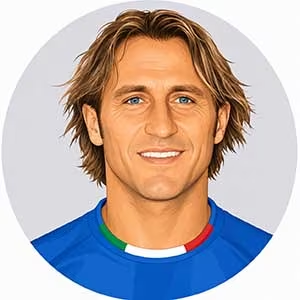
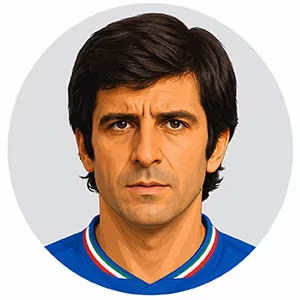
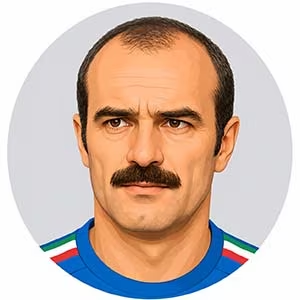
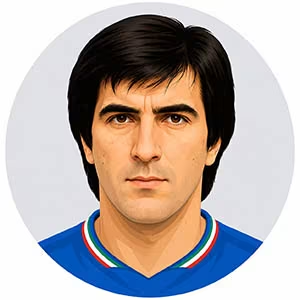
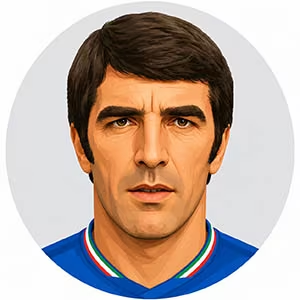
Italy - Right MidfielderDi Livio, Angelo
Roberto Baggio coined the nickname almost as a throwaway observation — watching a new teammate run up and down the flank with a particular gait, he said it reminded him of a toy soldier. Angelo Di Livio kept the name for the rest of his career, and it stopped being about how he ran long before he retired. It became about what he did in 2002, when Fiorentina collapsed into bankruptcy and were reconstituted from scratch in Italy's fourth tier: every other significant player left. Di Livio, the club captain, stayed, and led the rebuilt team back up two divisions to Serie A.
Born in Rome in 1966 and a lifelong supporter of Roma, Di Livio never played a single match for his boyhood club, released after one season without a first-team appearance, and spent the better part of a decade working through Reggiana, Nocerina, Perugia and Padova — where he played alongside a young Alessandro Del Piero — before finally reaching Serie A at twenty-seven. He was a right-sided midfielder or wing-back of modest technical range and exceptional stamina, his game built on tireless running, defensive discipline and reliable crossing rather than individual flair, the kind of player whose value showed up in the collective result more than in his own statistics. Juventus signed him in 1993, and over six seasons he became a fixture in one of the club's greatest sides, winning three Scudetti, a Coppa Italia and the 1996 Champions League — setting up Del Piero's first-ever Juventus goal along the way — despite being sent off only once across the entire spell. He moved to Fiorentina in 1999, captained the club to the 2001 Coppa Italia, and then stayed through the bankruptcy and rebuild that followed, retiring in 2005 after helping return the club to the top flight. For Italy he won 40 caps across two World Cups and two European Championships, reaching the Euro 2000 final.
His limitations were the honest cost of a career built almost entirely on effort rather than technique. Di Livio was never a decisive creative force and contributed little in the way of individual moments that changed matches on their own; his football depended on structure and repetition rather than improvisation, and against opponents who could simply outclass him technically in one-on-one situations, his contribution shrank to pure legwork. His path to the top level was also unusually slow, meaning his prime professional years arrived later and were compressed into a shorter window than more precocious teammates enjoyed.
Temperamentally he was defined, with almost total consistency across every account available, by sacrifice, discipline and an absence of personal vanity. Di Livio maintained an excellent disciplinary record throughout a career built on constant physical engagement, a combination contemporaries considered genuinely unusual for a player whose whole game was built on relentless tackling and closing down space. He built strong, lasting relationships with strict, demanding coaches — Marcello Lippi, Arrigo Sacchi, Giovanni Trapattoni — precisely the kind of disciplinarians who periodically clashed with more individually gifted teammates like Baggio, suggesting a temperament that welcomed structure rather than chafing against it. He moved from boyhood club Roma to the fiercely disliked rival Juventus and later to Fiorentina without ever losing the respect of any of the three fan bases, a rare feat in Italian football's tribal club culture, earned through visible, uncomplicated commitment rather than diplomacy. His decision to remain at Fiorentina through bankruptcy, relegation to the fourth tier and a two-season climb back to Serie A, when every other option would have been easier and more lucrative, was treated by the club decades later as the defining act of his career, honored with induction into its Hall of Fame specifically for loyalty and leadership. Away from the pitch he moved into television work without losing his reputation for straightforwardness. Humble, disciplined and definitionally loyal, Di Livio built an eighteen-year career almost entirely on doing, without complaint, the parts of football that talent alone cannot supply.