We use Google Analytics to understand how visitors use this site. Analytics cookies are only activated with your consent. For details, read our Privacy Policy.
Profile lensThe same player, read from a different angle.
Athletic79
Acceleration
73
Pace
72
Agility
73
Strength
80
Balance
83
Jumping
83
Stamina
88
Fitness
83
Technical82
Dribbling
73
Short Passing
82
Long Passing
88
Finishing
73
Shot Accuracy
74
Shot Power
91
Shooting Technique
72
Heading
85
Tackling
84
Crossing
81
Free Kick
83
Penalties
80
First Touch
80
Mental81
Composure
84
Aggression
78
Consistency
78
Creativity
73
Leadership
82
Work Rate
81
Tactical83
Vision
85
Off the Ball
68
Defensive Positioning
83
Teamwork
89
Anticipation
82
Marking
81
Player Traits
Attacking76
Crossing
81
Finishing
73
Heading Accuracy
85
Shot Accuracy
74
Off the Ball
68
Technique80
Dribbling
73
Free Kick
83
Short Passing
82
Long Passing
88
First Touch
80
Shot Technique
72
Movement75
Acceleration
73
Pace
72
Agility
73
Balance
83
Physicality85
Shot Power
91
Jumping
83
Stamina
88
Strength
80
Fitness
83
Defending83
Marking
81
Tackling
84
Def. Positioning
83
Mentality & Game Reading81
Aggression
78
Composure
84
Penalties
80
Vision
85
Leadership
82
Work Rate
81
Teamwork
89
Anticipation
82
Consistency
78
Creativity
73
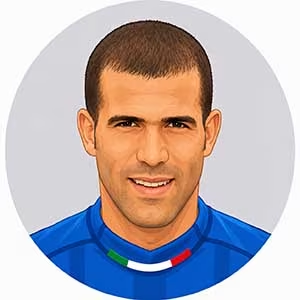
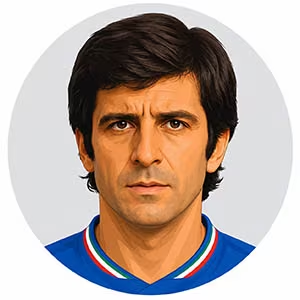
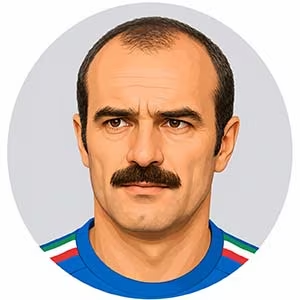
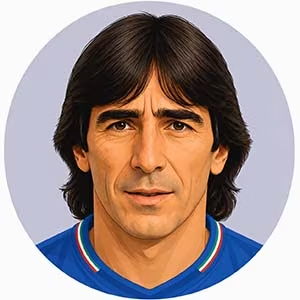
Italy - Defensive MidfielderDi Biagio, Luigi
In Amsterdam on 29 June 2000, Italy and the Netherlands reached a penalty shoot-out after 120 minutes in which the Italians had played most of the match with ten men. Luigi Di Biagio did not want to take the first kick. Two years earlier, at the Stade de France, his penalty against France had struck the crossbar and eliminated Italy from the World Cup. Dino Zoff nevertheless looked at him and sent him forward. Di Biagio later admitted that he was frightened and that the memory of Paris had been running repeatedly through his mind. Then he looked around, saw how physically exhausted his teammates were and understood that he was needed. He took the ball and scored. Italy eventually won the shoot-out 3–1. The moment is unusually revealing because nothing was psychologically erased. The old failure remained active, fear remained present, and avoidance appeared briefly as a real impulse. Responsibility overrode it rather than replacing it.
Di Biagio was primarily a defensive midfielder, but his game became more expansive under Zdeněk Zeman. The FIGC describes him as having begun as a holding midfielder before being transformed into a regista because of his ability to dictate the rhythm of possession. He was not a delicate deep playmaker detached from defensive work: his game combined physical engagement, tactical discipline, passing range and an unusual goal threat for the position. He could screen the defence, compete for second balls, switch play and then attack set pieces aggressively. His heading was particularly productive, including a goal against Cameroon at the 1998 World Cup and another against Sweden at Euro 2000. Across spells with Foggia, Roma, Inter, Brescia and Ascoli he accumulated 391 Serie A appearances and 58 goals, while Italy used him 31 times between 1998 and 2002. His usefulness therefore came from occupying the space between destroyer and organiser: he could provide structure without becoming merely conservative, and his willingness to attack the box added another layer when the team needed it.
The same hybrid profile had limits. Di Biagio was not a high-speed transition midfielder and could be exposed when the game became stretched enough to force repeated long recovery runs. Nor was he a pure possession controller capable of escaping pressure indefinitely through technical superiority alone. His passing was purposeful, but he did not dominate rhythm in the manner of a specialist conductor; under severe pressing or against opponents capable of dragging him laterally over large distances, his influence could become less clean. His aggressive defensive involvement also carried disciplinary risk, because a player who repeatedly stepped into duels and contested second balls accumulated contact as part of the function. More importantly, the 1998 penalty miss should not be interpreted as evidence of major-event fragility. He had already performed strongly in the tournament, scoring and providing a decisive long pass against Norway, and contemporary reporting described him as having grown into one of Italy’s most important midfielders during the competition. The miss was a catastrophic single action, not a general collapse under pressure. The evidence from 2000 makes that distinction even stronger.
Psychologically, Di Biagio is best defined by **responsibility re-entry despite retained fear**. After the 1998 miss, he did not retrospectively minimise the error. Years later he still described it as his responsibility and explicitly rejected excuses. In Amsterdam in 2000, the old failure remained vivid enough that he initially refused the first penalty. Zoff did not reassure him verbally; Di Biagio instead interpreted the physical state of the team and concluded that his role required him to act. That sequence matters more than the successful finish itself. It shows that his return to responsibility was not produced by forgetting, emotional numbness or confidence restored to its previous level. It was a decision made while the original fear remained psychologically available. The broader career fits that pattern cautiously. He moved through strong tactical structures, accepted substantial defensive responsibility and repeatedly operated as a balancing player rather than seeking attacking centrality. There is insufficient evidence to score persistent referee conflict, provocation-driven aggression, teammate blame or hostile-crowd degradation with confidence. What is documented is narrower and more valuable: Di Biagio could experience a failure as personally his, continue to carry its emotional weight and still re-enter the same high-risk responsibility when the collective situation demanded it.