We use Google Analytics to understand how visitors use this site. Analytics cookies are only activated with your consent. For details, read our Privacy Policy.
Profile lensThe same player, read from a different angle.
Athletic82
Acceleration
88
Pace
83
Agility
91
Strength
73
Balance
78
Jumping
76
Stamina
85
Fitness
78
Technical86
Dribbling
92
Short Passing
86
Long Passing
83
Finishing
81
Shot Accuracy
78
Shot Power
80
Shooting Technique
88
Heading
66
Tackling
48
Crossing
79
Free Kick
75
Penalties
78
First Touch
91
Mental76
Composure
82
Aggression
68
Consistency
71
Creativity
91
Leadership
73
Work Rate
73
Tactical80
Vision
85
Off the Ball
81
Defensive Positioning
55
Teamwork
76
Anticipation
77
Marking
42
Player Traits
Attacking77
Crossing
79
Finishing
81
Heading Accuracy
66
Shot Accuracy
78
Off the Ball
81
Technique86
Dribbling
92
Free Kick
75
Short Passing
86
Long Passing
83
First Touch
91
Shot Technique
88
Movement85
Acceleration
88
Pace
83
Agility
91
Balance
78
Physicality78
Shot Power
80
Jumping
76
Stamina
85
Strength
73
Fitness
78
Defending48
Marking
42
Tackling
48
Def. Positioning
55
Mentality & Game Reading77
Aggression
68
Composure
82
Penalties
78
Vision
85
Leadership
73
Work Rate
73
Teamwork
76
Anticipation
77
Consistency
71
Creativity
91
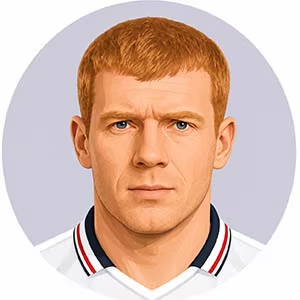
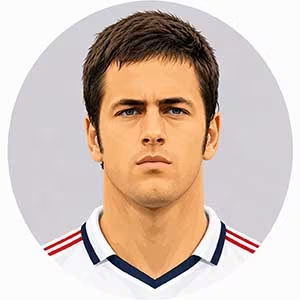
England - Attacking MidfielderCole, Joe
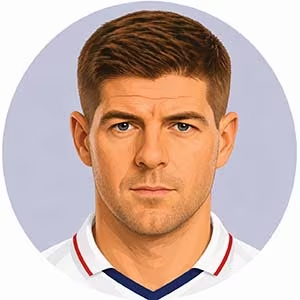
Cole was an attacking midfielder capable of playing centrally, from either wing or behind a striker. At around 1.75 metres, he relied on balance, acceleration and exceptional close control rather than strength. He received naturally on the half-turn, manipulated defenders through feints and rapid touches, and could escape pressure in spaces where a safer player would simply return possession. As a teenager at West Ham he was expected to become a traditional number ten, but his career gradually widened that role. Glenn Roeder made him captain at only 21 during West Ham’s relegation season, trusting him to keep demanding possession even when the team was struggling. Chelsea signed him in 2003, and José Mourinho then required a profound tactical adjustment. Cole learned to play from the wing, press, track runners and recover defensive positions without abandoning his dribbling or improvisation. The result was the strongest period of his career. He won three Premier League titles, two FA Cups and two League Cups with Chelsea and was named the club’s Player of the Year in 2008. His 2005–06 season was especially complete, combining defensive discipline with goals such as the individual effort against Manchester United that helped secure the title. Later injuries interrupted his momentum, particularly a serious knee problem in 2009. He subsequently played for Liverpool, Lille, returned to West Ham, and continued through Aston Villa, Coventry City and Tampa Bay. For England he won 56 caps and scored 10 goals, appearing at three World Cups.
Cole’s creativity carried obvious tactical costs. He could hold the ball too long, attempt the difficult dribble when circulation offered the safer solution and lose influence when confined to rigid wide positions far from combinations. Mourinho’s demands improved his defensive responsibility precisely because those elements had not been naturally central to his game. Against organised opponents who doubled up and denied him room to turn, Cole could become peripheral rather than forcing control through passing volume or physical dominance. His body eventually became another limitation. Repeated injuries removed acceleration and continuity during years when his technique should still have been at its peak, and after the major knee injury he never sustained his best Chelsea level for long enough again. His emotional investment in decisive actions also had a cost. Cole remembered a missed chance against Liverpool in the 2006 FA Cup semi-final years later, describing the journey home as feeling that he had personally let people down. Failure did not disappear quickly simply because the next match arrived.
Psychologically, Cole’s development is defined by the conversion of external expectation into selective trust. He grew up treated as an exceptional prospect and later acknowledged that being expected to become world-class at seventeen or eighteen created pressure before he was physically or tactically ready. Rather than becoming indifferent to criticism, he learned to narrow whose judgement mattered. By 2006 he said explicitly that he no longer listened to supporters, media or friends about his football, preferring coaches and senior players from whom he believed he could learn. That is not low sensitivity; it is active filtering. Mourinho became particularly important because Cole accepted criticism that directly challenged his preferred way of playing. He learned defensive work, positional responsibility and the value of pressing without surrendering the actions that made him unpredictable. Cole later described himself not as a luxury player but as a grafter, and his training behaviour supports the claim: after scoring the extraordinary goal against Sweden, he explained that he practised finishing repeatedly and continued doing so even during the tournament. Major occasions generally increased his willingness to attempt decisive actions rather than reducing it. The Sweden volley, title-winning performances for Chelsea and repeated cup-final contributions show creativity surviving pressure. His reaction to failure, however, was strongly internalising. The missed Liverpool chance stayed with him because he felt he had failed the group, not because he blamed the referee, manager or teammates. There is little evidence of habitual retaliation after fouls or of sustained disputes with officials; criticism was much more likely to produce work or self-examination than confrontation. His leadership was similarly supportive rather than authoritarian. West Ham made him captain young because he continued taking responsibility for possession, while later interviews repeatedly redirect individual praise toward teammates and collective achievement. Cole therefore combined high openness and technical risk with an increasingly disciplined competitive framework. The contradiction is essential: structure did not extinguish his creativity. It gave him enough reliability for coaches to keep trusting the moments when he ignored the obvious option and tried something nobody else had seen.


 All Time ChelseaClub