We use Google Analytics to understand how visitors use this site. Analytics cookies are only activated with your consent. For details, read our Privacy Policy.
Profile lensThe same player, read from a different angle.
Athletic82
Acceleration
82
Pace
86
Agility
77
Strength
83
Balance
78
Jumping
77
Stamina
93
Fitness
83
Technical79
Dribbling
79
Short Passing
80
Long Passing
80
Finishing
79
Shot Accuracy
74
Shot Power
82
Shooting Technique
72
Heading
82
Tackling
62
Crossing
75
Free Kick
67
Penalties
74
First Touch
79
Mental78
Composure
77
Aggression
85
Consistency
78
Creativity
72
Leadership
76
Work Rate
86
Tactical82
Vision
83
Off the Ball
79
Defensive Positioning
71
Teamwork
85
Anticipation
84
Marking
63
Player Traits
Attacking78
Crossing
75
Finishing
79
Heading Accuracy
82
Shot Accuracy
74
Off the Ball
79
Technique76
Dribbling
79
Free Kick
67
Short Passing
80
Long Passing
80
First Touch
79
Shot Technique
72
Movement81
Acceleration
82
Pace
86
Agility
77
Balance
78
Physicality84
Shot Power
82
Jumping
77
Stamina
93
Strength
83
Fitness
83
Defending65
Marking
63
Tackling
62
Def. Positioning
71
Mentality & Game Reading80
Aggression
85
Composure
77
Penalties
74
Vision
83
Leadership
76
Work Rate
86
Teamwork
85
Anticipation
84
Consistency
78
Creativity
72
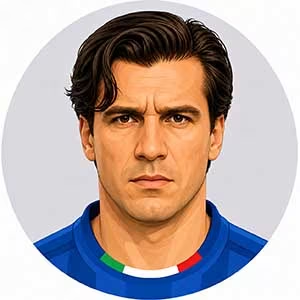
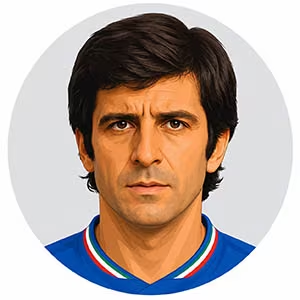
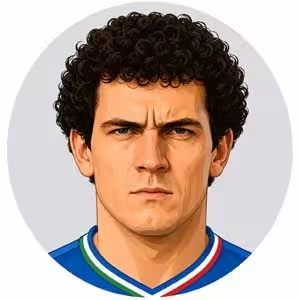
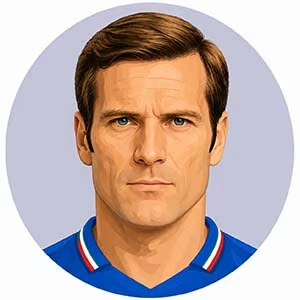
Italy - Centre MidfielderBerti, Nicola
Born in Salsomaggiore Terme in 1967, Berti was a central or right-sided midfielder built almost entirely on stamina and directness rather than tactical sophistication — he was, by his own club's later assessment, not a particularly refined reader of the game, and made his name instead through tireless running, relentless pressing, a hard shot from distance, and driving forward bursts that defenders found extremely difficult to contain once he had built momentum. He came through Parma in Serie C and B before three seasons at Fiorentina established him, and Inter signed him in 1988 for a large fee that made him a fixture of the club for a decade. In his first season under Giovanni Trapattoni he was ever-present as Inter won the 1988–89 Scudetto by an eleven-point margin, still one of the most dominant title-winning campaigns in Serie A history, and he went on to win two UEFA Cups, scoring in both finals, plus an Italian Super Cup. He closed his career with brief, injury-shortened spells at Tottenham, where he won the 1999 League Cup, then Alavés and finally Australia's Northern Spirit. For Italy he won 39 caps under Azeglio Vicini and then Sacchi, played every match of the run to the 1994 World Cup final, and set up Roberto Baggio's decisive goal against Spain with a long, precise pass in the quarter-final.
His limitations were physical rather than temperamental, and they cost him a considerable portion of what should have been his best years. Berti's game depended entirely on athleticism, and a series of severe injuries — two ruptured knee ligaments and a broken metatarsal within a few seasons — repeatedly took away the acceleration and stamina his entire style relied on; he returned from one of the worst of them, an ACL tear, in time for the 1994 World Cup only because Sacchi refused to select anyone else in his place. He was tactically limited enough that coaches rarely used him as a source of structure, and toward the end of his Inter career, watching a young Ronaldo dazzle from the bench while his own body failed him, he found the diminished, spectator version of himself impossible to accept and left for England still craving first-team football rather than accepting a smaller role gracefully.
Temperamentally he was almost entirely defined by one thing: an openly, permanently tribal devotion to Inter that he wore as identity rather than mere loyalty, describing himself as the club's second-most representative figure after its legendary lawyer and vice-president, Peppino Prisco. He deliberately courted being the player Milan supporters hated most, elevated himself specifically for derbies, taunted opposing defenders mid-match with theatrical gestures after beating them, and picked fights with Baresi and others in the tunnel without a trace of real animosity underneath the performance — decades later the two were doing joint public appearances together, laughing about the same incidents. That intensity was still visible well into retirement: television cameras caught him nearly in tears in the stands during a 2020s Champions League penalty shootout loss, the same emotional exposure he'd shown as a player transferred whole into his life as a supporter. Off the pitch he embraced Milan's nightlife fully, hosting famously extravagant parties at his city-centre apartment through the 1980s that drew visiting Hollywood figures, while insisting — and his coaches largely corroborated it — that none of it ever compromised his training intensity or his commitment on matchdays. He got on well with most managers, especially Trapattoni, who described their bond as closer to father and son, though his relationship with Roy Hodgson late at Inter turned genuinely sour. Away from football he later worked as an Inter ambassador and remained a constant, vocal presence at club events decades after his final match. Combustible, self-mythologizing and never once ambivalent about where his loyalties lay, Berti built an identity around Inter so complete that his own football sometimes seemed secondary to it.