We use Google Analytics to understand how visitors use this site. Analytics cookies are only activated with your consent. For details, read our Privacy Policy.
Profile lensThe same player, read from a different angle.
Athletic82
Acceleration
92
Pace
87
Agility
93
Strength
66
Balance
80
Jumping
73
Stamina
85
Fitness
80
Technical86
Dribbling
92
Short Passing
82
Long Passing
88
Finishing
84
Shot Accuracy
83
Shot Power
86
Shooting Technique
85
Heading
73
Tackling
40
Crossing
85
Free Kick
78
Penalties
80
First Touch
90
Mental81
Composure
82
Aggression
79
Consistency
85
Creativity
87
Leadership
70
Work Rate
83
Tactical81
Vision
85
Off the Ball
87
Defensive Positioning
38
Teamwork
82
Anticipation
82
Marking
41
Player Traits
Attacking82
Crossing
85
Finishing
84
Heading Accuracy
73
Shot Accuracy
83
Off the Ball
87
Technique86
Dribbling
92
Free Kick
78
Short Passing
82
Long Passing
88
First Touch
90
Shot Technique
85
Movement88
Acceleration
92
Pace
87
Agility
93
Balance
80
Physicality78
Shot Power
86
Jumping
73
Stamina
85
Strength
66
Fitness
80
Defending40
Marking
41
Tackling
40
Def. Positioning
38
Mentality & Game Reading82
Aggression
79
Composure
82
Penalties
80
Vision
85
Leadership
70
Work Rate
83
Teamwork
82
Anticipation
82
Consistency
85
Creativity
87
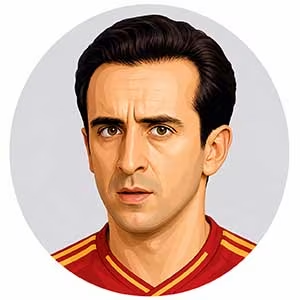
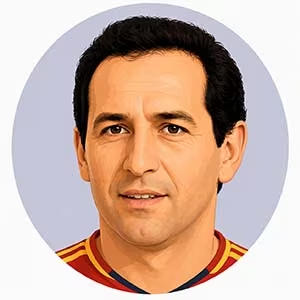
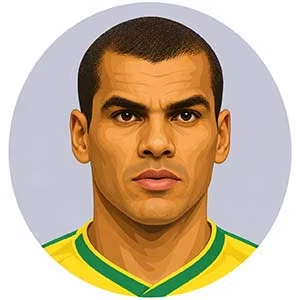
Spain - Right WingerBasora, Estanislao
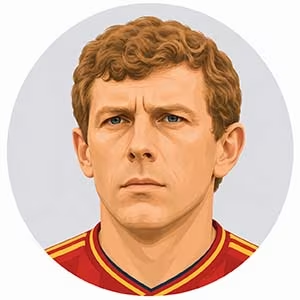
At Curitiba in Spain’s opening match of the 1950 World Cup, Estanislao Basora spent most of the afternoon doing what an orthodox right winger was expected to do: keeping the pitch wide, attacking his full-back and supplying the forwards from outside. With ten minutes remaining, however, Spain were still losing 1–0 to the United States. Basora then scored twice in rapid succession as Spain overturned the match 3–1. Four days later he scored against Chile; against England his delivery from the right created the decisive goal; against Uruguay, Spain again fell behind and Basora scored both goals in a 2–2 draw. The sequence captured something easily obscured by the period label of “touchline winger”. Basora could serve an attack without becoming subordinate to it. His starting position was wide, but his decisions near goal were those of a forward: he recognised when the move required a cross and when the space belonged to him. That combination had already produced his famous hat-trick against France at Colombes in 1949 and would make him an unusually prolific winger for both club and country.
Basora was a fast, technically clean right winger whose game depended less on elaborate sequences of tricks than on separation: changes of direction, acceleration, body movement and intelligent running allowed him to escape a marker before delivering accurately or attacking the penalty area himself. Catalan accounts particularly credit him with helping introduce body feints into the modern game, while Barcelona’s own retrospective emphasises his ability to lose defenders and operate even when space became narrow. He remained fundamentally a wide player rather than an inside forward disguised on the flank; Basora later stressed that wingers of his generation attacked from outside and crossed from distance rather than habitually moving into central zones. Yet his scoring output made the role unusually elastic. After joining Barcelona from Manresa in 1946, he became a fixture of the sides that won four league championships, four Spanish Cups and two Latin Cups, including the celebrated five-trophy campaign of 1951–52. His Barcelona career extended until 1958 apart from a season on loan at Lleida, and his 22 appearances for Spain produced 13 goals.
There were limits to that effectiveness. Basora’s football was structurally dependent on receiving situations in which width, forward momentum and a defender to attack could be converted into an advantage. He was not a midfield organiser who could relocate himself deeper and dictate a blocked game through sustained possession, nor does the surviving description support treating him as a high-volume combination player between central lines. His own recollection was explicit that his generation circulated the ball less and that his work belonged primarily to the flank. Consequently, conditions that removed the runway for acceleration, denied useful crossing positions or forced repeated play with his back to goal reduced the distinctive value of his game. There is also a meaningful career interruption: after losing his regular place under Sandro Puppo and then Franz Platko, he spent 1955–56 on loan at Lleida before returning to Barcelona. That decline in status should not be rewritten as technical collapse—he subsequently returned to substantial first-team use—but neither should his peak explosiveness and attacking influence be projected uniformly across all twelve Barcelona seasons.
The most discriminating psychological evidence around Basora is not demonstrative leadership or competitive hostility but an unusually low attachment to status. When Puppo and Platko reduced him from established international and decorated starter to reserve, contemporary retrospective accounts record neither confrontation with the coaches nor public resistance; he accepted the subsequent loan to Lleida without protest, then returned and played again for Barcelona. His own later testimony points in the same direction without proving emotional passivity: he said that simply having played for Barcelona mattered more to him than the trophies, recalled never renegotiating the contract he signed in 1946 and described himself as willing to accept whatever the club paid. This was institutional compliance, not evidence that competitive pressure left him emotionally untouched. On the field the available evidence actually shows repeated production under scoreboard pressure: two late goals while trailing against the United States and two more after Uruguay had taken the lead at the World Cup. Nor did prestige appear to demand self-mythologising afterwards: discussing a celebrated Latin Cup performance for which a journalist had effectively singled him out above the team, Basora later rejected the account as exaggerated. Sources describe close relations with teammates and a preference for collective enjoyment, while even his proximity to spectators was strikingly informal—at Les Corts he remembered conversing during matches with regulars beside his wing. What is not documented should remain open: there is insufficient evidence to assign distinctive responses to refereeing, individual provocation, teammates’ errors, hostile crowds or criticism. His profile is therefore not simply “calm”. The stronger signal is **status non-defensiveness**: competitive intervention remained available under match pressure while loss of hierarchy, personal credit and institutional control produced remarkably little observable struggle for self-protection.