We use Google Analytics to understand how visitors use this site. Analytics cookies are only activated with your consent. For details, read our Privacy Policy.
Profile lensThe same player, read from a different angle.
Athletic81
Acceleration
93
Pace
87
Agility
87
Strength
74
Balance
77
Jumping
75
Stamina
77
Fitness
78
Technical86
Dribbling
92
Short Passing
85
Long Passing
85
Finishing
85
Shot Accuracy
83
Shot Power
79
Shooting Technique
82
Heading
72
Tackling
40
Crossing
86
Free Kick
76
Penalties
75
First Touch
91
Mental77
Composure
78
Aggression
75
Consistency
76
Creativity
87
Leadership
76
Work Rate
76
Tactical78
Vision
83
Off the Ball
85
Defensive Positioning
42
Teamwork
79
Anticipation
77
Marking
39
Player Traits
Attacking82
Crossing
86
Finishing
85
Heading Accuracy
72
Shot Accuracy
83
Off the Ball
85
Technique85
Dribbling
92
Free Kick
76
Short Passing
85
Long Passing
85
First Touch
91
Shot Technique
82
Movement86
Acceleration
93
Pace
87
Agility
87
Balance
77
Physicality77
Shot Power
79
Jumping
75
Stamina
77
Strength
74
Fitness
78
Defending40
Marking
39
Tackling
40
Def. Positioning
42
Mentality & Game Reading78
Aggression
75
Composure
78
Penalties
75
Vision
83
Leadership
76
Work Rate
76
Teamwork
79
Anticipation
77
Consistency
76
Creativity
87
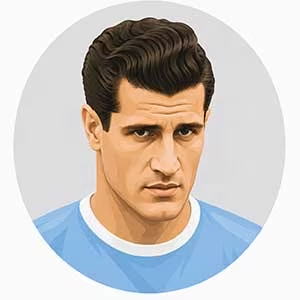
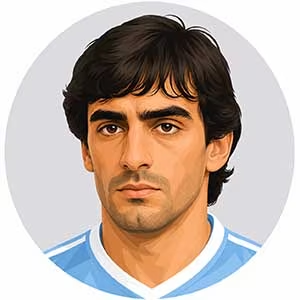
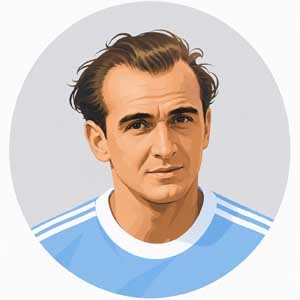
Uruguay - Right WingerAbbadie, Julio César
Carving his identity along the right touchline with blistering acceleration, close control, and unselfish crossing precision, Julio César Abbadie Gismero was one of the most effective and technically accomplished wingers in South American and Italian football across the 1950s and 1960s. Emerging from Peñarol's youth ranks and universally known by the affectionate nickname El Pardo, Abbadie combined a balanced, compact physical frame with sudden changes of direction that left full-backs flat-footed in one-on-one isolations. Rather than playing as a self-indulgent dribbler, his game was built around speed and surgical efficiency: driving hard to the byline to whip driven crosses for target forwards, or cutting diagonally into the penalty area to finish with crisp, low-trajectory strikes. With Peñarol, he was an integral part of the legendary Escuadrilla de la Muerte frontline, securing multiple Uruguayan league titles before moving to Italy, where he spent six consistent seasons with Genoa and Lecco—scoring over 20 Serie A goals and earning cult status among Rossoblù supporters for his work rate and technical delivery. On the international stage, he was a key protagonist for La Celeste at the 1954 World Cup in Switzerland, scoring twice in the group stage against Scotland before helping Uruguay reach the semi-finals, eventually returning to Peñarol in 1962 to lift the Copa Libertadores and the 1966 Intercontinental Cup against Real Madrid. Mentally and emotionally, Abbadie was an unpretentious, disciplined team player whose competitive spirit was rooted in tactical generosity and an extraordinary work ethic. Unlike many South American flair wingers of his era who neglected their defensive tracking duties, El Pardo embraced back-tracking and midfield recovery runs with natural diligence, earning the deep tactical trust of managers in both South America and the rigid defensive tactical environments of 1950s Italian Calcio. Inside the locker room, he was a quiet, modest, and unifying presence—warm-hearted, approachable, and possessing a grounded professionalism that helped him adapt effortlessly to European life while remaining a beloved pillar upon his return to Montevideo. Under high-stakes tournament conditions, his emotional pulse was remarkably steady; when Uruguay faced ferocious opposition in the 1954 World Cup or during the high-tension clashes of the 1966 Intercontinental Cup, he maintained sharp tactical focus, never allowing physical intimidation or hostile crowds to rush his decision-making. Toward referees and aggressive defenders who frequently targeted his rapid bursts with hard fouls, Abbadie maintained an honorable, stoic attitude: absorbing contact, quickly getting back to his feet, and answering with incisive runs and clean sportsmanship, cementing his legacy as a classic, universally respected winger of Uruguay's golden era.