We use Google Analytics to understand how visitors use this site. Analytics cookies are only activated with your consent. For details, read our Privacy Policy.
Profile lensThe same player, read from a different angle.
Athletic80
Acceleration
70
Pace
74
Agility
66
Strength
94
Balance
87
Jumping
82
Stamina
82
Fitness
87
Technical75
Dribbling
68
Short Passing
72
Long Passing
68
Finishing
63
Shot Accuracy
60
Shot Power
83
Shooting Technique
65
Heading
85
Tackling
90
Crossing
63
Free Kick
57
Penalties
55
First Touch
72
Mental85
Composure
85
Aggression
90
Consistency
86
Creativity
66
Leadership
87
Work Rate
88
Tactical81
Vision
70
Off the Ball
58
Defensive Positioning
85
Teamwork
80
Anticipation
86
Marking
89
Player Traits
Attacking66
Crossing
63
Finishing
63
Heading Accuracy
85
Shot Accuracy
60
Off the Ball
58
Technique67
Dribbling
68
Free Kick
57
Short Passing
72
Long Passing
68
First Touch
72
Shot Technique
65
Movement74
Acceleration
70
Pace
74
Agility
66
Balance
87
Physicality86
Shot Power
83
Jumping
82
Stamina
82
Strength
94
Fitness
87
Defending88
Marking
89
Tackling
90
Def. Positioning
85
Mentality & Game Reading79
Aggression
90
Composure
85
Penalties
55
Vision
70
Leadership
87
Work Rate
88
Teamwork
80
Anticipation
86
Consistency
86
Creativity
66
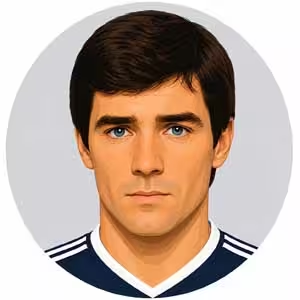
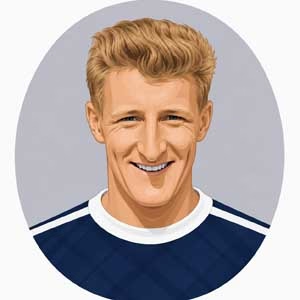
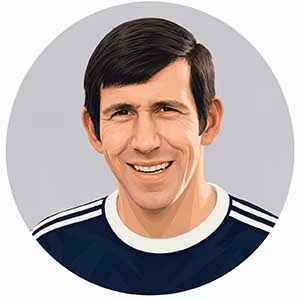
Scotland - Centre-backYeats, Ron
When Bill Shankly unveiled his new Scottish recruit to the press corps at Anfield in the summer of 1961, he famously invited journalists to "walk around him, he's a colossus." Ronald Yeats was the towering, six-foot-two central stopper and defensive patriarch who served as the physical rock upon which Shankly built modern Liverpool from the Second Division into an elite European powerhouse. Stationed in the heart of the defense, Yeats was an immovable aerial fortress: dominating high balls with thunderous clearing headers, crushing opposing center-forwards through sheer upper-body strength, and executing decisive, ball-and-all recovery challenges inside the box. Over 454 appearances and 16 goals in red between 1961 and 1971, he captained Liverpool to promotion, two First Division titles (1963–64, 1965–66), three Charity Shields, and famously became the first Liverpool captain in history to hoist the FA Cup in 1965 after a tense final against Leeds United. For Scotland, across two caps, his international opportunities were criminally scarce, overlooked in an era rich with home-grown domestic defenders.
Yeats’s immense physical dominance, however, was fundamentally anchored in old-school stopper orthodoxy. He was completely devoid of modern ball-playing finesse; his distribution was strictly pragmatic punts down the channel or clearances into the stands, and his heavy, muscular frame made him vulnerable to nimble, low-gravity forwards who could turn quickly in open space outside the eighteen-yard box. When dragged into forty-yard footraces against lightning-fast transitional attackers, his turning circle was slow and cumbersome.
Commanding, fearless, and possessing an unyielding Scottish blue-collar spine, Yeats led through sheer physical presence and moral courage. He was an intimidating presence on the pitch: staring down opposing forwards in the tunnel, organizing his defensive partners with booming Scottish roars, and throwing his frame into flying boots without a shred of self-preservation. Inside the Anfield dressing room, his captaincy was sacred law—a true lieutenant to Shankly who set the standard of defensive hardness and collective unity, leaving behind an immortal legacy as the original, heroic defensive bedrock of Liverpool Football Club.