We use Google Analytics to understand how visitors use this site. Analytics cookies are only activated with your consent. For details, read our Privacy Policy.
Profile lensThe same player, read from a different angle.
Athletic77
Acceleration
80
Pace
73
Agility
86
Strength
64
Balance
82
Jumping
68
Stamina
82
Fitness
80
Technical85
Dribbling
92
Short Passing
91
Long Passing
90
Finishing
65
Shot Accuracy
66
Shot Power
73
Shooting Technique
86
Heading
63
Tackling
81
Crossing
86
Free Kick
70
Penalties
70
First Touch
90
Mental82
Composure
90
Aggression
90
Consistency
83
Creativity
85
Leadership
74
Work Rate
74
Tactical84
Vision
88
Off the Ball
75
Defensive Positioning
75
Teamwork
91
Anticipation
83
Marking
74
Player Traits
Attacking71
Crossing
86
Finishing
65
Heading Accuracy
63
Shot Accuracy
66
Off the Ball
75
Technique87
Dribbling
92
Free Kick
70
Short Passing
91
Long Passing
90
First Touch
90
Shot Technique
86
Movement80
Acceleration
80
Pace
73
Agility
86
Balance
82
Physicality73
Shot Power
73
Jumping
68
Stamina
82
Strength
64
Fitness
80
Defending77
Marking
74
Tackling
81
Def. Positioning
75
Mentality & Game Reading83
Aggression
90
Composure
90
Penalties
70
Vision
88
Leadership
74
Work Rate
74
Teamwork
91
Anticipation
83
Consistency
83
Creativity
85
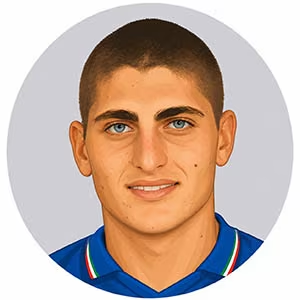
Italy - Centre MidfielderVerratti, Marco
Nine bookings by February of a single season, three separate suspensions, and a coach — Laurent Blanc — telling reporters flatly that his own player was going to have problems if nothing changed. Marco Verratti's response, delivered to journalists after the latest yellow card, was to insist the referee had been influenced by his opponent's complaints and that he'd barely touched the man. Blanc's own diagnosis was more sympathetic than the numbers suggested it should be: it wasn't funny, he said, but Verratti was punishing himself, not anyone else.
Born in Manoppello, near Pescara, in 1992, Verratti broke through at his hometown club as a teenager with a technical range well beyond his level of competition — exceptional close control, a passing radius that let him dictate tempo from deep positions, and defensive positioning good enough that Paris Saint-Germain signed him from Serie B at nineteen, betting on potential few outside Italy had noticed yet. He became first-choice in PSG's midfield almost immediately and stayed there for over a decade, at the heart of a French football project rebuilt around Qatari investment, winning nine Ligue 1 titles, multiple domestic cups, and reaching the 2020 Champions League final, before eventually leaving for Qatar's Al-Arabi. For Italy he won 55 caps and was part of the Euro 2020-winning squad, though persistent injuries limited his international availability across his career.
His limitations were almost entirely disciplinary rather than technical, and unusually well documented because they recurred across nearly every season of his early career. Verratti led Ligue 1 in yellow cards during multiple campaigns, primarily for dissent and reckless challenges rather than calculated fouls, a pattern that cost PSG suspensions in important matches, including a European quarter-final period, and that both Ancelotti and Blanc separately identified as his one significant weakness. He also picked up cards through simple carelessness — including, on at least one occasion, a caution for an obscure technical infringement most players and observers didn't know existed — suggesting a player whose petulance under pressure occasionally outran his football intelligence.
Temperamentally he combined genuine hometown attachment with a volatile, self-justifying reaction to confrontation on the pitch. He admitted years later that he had planned to return to Pescara after just six months in Paris, homesick and unconvinced the move would work, before staying to become one of the club's most enduring figures instead — a reversal he attributed entirely to how completely PSG had come to give him what he wanted from football. On the pitch his instinct under provocation was to protest rather than absorb, and to externalize responsibility for cautions rather than accept them, a pattern senior teammates worked to manage directly: PSG captain Thiago Silva spoke publicly about talking to him regularly, treating the young Italian's discipline as something the dressing room's older figures needed to actively shepherd rather than something that would resolve on its own. He was also fined by the club after a drink-driving stop early in his Paris career, a lapse PSG addressed through an internal conduct penalty rather than public escalation. Away from those specific flashpoints he was, by wide consensus inside PSG's dressing room, well liked and central to the group, eventually captaining the side himself in his final seasons. Technically gifted, chronically undisciplined in a specific and repeated way, and genuinely rooted to both his hometown and his adopted club despite early doubts about the latter, Verratti built a decorated career around a flaw he never fully resolved but that never once outweighed what he offered.