We use Google Analytics to understand how visitors use this site. Analytics cookies are only activated with your consent. For details, read our Privacy Policy.
Profile lensThe same player, read from a different angle.
Athletic80
Acceleration
91
Pace
84
Agility
92
Strength
68
Balance
76
Jumping
77
Stamina
78
Fitness
76
Technical81
Dribbling
87
Short Passing
76
Long Passing
72
Finishing
85
Shot Accuracy
83
Shot Power
76
Shooting Technique
79
Heading
72
Tackling
38
Crossing
68
Free Kick
68
Penalties
73
First Touch
86
Mental75
Composure
77
Aggression
74
Consistency
73
Creativity
86
Leadership
76
Work Rate
72
Tactical80
Vision
78
Off the Ball
85
Defensive Positioning
37
Teamwork
77
Anticipation
85
Marking
38
Player Traits
Attacking79
Crossing
68
Finishing
85
Heading Accuracy
72
Shot Accuracy
83
Off the Ball
85
Technique78
Dribbling
87
Free Kick
68
Short Passing
76
Long Passing
72
First Touch
86
Shot Technique
79
Movement86
Acceleration
91
Pace
84
Agility
92
Balance
76
Physicality75
Shot Power
76
Jumping
77
Stamina
78
Strength
68
Fitness
76
Defending38
Marking
38
Tackling
38
Def. Positioning
37
Mentality & Game Reading77
Aggression
74
Composure
77
Penalties
73
Vision
78
Leadership
76
Work Rate
72
Teamwork
77
Anticipation
85
Consistency
73
Creativity
86
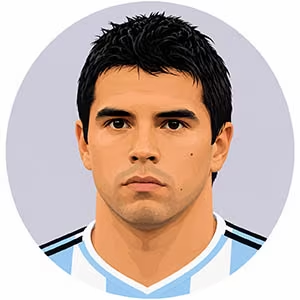
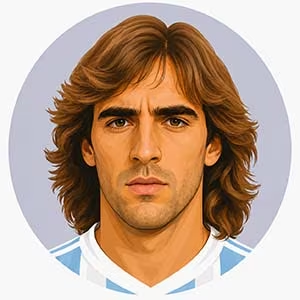
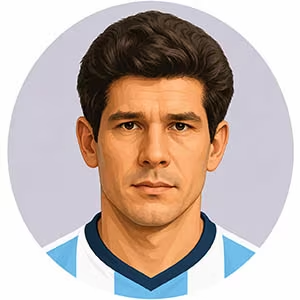
Argentina - ForwardSaviola, Javier
Javier Saviola scored so relentlessly as a teenager in Argentina that people started running out of comparisons before he had turned twenty, and then spent most of the following decade in Europe being judged against a version of himself that had existed at River Plate and never quite traveled with him. It's a familiar shape for prodigies, but few wore it with as little bitterness as he did.
Born in Rosario in 1981, Saviola broke into River Plate's first team as a teenager and became, briefly, the most talked-about young forward in South America — a low, quick, instinctive striker built around acceleration in tight spaces and a predator's sense of where a chance was about to open, rather than around size or aerial threat. He was two-footed, comfortable finishing off either side, and dangerous specifically in the moments right after a defense had lost its shape, which made him devastating in a fast, open Argentine league and considerably harder to deploy in the more structured, physically demanding football he encountered in Europe. He won two Argentine championships with River Plate and the 2001 South American Footballer of the Year award before Barcelona signed him in 2001, where his six seasons produced two Copa del Rey wins and a La Liga title but increasingly limited playing time behind a front line that eventually included Ronaldinho and a young Lionel Messi. Loan spells at Monaco and Sevilla followed before a genuinely productive stretch at Real Zaragoza, then a return to prominence at Benfica, where he was the Portuguese league's top scorer in 2011 and earned considerable affection from supporters for reviving a career many had already filed as a disappointment. For Argentina he won 39 caps, was top scorer at the 2004 Copa América as Argentina finished runners-up, and remains a key figure of the Olympic gold medal side of 2004.
His limitations were consistent across every club he played for after River Plate. Saviola's lack of physical size made him vulnerable against genuinely strong, aggressive defenders who could simply out-muscle him in contact, and his game depended heavily on space and pace in transition — qualities that European tactical football, increasingly compact and organized through the 2000s, gave him progressively less of. He was rarely a starter at the biggest clubs he represented, cycling in and out of favor with a series of coaches who valued his movement without ever fully building a system designed to exploit it, and his goal output away from Argentina, while respectable, never approached the volume that had made him famous as a teenager.
Temperamentally he handled that long, gradual recalibration of expectations with an evenness that surprised people who expected frustration or public complaint. Saviola rarely criticized coaches publicly for limiting his playing time, even at Barcelona during seasons when his role shrank considerably, and he was consistently described by teammates as easygoing, likeable and without the entitlement that sometimes accompanies a player who peaked so young and so visibly. He was not a vocal presence in any dressing room he occupied, offering little in the way of organizational leadership, and his disciplinary record stayed clean across a long career played mostly in a subordinate offensive role rather than as a focal point. He accepted a series of loan moves and squad rotations that would have provoked open conflict from less patient personalities, treating each new club as an opportunity to rebuild rather than a demotion to resent. Away from the pitch he remained low-profile and largely free of controversy, and his warm reception at Benfica late in his career — a fanbase actively willing him back to form — suggested a player who retained considerable goodwill precisely because he had never turned his own disappointment into anyone else's problem. Modest, adaptable and unusually free of resentment for a prodigy whose ceiling was reached at nineteen, Saviola spent a decade proving that talent could survive being overtaken by circumstance without curdling into anything bitter.