We use Google Analytics to understand how visitors use this site. Analytics cookies are only activated with your consent. For details, read our Privacy Policy.
Profile lensThe same player, read from a different angle.
Athletic87
Acceleration
89
Pace
85
Agility
87
Strength
83
Balance
91
Jumping
81
Stamina
95
Fitness
84
Technical85
Dribbling
86
Short Passing
82
Long Passing
82
Finishing
88
Shot Accuracy
85
Shot Power
91
Shooting Technique
88
Heading
77
Tackling
59
Crossing
78
Free Kick
75
Penalties
78
First Touch
85
Mental84
Composure
81
Aggression
93
Consistency
80
Creativity
76
Leadership
87
Work Rate
93
Tactical85
Vision
85
Off the Ball
87
Defensive Positioning
59
Teamwork
89
Anticipation
85
Marking
51
Player Traits
Attacking83
Crossing
78
Finishing
88
Heading Accuracy
77
Shot Accuracy
85
Off the Ball
87
Technique83
Dribbling
86
Free Kick
75
Short Passing
82
Long Passing
82
First Touch
85
Shot Technique
88
Movement88
Acceleration
89
Pace
85
Agility
87
Balance
91
Physicality87
Shot Power
91
Jumping
81
Stamina
95
Strength
83
Fitness
84
Defending56
Marking
51
Tackling
59
Def. Positioning
59
Mentality & Game Reading85
Aggression
93
Composure
81
Penalties
78
Vision
85
Leadership
87
Work Rate
93
Teamwork
89
Anticipation
85
Consistency
80
Creativity
76
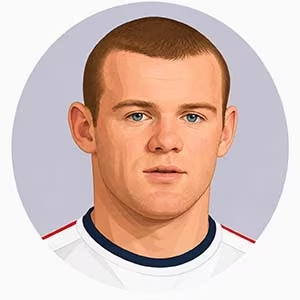
England - ForwardRooney, Wayne
A visceral, rampaging street footballer trapped inside the body of a world-class athlete, Wayne Mark Rooney burst into the global consciousness like a thunderclap as a sixteen-year-old at Everton before spending thirteen years conquering English and European football as the talismanic record goalscorer of Manchester United. Blessed with an extraordinarily low center of gravity, broad-shouldered barrel-chested power, and the sudden, violent burst of a middleweight boxer, Rooney broke every traditional tactical mold: he was an explosive penalty-box predator, a line-breaking second striker, and a workhorse central midfielder all rolled into one relentless engine. His technical profile was a clinic in brute versatility: thunderous 30-yard strikes on the half-volley, laser-guided 60-yard diagonal pings out to the wings, soft-shoed first-touch orientation on the turn, and an unselfish defensive instinct that saw him routinely chase back eighty meters to execute crunching slide-tackles in his own defensive box. Winning five Premier League titles, the 2008 Champions League, and becoming the all-time top scorer for both United and England, Rooney stood as the ultimate self-sacrificing genius of Sir Alex Ferguson’s later dynasties.
Psychologically, Rooney was forged in the uncompromising, bare-knuckle fires of Croxteth street football—a character driven by raw, combative pride, an insatiable appetite for physical struggle, and an innate, childlike obsession with the ball itself. On the pitch, his leadership was purely organic, leading not through polished speeches but through bone-rattling physical commitment, frantic tracking back, and a visible, red-faced fury whenever standards dipped. Inside the dressing room, he was a deeply beloved, straight-talking, and unpretentious working-class hero who bridged multiple generations of United teams, completely devoid of corporate superstar vanity and universally admired for willingly sacrificing his own goal tallies to accommodate the egos and tactical needs of stars like Ruud van Nistelrooy, Cristiano Ronaldo, and Carlos Tevez. Under high-stakes pressure, his emotional posture was a double-edged sword of terrifying intensity: at his peak, it fueled clutch, match-winning volleys in Manchester derbies and Champions League semi-finals, while during his younger years it occasionally erupted into explosive, red-mist flashpoints—most notoriously his stamp on Ricardo Carvalho at the 2006 World Cup. Toward referees and opposition defenders, Rooney was a constant storm of verbal aggression and fearless physical contact, challenging every decision and giving as much punishment as he took, leaving an indelible legacy as the quintessential warrior-prodigy of modern British sport.