We use Google Analytics to understand how visitors use this site. Analytics cookies are only activated with your consent. For details, read our Privacy Policy.
Profile lensThe same player, read from a different angle.
Athletic85
Acceleration
92
Pace
87
Agility
86
Strength
85
Balance
87
Jumping
78
Stamina
83
Fitness
78
Technical89
Dribbling
91
Short Passing
85
Long Passing
86
Finishing
87
Shot Accuracy
93
Shot Power
93
Shooting Technique
90
Heading
79
Tackling
48
Crossing
83
Free Kick
90
Penalties
90
First Touch
92
Mental79
Composure
85
Aggression
88
Consistency
76
Creativity
86
Leadership
70
Work Rate
85
Tactical84
Vision
85
Off the Ball
88
Defensive Positioning
44
Teamwork
78
Anticipation
87
Marking
38
Player Traits
Attacking86
Crossing
83
Finishing
87
Heading Accuracy
79
Shot Accuracy
93
Off the Ball
88
Technique89
Dribbling
91
Free Kick
90
Short Passing
85
Long Passing
86
First Touch
92
Shot Technique
90
Movement88
Acceleration
92
Pace
87
Agility
86
Balance
87
Physicality83
Shot Power
93
Jumping
78
Stamina
83
Strength
85
Fitness
78
Defending43
Marking
38
Tackling
48
Def. Positioning
44
Mentality & Game Reading83
Aggression
88
Composure
85
Penalties
90
Vision
85
Leadership
70
Work Rate
85
Teamwork
78
Anticipation
87
Consistency
76
Creativity
86
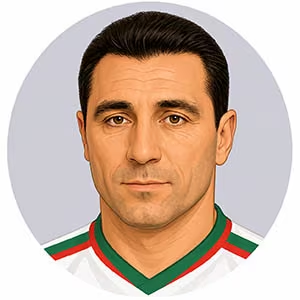
Bulgaria - ForwardStoichkov, Hristo
Johan Cruyff specifically requested a volcanic temperament to shatter the complacency of Barcelona’s locker room, and in the summer of 1990, CSKA Sofia delivered the exact firebrand required. Stoichkov (El Pistolero) arrived in Catalonia with a European Golden Shoe under his belt and immediately became the sharpest edge of the iconic Dream Team. Operating primarily from the left channel or across a dynamic front two alongside Romário, he punished defensive lines with explosive diagonal runs, unmatched violence in his left-footed ball-striking, and a low center of gravity that allowed him to ride sliding challenges without breaking stride. Over his spells at Camp Nou, he collected four consecutive La Liga titles (1991–1994), the 1992 European Cup at Wembley, and the 1994 Ballon d'Or. For Bulgaria, his 83 caps and 37 goals were headlined by the historic run to fourth place at the 1994 World Cup in the United States, where his six goals earned him the tournament’s Golden Boot.
Tactically, his game was defined by high-intensity verticality, which had distinct limitations: his right foot was largely decorative, his efficacy waned against deep, static low blocks that denied him transition space, and his refusal to engage in regular defensive tracking created spatial liabilities on the left flank. Furthermore, an ill-fated 1995 move to Parma in Serie A exposed his struggles when removed from Cruyff's fluid, proactive attacking framework.
Few players in football history have weaponized anger quite like Stoichkov. He did not merely play the match; he engaged in open war with opposing defenders, linesmen, and hostile terrace crowds, feeding ravenously on friction to sharpen his execution. This volatile emotional profile occasionally spiraled into disciplinary disasters, most infamously when he stomped on referee Urízar Azpitarte’s foot during a Clásico in his debut season, earning a multi-month suspension. Inside the dressing room, he was an ultra-demanding, protective leader who formed an telepathic bond with Romário while clashing openly with Cruyff whenever tactical autonomy was questioned. Toward aggressive man-markers, he responded with retaliatory elbow checks and venomous verbal intimidation, leaving an immortal legacy as the most ferocious, electrifying, and combustible forward of the 1990s.


 All Time BarcelonaClub