We use Google Analytics to understand how visitors use this site. Analytics cookies are only activated with your consent. For details, read our Privacy Policy.
Profile lensThe same player, read from a different angle.
Athletic81
Acceleration
80
Pace
77
Agility
79
Strength
82
Balance
77
Jumping
88
Stamina
81
Fitness
80
Technical81
Dribbling
77
Short Passing
71
Long Passing
66
Finishing
91
Shot Accuracy
86
Shot Power
77
Shooting Technique
88
Heading
93
Tackling
38
Crossing
60
Free Kick
67
Penalties
85
First Touch
81
Mental78
Composure
84
Aggression
87
Consistency
74
Creativity
66
Leadership
78
Work Rate
74
Tactical82
Vision
72
Off the Ball
88
Defensive Positioning
38
Teamwork
75
Anticipation
90
Marking
36
Player Traits
Attacking84
Crossing
60
Finishing
91
Heading Accuracy
93
Shot Accuracy
86
Off the Ball
88
Technique75
Dribbling
77
Free Kick
67
Short Passing
71
Long Passing
66
First Touch
81
Shot Technique
88
Movement78
Acceleration
80
Pace
77
Agility
79
Balance
77
Physicality82
Shot Power
77
Jumping
88
Stamina
81
Strength
82
Fitness
80
Defending37
Marking
36
Tackling
38
Def. Positioning
38
Mentality & Game Reading79
Aggression
87
Composure
84
Penalties
85
Vision
72
Leadership
78
Work Rate
74
Teamwork
75
Anticipation
90
Consistency
74
Creativity
66
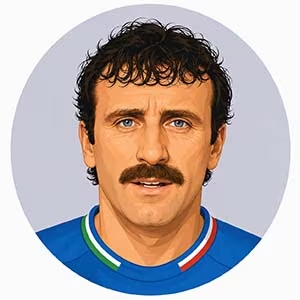
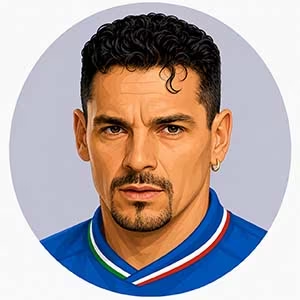
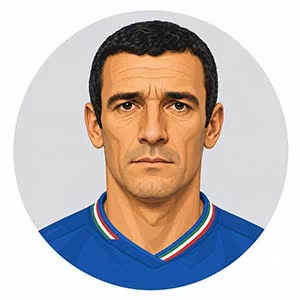
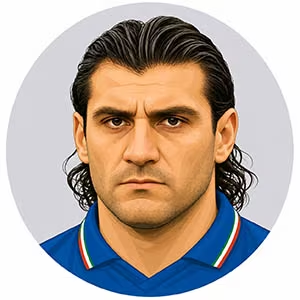
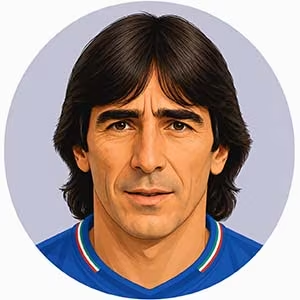
Italy - StrikerPruzzo, Roberto
He was called Il Bomber, but the nickname that mattered in Rome was O Rey de Crocefieschi — the King of Crocefieschi, after the tiny Ligurian village of a few hundred people where he was born. It was a joke about scale that turned into a statement of fact: Roberto Pruzzo won three Serie A top-scorer titles in a decade when Italy imported Falcão, Platini, Rummenigge and Maradona, and he did it as a provincial boy from the Apennines who never made the slightest effort to become anything else.
Born in 1955, Pruzzo emerged at Genoa, where he scored prolifically enough as a teenager to attract Italy's biggest clubs, and joined Roma in 1978 for a fee that made him briefly the most expensive player in the country. He was a complete centre-forward of the old Italian school: 1.79m, strong in the shoulder, and exceptional in the air, where his timing and neck power let him beat taller defenders consistently. On the ground he finished with both feet inside the box, held the ball up under pressure to bring midfielders into play, and possessed a genuine talent for the technically difficult finish — volleys, half-volleys, and shots taken early from angles that offered little. He was not quick and did not run in behind; his game was played in and around the penalty area, with his back to goal as often as facing it. Across nine seasons at Roma he scored 138 goals in 316 appearances, still the club's all-time record, and won the Capocannoniere in 1981, 1982 and 1986. He was central to the scudetto of 1983, the club's first in forty-one years and only its second ever, and to four Coppa Italia victories. He also scored Roma's goal in the 1984 European Cup final against Liverpool, played at the Stadio Olimpico and lost on penalties — the defining wound of the club's modern history. Italy capped him only six times, an omission that remains one of the least explicable in the national team's history and which he attributed, with some justification, to the durable prejudice of Italian football against players from outside the traditional power structure.
His limitations were real and largely positional. Pruzzo lacked pace and offered nothing in behind a defensive line, which made him ineffective in transition-heavy matches and dependent on a side willing to play through him. He pressed rarely, contributed little defensively, and in matches where crosses did not arrive or midfield support was absent, his involvement could shrink to a handful of touches. He was also inconsistent physically, with a body that carried weight easily and required management.
What made him beloved was the absence of ambition beyond the one thing he wanted. Pruzzo turned down Juventus and Milan more than once, and stayed at Roma through the years when leaving would have brought more trophies and a national team career, because he had found a city that treated him as its own and had no interest in trading that for anything. He was blunt, ironic and openly Ligurian in temperament — dry, unsentimental in speech, allergic to grand statements — and he combined that with a Roman crowd that demanded exactly the opposite, which produced an odd and durable affection. On the pitch he was composed rather than expressive: he argued little with referees, fouled rarely, took heavy defensive treatment without retaliating, and reacted to missed chances by immediately repositioning rather than despairing. He was not a vocal leader, and the Roma dressing room of that era did not need him to be, with Falcão and Di Bartolomei present; his authority was that of the man who scored, and it required no amplification. Away from football he was conventional and private, attached to his family, his village and his region, later becoming one of Italy's most acerbic television pundits without ever softening the Ligurian bluntness. Loyal beyond professional logic and undervalued beyond reason, Pruzzo remains the greatest goalscorer Roma has ever had and the least celebrated great striker of his generation.