We use Google Analytics to understand how visitors use this site. Analytics cookies are only activated with your consent. For details, read our Privacy Policy.
Profile lensThe same player, read from a different angle.
Athletic80
Acceleration
79
Pace
83
Agility
81
Strength
71
Balance
74
Jumping
77
Stamina
91
Fitness
85
Technical75
Dribbling
75
Short Passing
76
Long Passing
78
Finishing
71
Shot Accuracy
68
Shot Power
77
Shooting Technique
70
Heading
68
Tackling
68
Crossing
76
Free Kick
71
Penalties
70
First Touch
75
Mental78
Composure
74
Aggression
85
Consistency
78
Creativity
70
Leadership
79
Work Rate
86
Tactical76
Vision
74
Off the Ball
77
Defensive Positioning
68
Teamwork
82
Anticipation
81
Marking
73
Player Traits
Attacking72
Crossing
76
Finishing
71
Heading Accuracy
68
Shot Accuracy
68
Off the Ball
77
Technique74
Dribbling
75
Free Kick
71
Short Passing
76
Long Passing
78
First Touch
75
Shot Technique
70
Movement79
Acceleration
79
Pace
83
Agility
81
Balance
74
Physicality80
Shot Power
77
Jumping
77
Stamina
91
Strength
71
Fitness
85
Defending70
Marking
73
Tackling
68
Def. Positioning
68
Mentality & Game Reading78
Aggression
85
Composure
74
Penalties
70
Vision
74
Leadership
79
Work Rate
86
Teamwork
82
Anticipation
81
Consistency
78
Creativity
70
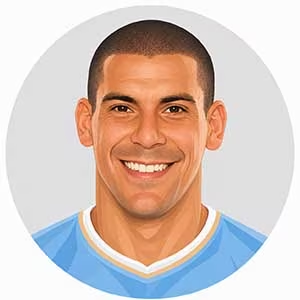
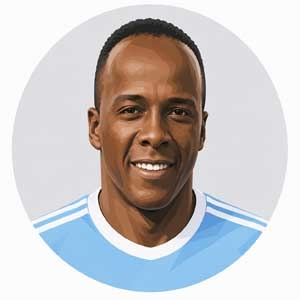
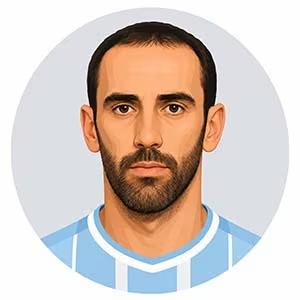
Uruguay - Right BackPereira, Maxi
Pereira began as a more advanced right-sided midfielder with Defensor Sporting before being converted into a full-back after moving to Benfica in 2007. At 1.73 metres, he lacked imposing size but compensated through stamina, acceleration, balance and an extraordinary appetite for repeated involvement. He defended aggressively on the front foot, closing wingers early and using body position and persistence rather than aerial dominance. In possession he was less a refined creative full-back than a relentless supporting runner. He overlapped constantly, attacked the far post, combined quickly with midfielders and continued making forward runs deep into matches. His early experience higher up the pitch also gave him enough technical confidence to enter central areas or shoot when space opened. After five senior seasons with Defensor, Pereira spent eight years at Benfica, eventually becoming one of the club’s most dependable players and making more than 330 competitive appearances. He won three Portuguese league titles, the Portuguese Cup, five League Cups and a Super Cup, and appeared in consecutive Europa League finals in 2013 and 2014. In 2015 he crossed Portuguese football’s deepest modern rivalry by joining Porto, where he added another league title and remained for four seasons. He later returned to Uruguay with Peñarol and River Plate before retiring in 2023. For Uruguay he earned 125 official caps according to the AUF, scoring three goals, played at the 2010 and 2014 World Cups, was selected for the 2018 tournament, and won the 2011 Copa América.
The qualities that made Pereira valuable also created clear failure conditions. His forward aggression could leave space behind him, especially against teams capable of switching play quickly before he recovered. At 1.73 metres he could be targeted aerially at the far post, and his defensive style relied more on timing and persistence than on dominating physically. He was also not a natural positional controller who could slow the game down when chaos increased; his instinct was usually to keep competing at the same or greater intensity. That could become counterproductive. In the 2012 Champions League quarter-final against Chelsea he was dismissed after two bookings, leaving Benfica with ten men in a tie already balanced on narrow margins. More starkly, in Uruguay’s opening match of the 2014 World Cup, frustration after Costa Rica had turned a 1–0 deficit into a 3–1 victory culminated in Pereira kicking Joel Campbell in stoppage time and receiving a straight red card. High activation was therefore normally productive, but not infinitely self-regulating.
Pereira’s behavioural record suggests a player who experienced competition intensely but generally expressed that intensity through work rather than speech. He remained almost permanently available for Benfica and Uruguay, repeatedly playing high-minute seasons and maintaining the same running demands deep into his career. The national team provides particularly strong evidence of collective orientation. He played every minute of Uruguay’s 2010 World Cup campaign, remained a fixture through the 2011 Copa América victory, and later spoke positively about younger players entering the group, stressing that places had to remain open and that everyone needed to be ready when suspensions or absences created opportunities. Status did matter, however. His departure from Benfica in 2015 left a clear grievance: Pereira said he felt hurt that a club which publicly valued him had allowed his contract to run down without making a stronger effort to renew it. Yet the reaction was not withdrawal. Porto had pursued him consistently, so he accepted the move despite the rivalry and then invested fully in the new environment, later saying that his family had become more emotionally identified with Porto. This suggests attachment that is strong but not rigid; once he concludes that an institution no longer values him, loyalty can transfer rather than collapse. His relationship with demanding coaches points in the same direction. He has spoken highly of both Jorge Jesus and Sérgio Conceição precisely because they trained hard and demanded winning, indicating that strict authority itself was not a trigger when he perceived commitment and competence behind it. Pereira also learned to reduce external noise. In later interviews he explained that negative commentary was something he deliberately stopped consuming because players already knew when they had performed badly. That is active emotional management rather than indifference to criticism. The Costa Rica dismissal therefore should not be treated as his baseline, but neither should it be erased as an anomaly. When frustration, defeat and physical confrontation accumulated simultaneously, he could cross from task aggression into retaliation. Most of the time, however, the same emotional energy produced the opposite behaviour: another sprint, another duel and another attempt to keep the collective alive.