We use Google Analytics to understand how visitors use this site. Analytics cookies are only activated with your consent. For details, read our Privacy Policy.
Profile lensThe same player, read from a different angle.
Athletic73
Acceleration
57
Pace
62
Agility
57
Strength
92
Balance
72
Jumping
84
Stamina
77
Fitness
83
Technical77
Dribbling
68
Short Passing
75
Long Passing
73
Finishing
64
Shot Accuracy
64
Shot Power
76
Shooting Technique
63
Heading
87
Tackling
91
Crossing
69
Free Kick
55
Penalties
57
First Touch
73
Mental83
Composure
81
Aggression
87
Consistency
85
Creativity
63
Leadership
85
Work Rate
85
Tactical79
Vision
66
Off the Ball
51
Defensive Positioning
87
Teamwork
73
Anticipation
84
Marking
87
Player Traits
Attacking67
Crossing
69
Finishing
64
Heading Accuracy
87
Shot Accuracy
64
Off the Ball
51
Technique68
Dribbling
68
Free Kick
55
Short Passing
75
Long Passing
73
First Touch
73
Shot Technique
63
Movement62
Acceleration
57
Pace
62
Agility
57
Balance
72
Physicality82
Shot Power
76
Jumping
84
Stamina
77
Strength
92
Fitness
83
Defending88
Marking
87
Tackling
91
Def. Positioning
87
Mentality & Game Reading77
Aggression
87
Composure
81
Penalties
57
Vision
66
Leadership
85
Work Rate
85
Teamwork
73
Anticipation
84
Consistency
85
Creativity
63
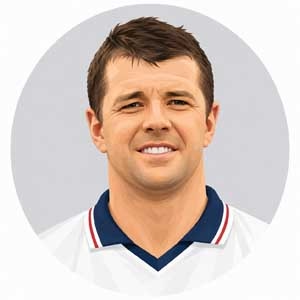
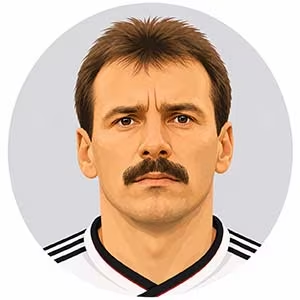
England - Centre-backPallister, Gary
A British record £2.3 million fee in 1989 drew immense skepticism when Alex Ferguson secured Gary Andrew Pallister from Middlesbrough, but the towering defender soon formed the foundational rock upon which Manchester United built their modern dynasty. Paired alongside Steve Bruce to create the legendary Dolly and Daisy central defensive tandem, Pally combined a commanding six-foot-four frame with surprising recovery pace, reading ground threats and aerial balls with equal authority. His recovery slide-tackles inside the eighteen-yard box were clean and decisive, while his long-range distribution with his left foot allowed United to launch rapid transitions. Between 1989 and 1998, he anchored United to four Premier League titles, three FA Cups, the 1991 European Cup Winners' Cup, and the 1992 League Cup, earning the PFA Players' Player of the Year award in 1991–92. For England, across 22 caps, his international appearances were sporadic, caught in positional battles with Tony Adams, Des Walker, and Terry Butcher.
Nevertheless, Pallister’s physical framework became an agonizing liability over time. Throughout his prime, he battled chronic, debilitating lower-back issues that severely restricted his training regimens and occasionally left him stiff when forced into rapid lateral turns against low-center-of-gravity forwards. Furthermore, when isolated against agile, tricky dribblers outside the penalty box, his large turning circle could be exploited if he failed to make contact with his initial tackle.
Laid-back off the pitch yet resolute and composed on it, Pallister approached defending with an unhurried, unflappable calmness that balanced Bruce’s blood-and-guts aggression. He never panicked under heavy pressure: sweeping up loose balls inside his own six-yard box with casual ease and stepping out of defense with his head held high. On the pitch, his presence was imposing and quiet, rarely engaging in theatrical arguments and preferring to neutralize opposing strikers through impeccable positioning and physical reach. Inside the Old Trafford locker room, he was an immensely popular, easygoing figure who took Ferguson's tactical instructions in stride and absorbed high-stakes pressure without flinching. Match officials respected his honest, non-cynical approach to physical defending, cementing his legacy as one of the most elegant, quick, and formidable center-halves of the early Premier League era.