We use Google Analytics to understand how visitors use this site. Analytics cookies are only activated with your consent. For details, read our Privacy Policy.
Profile lensThe same player, read from a different angle.
Athletic81
Acceleration
98
Pace
93
Agility
91
Strength
68
Balance
74
Jumping
72
Stamina
77
Fitness
71
Technical80
Dribbling
87
Short Passing
76
Long Passing
81
Finishing
81
Shot Accuracy
75
Shot Power
76
Shooting Technique
81
Heading
66
Tackling
42
Crossing
83
Free Kick
65
Penalties
72
First Touch
85
Mental75
Composure
79
Aggression
85
Consistency
73
Creativity
85
Leadership
71
Work Rate
71
Tactical75
Vision
78
Off the Ball
83
Defensive Positioning
42
Teamwork
68
Anticipation
78
Marking
38
Player Traits
Attacking78
Crossing
83
Finishing
81
Heading Accuracy
66
Shot Accuracy
75
Off the Ball
83
Technique79
Dribbling
87
Free Kick
65
Short Passing
76
Long Passing
81
First Touch
85
Shot Technique
81
Movement89
Acceleration
98
Pace
93
Agility
91
Balance
74
Physicality73
Shot Power
76
Jumping
72
Stamina
77
Strength
68
Fitness
71
Defending41
Marking
38
Tackling
42
Def. Positioning
42
Mentality & Game Reading76
Aggression
85
Composure
79
Penalties
72
Vision
78
Leadership
71
Work Rate
71
Teamwork
68
Anticipation
78
Consistency
73
Creativity
85
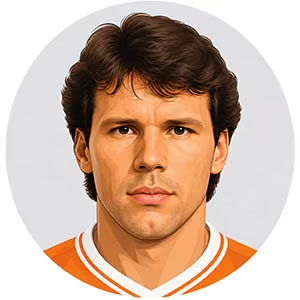
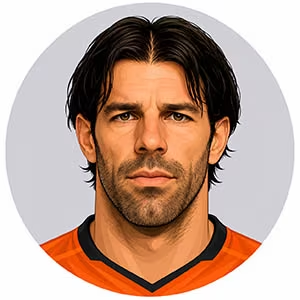
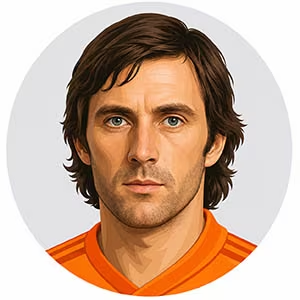
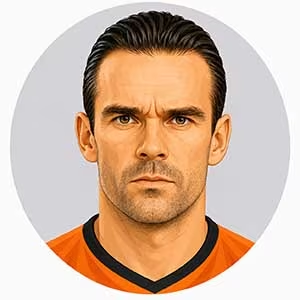
Netherlands - Right WingerOvermars, Marc
Unleashing a devastating burst of acceleration that made him one of the most feared transition wingers of the 1990s, Marc Overmars turned straight-line speed, low-center-of-gravity balance, and ambidextrous directness into an exact attacking science. Developed at Go Ahead Eagles and Willem II before flourishing under Louis van Gaal at Ajax, Overmars earned the moniker Roadrunner due to his explosive first step and ability to reach top velocity with the ball glued to his feet. Tactically versatile, he could hug the left touchline to cut inside onto his right foot or operate on the right flank to beat full-backs on the outside and deliver crisp, low pull-backs. A foundational pillar of Ajax's 1995 Champions League-winning side and three consecutive Eredivisie titles, he made a seismic impact in England under Arsène Wenger at Arsenal, scoring crucial, ice-cold goals—most notably the winner at Old Trafford and the opening strike in the 1998 FA Cup final—to seal the historic 1997–98 Double. A high-profile move to Barcelona in 2000 confirmed his elite status, though persistent cartilage damage in his knees steadily eroded his explosive edge. Across 86 caps and 17 goals for the Netherlands, he featured in two World Cups (1994, 1998) and two European Championships (2000, 2004), consistently providing the Dutch attack with genuine vertical penetration. Mentally and emotionally, Overmars was a quiet, fiercely driven pragmatist who possessed an understated self-belief and a completely no-nonsense attitude toward his craft. He avoided flashiness for its own sake; every body feint, step-over, and change of pace was executed with the singular purpose of attacking space and punishing defensive mismatches. His character was severely tested in late 1995 when a major cruciate ligament tear threatened his career, yet he handled the grueling rehabilitation with quiet stoicism, returning to the pitch without losing his willingness to take on defenders at maximum speed. In the locker room, he was a reserved, low-maintenance, and highly professional figure—never demanding the spotlight, getting along effortlessly with teammates across different cultures, and focusing purely on the tactical job at hand. In high-leverage knockout matches, his composure was sharp and uncluttered; when put through on goal in one-on-one scenarios against charging keepers, he rarely panicked, slotting finishes with clinical, low-trajectory precision. Toward referees and aggressive full-backs who frequently hacked at his ankles to halt counter-attacks, Overmars maintained a businesslike demeanor: rarely engaging in confrontations or theatrical simulation, picking himself up, and running at his marker with the exact same relentless aggression on the very next play.


 All Time AjaxClub