We use Google Analytics to understand how visitors use this site. Analytics cookies are only activated with your consent. For details, read our Privacy Policy.
Profile lensThe same player, read from a different angle.
Athletic83
Acceleration
85
Pace
82
Agility
81
Strength
71
Balance
82
Jumping
85
Stamina
89
Fitness
87
Technical77
Dribbling
75
Short Passing
75
Long Passing
80
Finishing
70
Shot Accuracy
70
Shot Power
82
Shooting Technique
71
Heading
78
Tackling
79
Crossing
78
Free Kick
64
Penalties
68
First Touch
78
Mental78
Composure
78
Aggression
85
Consistency
80
Creativity
71
Leadership
70
Work Rate
87
Tactical78
Vision
78
Off the Ball
71
Defensive Positioning
76
Teamwork
84
Anticipation
80
Marking
80
Attacking73
Crossing
78
Finishing
70
Heading Accuracy
78
Shot Accuracy
70
Off the Ball
71
Technique74
Dribbling
75
Free Kick
64
Short Passing
75
Long Passing
80
First Touch
78
Shot Technique
71
Movement83
Acceleration
85
Pace
82
Agility
81
Balance
82
Physicality83
Shot Power
82
Jumping
85
Stamina
89
Strength
71
Fitness
87
Defending78
Marking
80
Tackling
79
Def. Positioning
76
Mentality & Game Reading78
Aggression
85
Composure
78
Penalties
68
Vision
78
Leadership
70
Work Rate
87
Teamwork
84
Anticipation
80
Consistency
80
Creativity
71
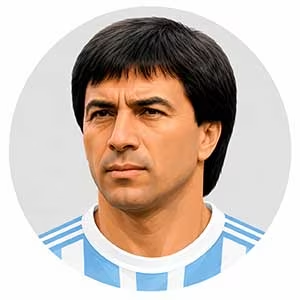
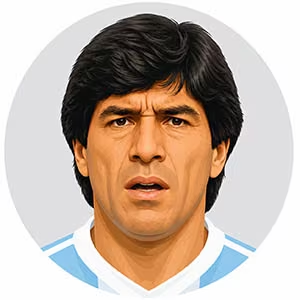
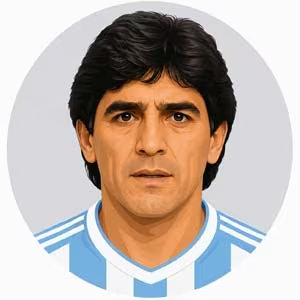
Argentina - Right BackOlarticoechea, Julio
The searing midday heat of the Estadio Azteca on June 22, 1986, witnessed one of the most miraculous defensive clearances in World Cup lore when a versatile utility player from Saladillo soared backward to clear Gary Lineker’s goal-bound header off the goal line with his ear, preserving Argentina’s 2–1 quarter-final lead against England. Julio Jorge Olarticoechea—affectionately known as El Vasco—was Carlos Bilardo’s ultimate tactical wildcard, capable of slotting in seamlessly as a left wing-back, central holding midfielder, or orthodox full-back without the slightest drop in intensity. Armed with limitless cardiovascular stamina, clean tackling mechanics, and sharp positional reading, Olarticoechea provided the defensive security and dynamic running that stabilized Argentina’s 3-5-2 system during their global triumph in Mexico '86. Across a distinguished club career spanning over 600 matches, he achieved the rare distinction of playing for all four traditional Buenos Aires heavyweights: Racing Club, River Plate (winning the 1981 Nacional), Boca Juniors, and Argentinos Juniors, alongside a stint in France with FC Nantes. For Argentina, across 32 caps, he was a key figure in three consecutive World Cups (1982, 1986, 1990), starting the 1986 final against West Germany and playing a pivotal role in the march to the 1990 final in Rome.
Yet Olarticoechea’s game was rooted firmly in energetic utility rather than technical virtuosity. He was not a flashy dribbler who could eliminate markers in tight spaces, and his crossing from deep wide positions was functional and direct rather than curling and creative. When tasked with being the primary playmaker during phases of slow, structured build-up against compact defensive blocks, his contribution was limited to safe, short-range recycling.
Unpretentious, fiercely loyal, and carrying an unshakeable blue-collar work ethic, Olarticoechea was the dream teammate who embraced the dirty work without demanding the spotlight. He never complained about tactical repositioning, slipping from the left flank to the midfield engine room with absolute focus and commitment. On the pitch, his body language was all kinetic urgency and relentless determination: chasing loose balls across thirty yards of open turf, throwing his body into flying boots, and staying on his feet to launch quick counters. Inside the Argentine dressing room, he was a universally beloved, grounding personality whose dry wit and complete selflessness made him a vital locker-room glue guy during the intense pressure cooker of Bilardo's campaigns, cementing an enduring legacy as one of the most reliable and versatile soldiers in Argentine football history.