We use Google Analytics to understand how visitors use this site. Analytics cookies are only activated with your consent. For details, read our Privacy Policy.
Profile lensThe same player, read from a different angle.
Athletic79
Acceleration
85
Pace
79
Agility
86
Strength
68
Balance
77
Jumping
82
Stamina
80
Fitness
78
Technical84
Dribbling
85
Short Passing
77
Long Passing
76
Finishing
91
Shot Accuracy
90
Shot Power
77
Shooting Technique
88
Heading
85
Tackling
37
Crossing
70
Free Kick
71
Penalties
84
First Touch
83
Mental79
Composure
84
Aggression
78
Consistency
77
Creativity
81
Leadership
77
Work Rate
77
Tactical84
Vision
75
Off the Ball
91
Defensive Positioning
37
Teamwork
75
Anticipation
93
Marking
38
Player Traits
Attacking85
Crossing
70
Finishing
91
Heading Accuracy
85
Shot Accuracy
90
Off the Ball
91
Technique80
Dribbling
85
Free Kick
71
Short Passing
77
Long Passing
76
First Touch
83
Shot Technique
88
Movement82
Acceleration
85
Pace
79
Agility
86
Balance
77
Physicality77
Shot Power
77
Jumping
82
Stamina
80
Strength
68
Fitness
78
Defending37
Marking
38
Tackling
37
Def. Positioning
37
Mentality & Game Reading80
Aggression
78
Composure
84
Penalties
84
Vision
75
Leadership
77
Work Rate
77
Teamwork
75
Anticipation
93
Consistency
77
Creativity
81
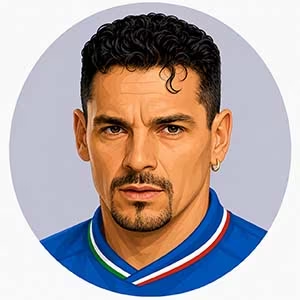
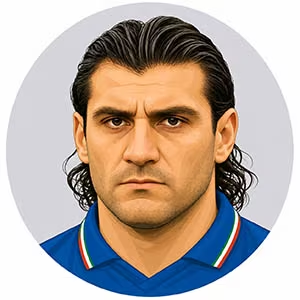
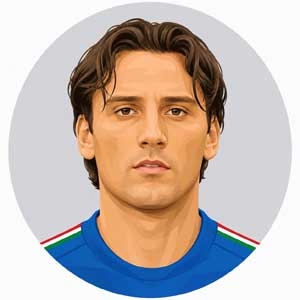
Italy - StrikerMontella, Vincenzo
Arms spread wide like a banking aircraft soaring across the Curva Sud became the inescapable weekend trademark of a diminutive marksman from Castello di Cisterna. Vincenzo Montella—immortalized across Italian football as L'Aeroplanino—was one of the most lethal, instinctive penalty-box predators in modern Serie A history, turning split-second reactions and soft, scooped finishes into pure art.
Operating as a classic second striker or central poacher, Montella made a mockery of towering defenders through low-center-of-gravity agility, sharp blind-side peeling runs, and an uncanny ability to strike volleys on the half-turn off his left boot. After exploding at Empoli, Genoa, and Sampdoria, he joined Fabio Capello’s AS Roma in 1999, forging an iconic attacking trident alongside Francesco Totti and Gabriel Batistuta to capture the historic 2000–01 Scudetto and the 2001 Supercoppa Italiana. His legendary apex remains the March 2002 Derby della Capitale, where he dismantled Lazio with a historic four-goal haul in a 5–1 rout. Across 102 goals in 258 matches for Roma, he proved an indispensable weapon, later adding a loan spell at Fulham. For Italy, across 20 caps and three goals, he featured at Euro 2000 and the 2002 World Cup, providing the crucial assist for Totti's equalizer in the Euro 2000 final against France.
His specialized skill set, however, lived almost exclusively inside the final eighteen yards. Montella lacked the physical frame to win isolated aerial battles against bruising stoppers, and when asked to lead the line as a lone target man tasked with heavy back-to-goal hold-up play against high-pressing backlines, his impact diminished. Furthermore, a series of chronic ankle and back problems in the mid-2000s steadily eroded his sudden initial burst of acceleration over the first five yards.
Fiercely proud, competitive, and carrying the mischievous swagger of a Neapolitan street kid, Montella demanded his share of the spotlight, never hiding his frustration when left on the bench by authoritarian coaches like Capello. On the pitch, his presence was pure concentrated anticipation: lingering quietly between central defenders before darting onto a loose ball with predatory finality. Inside the Trigoria locker room, he was a respected, sharp-witted figure who delivered in high-voltage derbies when the pressure was suffocating, cementing an enduring legacy as one of the most clinical, stylish finishers Italian football has produced.


 All Time RomaClub