We use Google Analytics to understand how visitors use this site. Analytics cookies are only activated with your consent. For details, read our Privacy Policy.
Profile lensThe same player, read from a different angle.
Athletic84
Acceleration
86
Pace
84
Agility
82
Strength
80
Balance
77
Jumping
82
Stamina
92
Fitness
86
Technical83
Dribbling
82
Short Passing
85
Long Passing
83
Finishing
83
Shot Accuracy
82
Shot Power
83
Shooting Technique
80
Heading
79
Tackling
71
Crossing
79
Free Kick
74
Penalties
74
First Touch
84
Mental86
Composure
78
Aggression
88
Consistency
90
Creativity
74
Leadership
87
Work Rate
93
Tactical86
Vision
85
Off the Ball
84
Defensive Positioning
66
Teamwork
94
Anticipation
88
Marking
63
Player Traits
Attacking81
Crossing
79
Finishing
83
Heading Accuracy
79
Shot Accuracy
82
Off the Ball
84
Technique81
Dribbling
82
Free Kick
74
Short Passing
85
Long Passing
83
First Touch
84
Shot Technique
80
Movement82
Acceleration
86
Pace
84
Agility
82
Balance
77
Physicality85
Shot Power
83
Jumping
82
Stamina
92
Strength
80
Fitness
86
Defending67
Marking
63
Tackling
71
Def. Positioning
66
Mentality & Game Reading85
Aggression
88
Composure
78
Penalties
74
Vision
85
Leadership
87
Work Rate
93
Teamwork
94
Anticipation
88
Consistency
90
Creativity
74
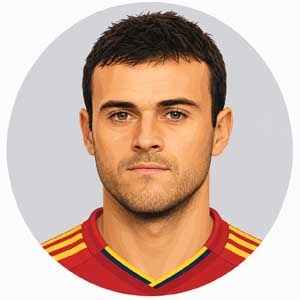
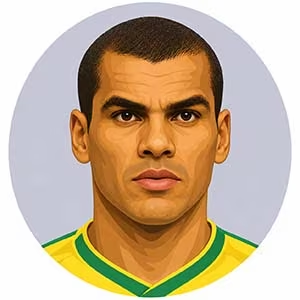
Spain - Centre MidfielderEnrique, Luis
A brawl broke out at the Camp Nou during a Clásico when Zinedine Zidane, furious after Carles Puyol's tackle, struck out and then screamed into the face of the Barcelona player who confronted him — Luis Enrique, who refused to back down from a superstar considerably more decorated than himself and walked away having earned the confrontation rather than a card. It was a minor incident in a long, trophy-filled career, but it captures something essential: Luis Enrique built his entire footballing identity on refusing to be intimidated by anyone, including opponents the rest of the sport treated with automatic deference.
Born in Gijón in 1970, Luis Enrique Martínez García was a versatile, technically capable attacking player comfortable as a midfielder, winger or forward, valued for stamina, vertical running and a tireless work rate as much as for his finishing. He came through Sporting Gijón before joining Real Madrid in 1991, where he spent five seasons and won two La Liga titles and a Copa del Rey — years he later said he barely recognized himself in, given what followed. In 1996 he crossed one of football's most bitter rivalries directly, signing for Barcelona as a free agent and becoming, within a few seasons, one of the most beloved captains in the club's history, a transition few players attempt and even fewer complete successfully. He played eight seasons at Camp Nou, retiring in 2004 with over 500 official appearances and more than 100 goals across his career, and for Spain he won 62 caps between 1991 and 2002, playing at multiple World Cups and European Championships.
His limitations were relatively modest for a player of his standing, though real: he was not the most explosive or technically extravagant attacker of his generation, relying instead on relentless movement, intelligent positioning and sheer competitive will to make himself effective across several attacking roles rather than dominating any single one through pure talent. That same intensity occasionally spilled into confrontations that added little tactical value, and his combativeness against Real Madrid specifically, given his own history there, made him a lightning rod for hostility from his former club's supporters for the remainder of his career.
Temperamentally he was defined, with almost total consistency across every account of his playing days, by fierce competitiveness paired with an unusually calm baseline temperament — a player who wanted to win at almost anything and channeled that need productively rather than erratically. He was a natural leader entrusted with the captaincy at Barcelona, respected by teammates for the intensity of his preparation and his refusal to give up in matches that looked lost, frequently scoring or creating decisive goals from positions that suggested the moment had passed. His years at Real Madrid produced what Spanish media described as guerrilla-style conduct on the pitch, a reputation for combativeness that made him unusually reviled among Barcelona's own supporters before he ever joined the club — and which he then redirected entirely in Barcelona's favor once he switched sides, adapting his identity completely rather than softening it. Away from specific flashpoints he was consistently described as encouraging toward teammates, hardworking without exception, and central to both dressing rooms he captained. Fiercely competitive, adaptable enough to switch complete institutional loyalty without ever losing his core intensity, and respected by rivals and teammates alike for never once appearing to accept defeat as final, Luis Enrique built a playing career on a will to win that later defined his considerably more decorated career on the touchline.