We use Google Analytics to understand how visitors use this site. Analytics cookies are only activated with your consent. For details, read our Privacy Policy.
Profile lensThe same player, read from a different angle.
Athletic79
Acceleration
76
Pace
77
Agility
78
Strength
82
Balance
79
Jumping
77
Stamina
86
Fitness
78
Technical86
Dribbling
87
Short Passing
92
Long Passing
90
Finishing
76
Shot Accuracy
74
Shot Power
85
Shooting Technique
82
Heading
77
Tackling
68
Crossing
87
Free Kick
75
Penalties
76
First Touch
89
Mental80
Composure
85
Aggression
75
Consistency
76
Creativity
87
Leadership
81
Work Rate
74
Tactical82
Vision
88
Off the Ball
79
Defensive Positioning
66
Teamwork
85
Anticipation
82
Marking
52
Player Traits
Attacking79
Crossing
87
Finishing
76
Heading Accuracy
77
Shot Accuracy
74
Off the Ball
79
Technique86
Dribbling
87
Free Kick
75
Short Passing
92
Long Passing
90
First Touch
89
Shot Technique
82
Movement78
Acceleration
76
Pace
77
Agility
78
Balance
79
Physicality82
Shot Power
85
Jumping
77
Stamina
86
Strength
82
Fitness
78
Defending62
Marking
52
Tackling
68
Def. Positioning
66
Mentality & Game Reading81
Aggression
75
Composure
85
Penalties
76
Vision
88
Leadership
81
Work Rate
74
Teamwork
85
Anticipation
82
Consistency
76
Creativity
87
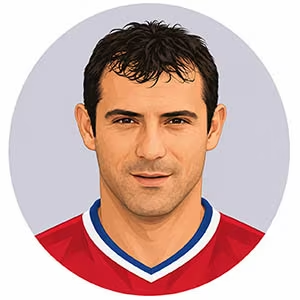
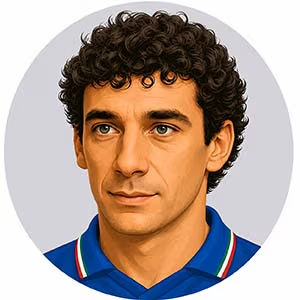
Serbia - Centre MidfielderJugović, Vladimir
He walked up to take the decisive penalty in the 1996 Champions League final with something close to a smile on his face — Edwin van der Sar waiting in the Ajax goal, the whole tournament riding on the shot, and Vladimir Jugović looking, by every account of that night, genuinely serene. He scored, and became, in the words of Juventus fans who still discuss it decades later, the man defined by that single smile rather than by anything else across a career that had already won him a European Cup once before, with a different club, in a different country that no longer existed by the time he lifted the second one.
Born in the village of Milutovac, near Trstenik, in 1969, Jugović was a technically complete midfielder — elegant on the ball, cool in decision-making, and gifted with a genuine eye for goal from midfield positions, qualities that made him equally dangerous recovering possession and arriving late into the box. He broke through at Red Star Belgrade, and at just 21 was central to the club's run to the 1991 European Cup, scoring twice and winning man of the match in the Intercontinental Cup final against Colo-Colo that followed months later. Sampdoria brought him to Italy in 1992, where three productive seasons — including a Coppa Italia and a memorable brace against Arsenal in a European semifinal, followed almost immediately by a missed penalty that ended the tie — earned him a move to Marcello Lippi's Juventus in 1995. There, in a midfield already containing Deschamps, Conte and Paulo Sousa, he carved out his own space and delivered the decisive Champions League penalty against Ajax before adding a Scudetto and a second Intercontinental Cup the following year. Later spells at Lazio, Atlético Madrid, Inter and Monaco closed out a career remarkable for its range: he remains the only player to have appeared in all four of Italy's major derbies, having represented Sampdoria, Juventus, Lazio and Inter in turn. For Yugoslavia, and later Serbia and Montenegro, he won 41 caps, playing every match of the 1998 World Cup, though his international prime coincided almost exactly with the country's suspension from international football during the wars of the 1990s — a disruption that cost him what should have been the peak years of a golden generation's international window.
His limitations were physical rather than technical, particularly later in his career: a serious muscular injury during a brief, difficult spell at Atlético Madrid under Arrigo Sacchi took time to recover from, and he subsequently had to fight to establish himself at Inter rather than being handed a starting role his earlier career would have suggested. His creativity depended on space to receive and turn, and against physically aggressive midfields that denied him time, his influence could be considerably reduced.
Temperamentally he was defined by a genuine composure under maximum pressure that both teammates and his own retrospective account confirm was not performed. He described feeling calm rather than tense before the Ajax penalty, and years later admitted his only real regret about that night was leaving the celebration almost immediately afterward to join his national team for international duty rather than staying to enjoy the moment with his Juventus teammates — a decision that speaks to a deeply internalized sense of obligation rather than any lack of feeling. He is frequently described in retrospectives as a quiet champion, overshadowed within his own celebrated Red Star generation by more flamboyant teammates like Mihajlović, Prosinečki and Savićević despite contributions of comparable importance, a pattern that persisted somewhat into his Italian career as well. He rarely generated controversy, moved across four historically hostile Italian clubs without ever becoming a lightning rod for any of their rivalries, and was specifically sought out by managers — Lippi at Juventus, Eriksson at Lazio, Sacchi at Atlético — who valued his reliability and technical range highly enough to pursue him personally. Elegant, understated, and calm at precisely the moments that undo less composed players, Jugović built a genuinely exceptional career that history has, by his own admission, remembered mostly for one smiling penalty.



 All Time SerbiaNT