We use Google Analytics to understand how visitors use this site. Analytics cookies are only activated with your consent. For details, read our Privacy Policy.
Profile lensThe same player, read from a different angle.
Athletic78
Acceleration
86
Pace
82
Agility
87
Strength
70
Balance
82
Jumping
66
Stamina
77
Fitness
76
Technical91
Dribbling
94
Short Passing
89
Long Passing
92
Finishing
85
Shot Accuracy
81
Shot Power
84
Shooting Technique
93
Heading
66
Tackling
38
Crossing
89
Free Kick
91
Penalties
90
First Touch
96
Mental80
Composure
87
Aggression
74
Consistency
77
Creativity
96
Leadership
74
Work Rate
74
Tactical84
Vision
88
Off the Ball
85
Defensive Positioning
43
Teamwork
84
Anticipation
77
Marking
38
Player Traits
Attacking81
Crossing
89
Finishing
85
Heading Accuracy
66
Shot Accuracy
81
Off the Ball
85
Technique93
Dribbling
94
Free Kick
91
Short Passing
89
Long Passing
92
First Touch
96
Shot Technique
93
Movement84
Acceleration
86
Pace
82
Agility
87
Balance
82
Physicality75
Shot Power
84
Jumping
66
Stamina
77
Strength
70
Fitness
76
Defending40
Marking
38
Tackling
38
Def. Positioning
43
Mentality & Game Reading82
Aggression
74
Composure
87
Penalties
90
Vision
88
Leadership
74
Work Rate
74
Teamwork
84
Anticipation
77
Consistency
77
Creativity
96
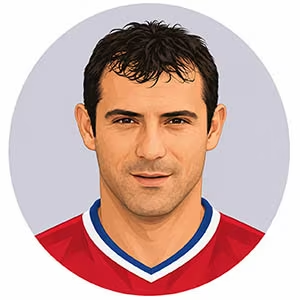
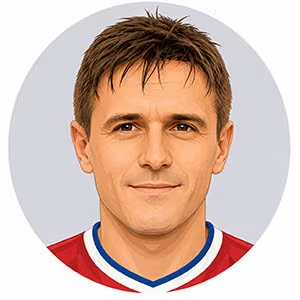
Serbia - Attacking MidfielderStojković, Dragan
Verona, June 1990. Yugoslavia against Spain in the last sixteen, extra time approaching, and a free-kick just outside the box. Dragan Stojković had already scored once that evening. He stood over the second one, looked up, and instead of striking it he clipped it with the outside of his right foot around a wall that had positioned itself for power, the ball curving late and dying inside the far post. Two goals in a World Cup knockout tie, both of them made rather than taken. He was twenty-five, the country he was playing for had eighteen months left to exist, and this was as close as the world would ever come to seeing him whole.
Born in Niš in 1965 and known everywhere as Piksi, Stojković was the finest Yugoslav footballer of his generation and one of the most technically complete number tens Europe produced in the 1980s. He was not tall or physically imposing, and his game rested entirely on touch, balance and vision: a first touch that killed any ball into a controllable position, dribbling in tight spaces performed at walking pace, and a passing imagination that specialised in the ball nobody in the stadium had identified. He struck free-kicks with either power or curl and could finish from distance. He emerged at Radnički Niš, then joined Red Star Belgrade in 1986, winning two Yugoslav championships and the 1990 Cup while becoming the emblem of a golden generation. A transfer to Marseille that summer should have opened the greatest chapter and instead began the ruin: serious knee injuries arrived almost immediately, a loan to Hellas Verona followed, and although he was at the club when Marseille won the 1993 Champions League, he was left out of the final in Munich. He rebuilt himself in Japan, joining Nagoya Grampus Eight in 1994, where he spent seven seasons, played under Arsène Wenger, won the J.League MVP award in 1995 and the Emperor's Cup, and became one of the most revered foreign players in the country's history. For Yugoslavia he collected 84 caps and 15 goals, captained the side at the 1990 and 1998 World Cups, and missed the entire 1992 European Championship — a tournament his team were favoured to win — because the country was excluded under international sanctions.
His fragility was chronic and defining. After 1990 Stojković never again strung together a fully fit season in Europe, and the knee damage removed the acceleration that had made his close control lethal rather than merely elegant. He contributed almost nothing defensively, was easily dispossessed by physically aggressive markers who denied him time, and struggled in leagues that prioritised intensity over rhythm. Against low blocks that refused to engage him, his influence could drain into sideways possession without penetration.
His temperament, by contrast, was unusually light. Stojković played with visible enjoyment, joking with opponents and referees, and led not by volume or intimidation but by demanding the ball in the moments when others were hiding from it — he took the free-kicks, the penalties, and the responsibility for a shootout against Argentina in 1990 in which he missed and then absorbed the consequences publicly. He argued rarely, simulated almost never, and responded to physical treatment with a raised eyebrow rather than retaliation, which made him easy to foul and difficult to provoke. When matches turned against him he could drift and sulk rather than fight, and his form dipped noticeably in environments where he felt undervalued, as it did in Marseille. What sustained him was adaptability of a kind few stars possess: arriving in Japan at twenty-nine as a wounded European, he learned the language, immersed himself completely, and turned a commercial exile into the most beloved period of his life. Away from football he was cultured, charming, sociable and entirely free of scandal, a man who carried the collapse of his country with dignity and never once used it as an excuse.


 All Time SerbiaNT