We use Google Analytics to understand how visitors use this site. Analytics cookies are only activated with your consent. For details, read our Privacy Policy.
Profile lensThe same player, read from a different angle.
Athletic81
Acceleration
77
Pace
76
Agility
74
Strength
83
Balance
82
Jumping
87
Stamina
86
Fitness
84
Technical78
Dribbling
68
Short Passing
74
Long Passing
81
Finishing
62
Shot Accuracy
64
Shot Power
83
Shooting Technique
69
Heading
85
Tackling
86
Crossing
79
Free Kick
76
Penalties
70
First Touch
75
Mental83
Composure
78
Aggression
88
Consistency
85
Creativity
66
Leadership
86
Work Rate
86
Tactical82
Vision
73
Off the Ball
66
Defensive Positioning
85
Teamwork
81
Anticipation
85
Marking
86
Player Traits
Attacking71
Crossing
79
Finishing
62
Heading Accuracy
85
Shot Accuracy
64
Off the Ball
66
Technique74
Dribbling
68
Free Kick
76
Short Passing
74
Long Passing
81
First Touch
75
Shot Technique
69
Movement77
Acceleration
77
Pace
76
Agility
74
Balance
82
Physicality85
Shot Power
83
Jumping
87
Stamina
86
Strength
83
Fitness
84
Defending86
Marking
86
Tackling
86
Def. Positioning
85
Mentality & Game Reading80
Aggression
88
Composure
78
Penalties
70
Vision
73
Leadership
86
Work Rate
86
Teamwork
81
Anticipation
85
Consistency
85
Creativity
66
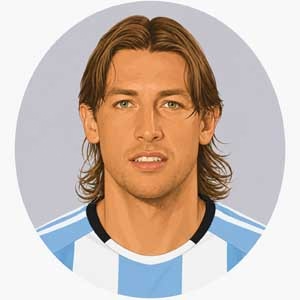
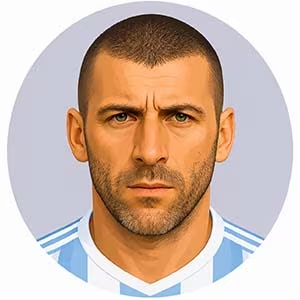
Argentina - Centre-backHeinze, Gabriel
A blood-stained bandage wrapped tightly around his forehead while snarling into the face of a towering Premier League forward in the driving rain of Old Trafford provided the definitive portrait of an enforcer from Crespo who treated defensive duels as an existential blood sport. Gabriel Iván Heinze—immortalized across South America and Europe as El Gringo—was the ultimate uncompromising, gladiatorial left-back and central stopper: a defensive fanatic whose game was forged in terrifying physical commitment, relentless man-marking hostility, and an unshakeable refusal to take a backward step.
Heinze was an old-school defensive enforcer who turned his flank into an impassable, high-friction bottleneck. Standing five-foot-ten with a thick-set, muscular build, he combined an explosive vertical spring with textbook slide-tackling mechanics, specializing in shutting down dynamic wingers by staying aggressively tight to their backs, suffocating their turning radius, and winning second balls with brute physical authority. Rising through Newell's Old Boys and establishing his European pedigree at Real Valladolid and Paris Saint-Germain—where he won the 2003–04 Coupe de France and became a cult hero at the Parc des Princes—he moved to Manchester United in 2004 for £6.9 million. In his debut campaign, his fearless defending instantly won over the Stretford End, earning him the Sir Matt Busby Player of the Year award before lifting the 2005–06 League Cup and the 2006–07 Premier League title. He later crossed continental divides with remarkable silverware success, winning the 2007–08 La Liga title with Real Madrid and the 2009–10 Ligue 1 championship with Didier Deschamps’ Olympique de Marseille, before concluding his playing days with Roma and a romantic title triumph back home at Newell's. For Argentina, across 72 caps and three goals, he was a key figure under Marcelo Bielsa and Diego Maradona, capturing the Olympic Gold Medal in Athens 2004, reaching two Copa América finals (2004, 2007), and starring across two World Cups (2006 and 2010, famously scoring the diving-header winner against Nigeria in Johannesburg).
That violent, combat-heavy style, however, carried stark technical and structural limitations. Heinze was a defense-first hybrid rather than a modern, progressive overlapping wing-back; his distribution under pressure was purely functional, his crossing was often hurried, and he offered virtually zero refined 1v1 dribbling when his side needed to unpick compact defensive blocks. Furthermore, his hyper-aggressive, front-foot tackling instincts meant he was prone to picking up yellow cards, occasionally diving into high-risk slide challenges that left space behind him if an elusive, low-gravity winger managed to slip his initial contact. A devastating anterior cruciate ligament injury in September 2005 also permanently took the sharpest edge off his recovery speed, making him transition more frequently into a central defensive stopper later in his career.
Fiercely proud, stubborn, and governed by an unbending code of personal honor, Heinze was an intimidating, iron-willed locker room presence who feared absolutely no one—neither opposing forwards nor legendary managers. His uncompromising temperament became legendary at Manchester United, where a brutal physical dressing-room altercation with Roy Keane earned the captain's immediate respect, while his later, controversial demand to transfer directly to arch-rivals Liverpool in 2007 showcased an unyielding independence that permanently fractured his relationship with Sir Alex Ferguson. On the pitch, his body language was all coiled, kinetic fury: staring down approaching attackers with wild intensity, throwing his entire body into flying boots without an ounce of self-preservation, and barking defensive commands with raw, primal aggression. Inside the dressing rooms of Rosario, Paris, Manchester, Madrid, and the Argentine national team, he was an adored, intensely loyal gladiator whose immense courage, competitive rage, and fearless leadership cemented an immortal legacy as one of the fiercest defensive warriors in modern Argentine football.