We use Google Analytics to understand how visitors use this site. Analytics cookies are only activated with your consent. For details, read our Privacy Policy.
Profile lensThe same player, read from a different angle.
Athletic80
Acceleration
75
Pace
78
Agility
72
Strength
84
Balance
82
Jumping
85
Stamina
82
Fitness
79
Technical75
Dribbling
69
Short Passing
73
Long Passing
70
Finishing
50
Shot Accuracy
54
Shot Power
74
Shooting Technique
51
Heading
84
Tackling
86
Crossing
56
Free Kick
60
Penalties
59
First Touch
72
Mental81
Composure
76
Aggression
90
Consistency
85
Creativity
60
Leadership
85
Work Rate
86
Tactical81
Vision
66
Off the Ball
55
Defensive Positioning
88
Teamwork
76
Anticipation
85
Marking
90
Player Traits
Attacking60
Crossing
56
Finishing
50
Heading Accuracy
84
Shot Accuracy
54
Off the Ball
55
Technique66
Dribbling
69
Free Kick
60
Short Passing
73
Long Passing
70
First Touch
72
Shot Technique
51
Movement77
Acceleration
75
Pace
78
Agility
72
Balance
82
Physicality81
Shot Power
74
Jumping
85
Stamina
82
Strength
84
Fitness
79
Defending88
Marking
90
Tackling
86
Def. Positioning
88
Mentality & Game Reading77
Aggression
90
Composure
76
Penalties
59
Vision
66
Leadership
85
Work Rate
86
Teamwork
76
Anticipation
85
Consistency
85
Creativity
60
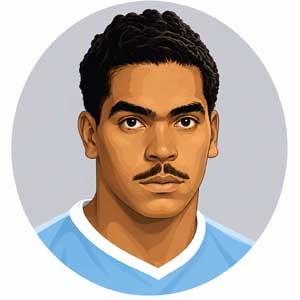
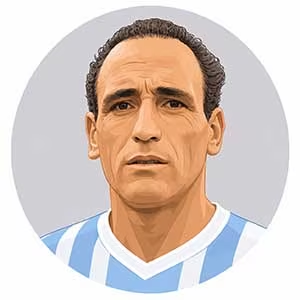
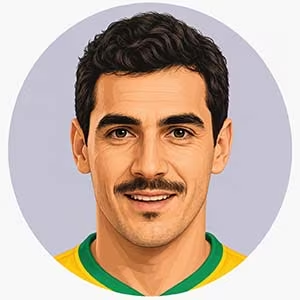
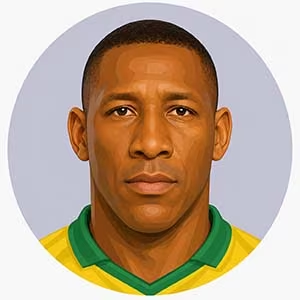
Uruguay - Centre-backGonzález, Matías
Matías González was the granite cornerstone of the legendary Celeste defense that silenced two hundred thousand roaring fans in Rio de Janeiro on July 16, 1950, securing the historic Maracanazo World Cup triumph over Brazil. Known affectionately as El León del Cerro (The Lion of the Hill), González was the quintessential classical South American center-back: an unyielding, rugged stopper who combined relentless physical bravery, formidable aerial dominance, and sharp positional anticipation to turn Uruguay's defensive third into an impenetrable battleground.
Operating as the right-sided central defender alongside Eusebio Tejera in Juan López Fontana’s hybrid tactical setup, González specialized in high-friction man-marking and decisive penalty-box clearances. Standing with a sturdy, broad-shouldered frame and exceptional lower-body strength, he excelled at pinning opposing center-forwards, timing his slide tackles to dispossess attackers before they could turn toward goal, and repelling crosses with powerful, well-timed headers. A lifelong one-club titan for CA Cerro, he spent over a decade anchoring the club's backline between the late 1940s and late 1950s, elevating the modest Montevideo side into a respected domestic force. For Uruguay, across 33 official caps between 1949 and 1956, his international pinnacle arrived at the 1950 World Cup in Brazil, where he played every single minute of the tournament—most notably withstanding the relentless, suffocating pressure of Brazil’s attacking trio of Zizinho, Ademir, and Jair during the decisive match at the Maracanã—and later helped Uruguay lift the 1956 South American Championship (Copa América) on home soil.
That resolute, containment-heavy approach, however, belonged firmly to the pre-modern school of specialized stoppers. González was not a cultured, ball-playing defender who advanced into midfield to orchestrate build-up with delicate ground passing; his distribution under pressure was strictly direct, pragmatic, and designed to clear danger immediately to half-backs like Obdulio Varela and Víctor Rodríguez Andrade. When drawn away from the eighteen-yard box into wide, open channels against nimble, low-gravity wingers who changed direction with rapid agility, his recovery turn was deliberate rather than dynamic, leaving him reliant on aggressive body positioning to avoid being bypassed.
Psychologically, González was an unshakeable monument of garra charrúa, radiating quiet courage, total fearlessness, and absolute loyalty to the collective cause. He was completely immune to the intimidating noise of hostile arenas, absorbing immense attacking pressure without showing a flicker of panic or physical fatigue. He took immense pride in his blue-collar roots in the Villa del Cerro neighborhood, playing with a fierce, uncompromising determination that treated every defensive duel as a matter of civic honor. On the pitch, his body language was steady, vigilant, and imposing: standing tall in front of his goal line, barking concise defensive cues to his full-backs, and rising into aerial challenges with total disregard for personal safety. Inside the Cerro and Uruguayan dressing rooms, his quiet strength and warrior spirit commanded immense reverence—an adored, fearless pillar of the nation's greatest sporting triumph whose heroic resistance in 1950 cemented an immortal place in the pantheon of world football history.