We use Google Analytics to understand how visitors use this site. Analytics cookies are only activated with your consent. For details, read our Privacy Policy.
Profile lensThe same player, read from a different angle.
Athletic78
Acceleration
77
Pace
77
Agility
80
Strength
76
Balance
77
Jumping
74
Stamina
79
Fitness
81
Technical86
Dribbling
85
Short Passing
92
Long Passing
88
Finishing
81
Shot Accuracy
77
Shot Power
84
Shooting Technique
83
Heading
77
Tackling
52
Crossing
89
Free Kick
80
Penalties
88
First Touch
87
Mental80
Composure
91
Aggression
71
Consistency
77
Creativity
85
Leadership
70
Work Rate
75
Tactical85
Vision
88
Off the Ball
84
Defensive Positioning
55
Teamwork
86
Anticipation
80
Marking
47
Player Traits
Attacking82
Crossing
89
Finishing
81
Heading Accuracy
77
Shot Accuracy
77
Off the Ball
84
Technique86
Dribbling
85
Free Kick
80
Short Passing
92
Long Passing
88
First Touch
87
Shot Technique
83
Movement78
Acceleration
77
Pace
77
Agility
80
Balance
77
Physicality79
Shot Power
84
Jumping
74
Stamina
79
Strength
76
Fitness
81
Defending51
Marking
47
Tackling
52
Def. Positioning
55
Mentality & Game Reading81
Aggression
71
Composure
91
Penalties
88
Vision
88
Leadership
70
Work Rate
75
Teamwork
86
Anticipation
80
Consistency
77
Creativity
85
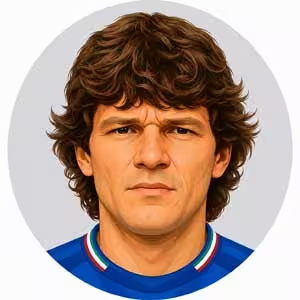
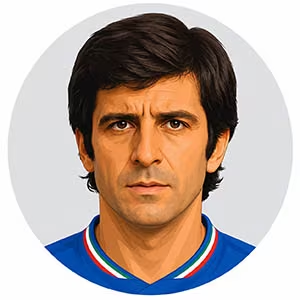
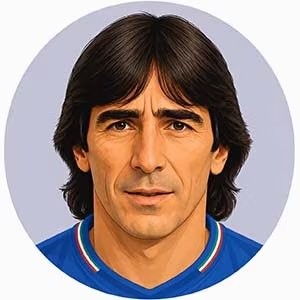
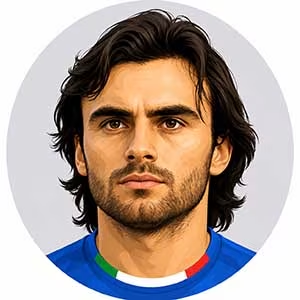
Italy - Attacking MidfielderGiannini, Giuseppe
Elegance in the half-turn, upright posture with chest puffed out, and a sweeping panoramic passing range earned Giuseppe Giannini the reverent moniker Il Principe (The Prince), establishing him as the definitive Roman midfield aristocrat of the late 1980s and early 1990s. Developed in the youth ranks of AS Roma before inheriting the midfield mantle from Paulo Roberto Falcão, Giannini spent fifteen seasons as the undisputed tactical orchestrator and long-time captain of the Giallorossi. Standing five-foot-ten with a smooth, gliding running style, he functioned as a classic central playmaker (regista-mezzala): possessing an immaculate first touch that absorbed incoming pressure, an innate ability to dictate match tempo with short-to-medium range distribution, and a lethal instinct for late, ghosting vertical runs into the eighteen-yard box to finish with clean half-volleys or headers. Across 437 official appearances for Roma, he lifted three Coppa Italia titles (1984, 1986, 1991) and captained the club to the two-legged 1991 UEFA Cup final against Inter Milan. For Italy, across 47 caps and six goals, he was the creative fulcrum of Azeglio Vicini’s Azzurri, anchoring the midfield at Euro 1988 and scoring the winning goal against the United States at the Stadio Olimpico during the Notti Magiche run to third place at Italia '90.
Yet Giannini’s aristocratic game carried glaring physical and mechanical vulnerabilities. His top-end sprinting speed was distinctly pedestrian, his lateral recovery pace left him exposed when opposition transitions bypassed him in central channels, and his lightweight frame struggled in high-friction, purely athletic midfield battles. Furthermore, when isolated without dynamic wide runners to stretch the pitch, his distribution could occasionally drift into slow, horizontal possession sequences that allowed opposing defensive blocks to reset with ease.
Proud, intensely passionate, and carrying the immense, crushing emotional weight of captaining his hometown club, Giannini lived every match as an existential chapter in Roman sporting history. He was not a detached tactician; his performance levels were deeply intertwined with the emotional atmosphere of the Stadio Olimpico, capable of producing transcendent, poetic masterclasses when lifted by the Curva Sud, but occasionally vulnerable to brooding frustration when whistles rained down during difficult club transitions. On the pitch, his leadership was regal and demanding; he directed traffic with sharp, authoritative hand gestures, holding his teammates to high technical standards while never hesitating to confront aggressive opponents who sought to disrupt his rhythm. Inside the Roma locker room, he was an untouchable patriarch and an essential bridge between eras, serving as the direct childhood idol and tactical mentor to a young Francesco Totti. Referees found him an articulate, constant presence who fiercely defended his teammates' interests, leaving an enduring legacy as one of the purest, most elegant, and emotionally resonant symbols of Italian midfield playmaking.


 All Time RomaClub