We use Google Analytics to understand how visitors use this site. Analytics cookies are only activated with your consent. For details, read our Privacy Policy.
Profile lensThe same player, read from a different angle.
Athletic78
Acceleration
87
Pace
79
Agility
91
Strength
66
Balance
80
Jumping
66
Stamina
78
Fitness
80
Technical89
Dribbling
93
Short Passing
91
Long Passing
86
Finishing
80
Shot Accuracy
80
Shot Power
74
Shooting Technique
89
Heading
66
Tackling
40
Crossing
85
Free Kick
74
Penalties
74
First Touch
95
Mental78
Composure
85
Aggression
66
Consistency
70
Creativity
93
Leadership
81
Work Rate
72
Tactical83
Vision
88
Off the Ball
85
Defensive Positioning
40
Teamwork
80
Anticipation
78
Marking
38
Player Traits
Attacking79
Crossing
85
Finishing
80
Heading Accuracy
66
Shot Accuracy
80
Off the Ball
85
Technique88
Dribbling
93
Free Kick
74
Short Passing
91
Long Passing
86
First Touch
95
Shot Technique
89
Movement84
Acceleration
87
Pace
79
Agility
91
Balance
80
Physicality73
Shot Power
74
Jumping
66
Stamina
78
Strength
66
Fitness
80
Defending39
Marking
38
Tackling
40
Def. Positioning
40
Mentality & Game Reading79
Aggression
66
Composure
85
Penalties
74
Vision
88
Leadership
81
Work Rate
72
Teamwork
80
Anticipation
78
Consistency
70
Creativity
93
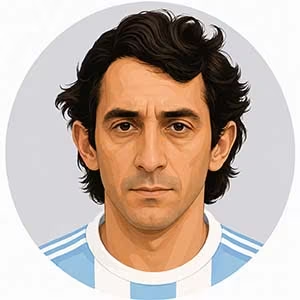
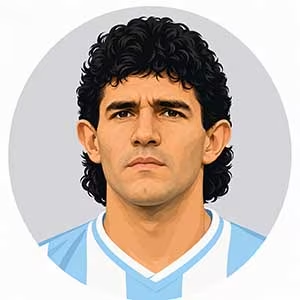
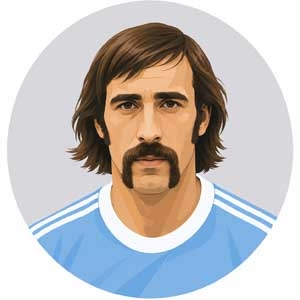
Argentina - Attacking MidfielderBochini, Ricardo
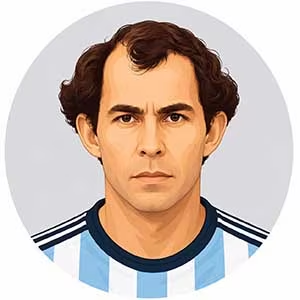
When an eight-year-old Diego Maradona stood on the wooden bleachers of the Doble Visera in the early 1970s, the fragile, balding playmaker orchestrating the pitch became his absolute, non-negotiable idol. Ricardo Enrique Bochini—revered across Avellaneda simply as El Bocha—spent nineteen seasons turning the through-ball into an exact science. Operating in the pocket as a pure enganche, he was the pioneer of the pase bochinesco: pausing for an excruciating split-second to freeze an entire defensive line (la pausa) before threading a reverse ball into the stride of an overlapping runner with millimeter precision. A one-club immortal, he made 714 appearances for Club Atlético Independiente between 1972 and 1991, capturing four Argentine Primera División titles, four Copas Libertadores (1973, 1974, 1975, 1984), and two Intercontinental Cups—famously scoring the delicate chipped winner against Dino Zoff’s Juventus in Rome in 1973. For Argentina, across 28 caps, his international career was criminally limited by the tactical preferences of César Luis Menotti and Carlos Bilardo, though he earned an iconic cameo in the 1986 World Cup semi-final against Belgium, where Maradona greeted him on the touchline with: "Come in, maestro, we’ve been waiting for you."
That cerebral vision, however, was housed inside an exceedingly slight, fragile physical frame. Bochini lacked explosive linear pace, offered virtually zero defensive resistance, and avoided rough aerial collisions at all costs. When matched against aggressive, man-marking hatchet men on heavy winter surfaces who fouled him before he could face forward, his influence could be smothered if his teammates failed to provide continuous movement around him.
Shy, soft-spoken, and completely uninterested in modern fame, Bochini was a footballing monk who came alive only with a leather ball at his feet. He never barked orders or threw tantrums, leading entirely through pure spatial geometry and cold-blooded composure under suffocating pressure. On the pitch, his body language was relaxed and unassuming: jogging with sloped shoulders before slicing open an opponent with a flick of his right ankle. Inside the Independiente locker room, his word was gospel; generations of forwards knew that if they made the run, El Bocha would place the ball onto their laces, leaving behind an immortal legacy as the purest, most romantic playmaker in Argentine history.