We use Google Analytics to understand how visitors use this site. Analytics cookies are only activated with your consent. For details, read our Privacy Policy.
Profile lensThe same player, read from a different angle.
Athletic80
Acceleration
91
Pace
87
Agility
88
Strength
70
Balance
75
Jumping
72
Stamina
78
Fitness
80
Technical83
Dribbling
91
Short Passing
81
Long Passing
86
Finishing
82
Shot Accuracy
75
Shot Power
81
Shooting Technique
83
Heading
68
Tackling
33
Crossing
81
Free Kick
66
Penalties
71
First Touch
87
Mental75
Composure
78
Aggression
78
Consistency
75
Creativity
85
Leadership
71
Work Rate
72
Tactical77
Vision
82
Off the Ball
83
Defensive Positioning
45
Teamwork
78
Anticipation
76
Marking
33
Player Traits
Attacking78
Crossing
81
Finishing
82
Heading Accuracy
68
Shot Accuracy
75
Off the Ball
83
Technique82
Dribbling
91
Free Kick
66
Short Passing
81
Long Passing
86
First Touch
87
Shot Technique
83
Movement85
Acceleration
91
Pace
87
Agility
88
Balance
75
Physicality76
Shot Power
81
Jumping
72
Stamina
78
Strength
70
Fitness
80
Defending37
Marking
33
Tackling
33
Def. Positioning
45
Mentality & Game Reading77
Aggression
78
Composure
78
Penalties
71
Vision
82
Leadership
71
Work Rate
72
Teamwork
78
Anticipation
76
Consistency
75
Creativity
85
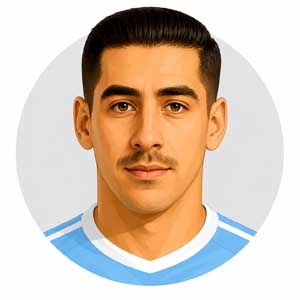
Uruguay - Right WingerGhiggia, Alcides
Teammate Omar Míguez was standing unmarked in the box, shouting for the ball, when Alcides Ghiggia decided against passing it. He drove into the penalty area himself instead, at the near post, and beat goalkeeper Moacir Barbosa low to his right with eleven minutes left in the 1950 World Cup final. Míguez asked him afterward, bewildered, why he hadn't been given the ball. Ghiggia's answer survives in the historical record almost verbatim: leave it there, Omar, it's fine where it is. Two hundred thousand people at the Maracanã went silent. Ghiggia later summarized the feeling with a line that outlived nearly everything else about him: only three people have ever silenced the Maracanã — the Pope, Frank Sinatra, and me.
Born in Montevideo in 1926 to a family of committed Peñarol supporters, Ghiggia was a right winger built on speed, close control and a willingness to take a defender on directly rather than around him — quick over the ground, two-footed, an accurate crosser, and, by his own club's later description, more inclined to set up a teammate than to shoot himself, which makes the Maracanã goal something of an exception rather than the rule of his game. He nearly played for Peñarol's rival Nacional as a teenager before his mother told him he would no longer be welcome at home if he did; he tried out for Peñarol instead and was in the first team within a week. He won two Uruguayan championships there before the 1950 World Cup, where he played every minute of every match and scored in all four, becoming the tournament's decisive figure in its final thirteen minutes: an assist for Juan Alberto Schiaffino's equalizer, then the winner himself. He earned only 12 caps for Uruguay in total, all before he turned 26, because two years after the World Cup he was suspended for fifteen months by the Uruguayan federation for striking a referee during a Peñarol–Nacional derby — an episode that effectively ended his international career and pushed him toward Italy, where he signed for Roma in 1953 and stayed eight seasons, adding a Fairs Cup and becoming enough of an Italian citizen by residence to later win four caps for the Azzurri. He closed out a Serie A title with Milan in 1961–62, made only four appearances that season, and returned to Uruguay to finish his career at Danubio, playing until he was 42.
His limitations were connected to scale as much as to any specific weakness. Ghiggia was slight and not physically imposing, and his international career, extraordinary as its highlight was, remains the shortest of any player commonly discussed among the game's greatest — 12 matches, all decided within a three-year window, none of them at home. He offered little as a creator of structure and depended on isolation and space out wide to be dangerous; against sides that doubled him or denied him the flank entirely, his individual contribution shrank considerably, and he was never asked to carry a team's tactical shape the way more central figures were.
Temperamentally the record contains two contradictory currents that never fully reconciled. By his son's account and by teammates' testimony, Ghiggia habitually put the team first, preferred the pass to the shot, and was popular precisely because he set others up rather than seeking personal glory — and then, in the single moment his entire career is remembered for, he did the opposite, kept the ball from a better-placed colleague, and never expressed the slightest regret about it. He was capable of real, uncontrolled aggression under provocation, as the referee-striking suspension shows, a rupture serious enough to end his international career outright rather than produce a lesser sanction. In Rome he became a genuine celebrity, photographed constantly, associated with film stars, driving an Alfa Romeo in a fur coat — and simultaneously called Uruguay every week to check Peñarol's results, an attachment to home that fame never dissolved. He believed, by his own account late in life, that his path had been shaped by destiny rather than by his own choices — the rejection from a Buenos Aires club that sent him back to Uruguay just before the World Cup, the family ultimatum that pushed him to Peñarol — a fatalistic streak that ran alongside his more assertive moments on the pitch. His final decades were financially difficult and, by his own repeated statements, embittered: he felt Uruguay's state and football establishment had never adequately repaid what he'd given the country, charged for interviews to support himself, and survived a catastrophic 2012 car accident that left him on life support for over a month and never fully recovered. He died in 2015, on the sixty-fifth anniversary of the goal, at his home outside Montevideo. Generous on the pitch except in the one moment history remembers, capable of real violence when provoked, sentimentally bound to a country he'd left young, and quietly aggrieved for decades about recognition he felt was never properly given — Ghiggia's psychological record is considerably less tidy than the single sentence usually attached to his name.


 All Time RomaClub