We use Google Analytics to understand how visitors use this site. Analytics cookies are only activated with your consent. For details, read our Privacy Policy.
Profile lensThe same player, read from a different angle.
Athletic79
Acceleration
74
Pace
77
Agility
78
Strength
83
Balance
82
Jumping
71
Stamina
87
Fitness
81
Technical79
Dribbling
77
Short Passing
78
Long Passing
83
Finishing
73
Shot Accuracy
74
Shot Power
87
Shooting Technique
74
Heading
72
Tackling
78
Crossing
76
Free Kick
77
Penalties
82
First Touch
78
Mental81
Composure
80
Aggression
85
Consistency
79
Creativity
71
Leadership
86
Work Rate
85
Tactical79
Vision
82
Off the Ball
73
Defensive Positioning
74
Teamwork
85
Anticipation
79
Marking
72
Attacking74
Crossing
76
Finishing
73
Heading Accuracy
72
Shot Accuracy
74
Off the Ball
73
Technique78
Dribbling
77
Free Kick
77
Short Passing
78
Long Passing
83
First Touch
78
Shot Technique
74
Movement78
Acceleration
74
Pace
77
Agility
78
Balance
82
Physicality82
Shot Power
87
Jumping
71
Stamina
87
Strength
83
Fitness
81
Defending75
Marking
72
Tackling
78
Def. Positioning
74
Mentality & Game Reading81
Aggression
85
Composure
80
Penalties
82
Vision
82
Leadership
86
Work Rate
85
Teamwork
85
Anticipation
79
Consistency
79
Creativity
71
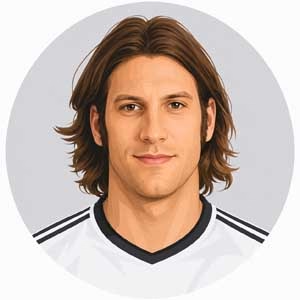
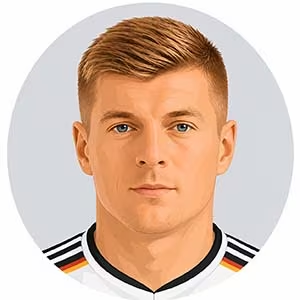
Germany - Defensive MidfielderFrings, Torsten
On 9 June 2006, Germany’s World Cup had barely begun when Torsten Frings received the ball more than twenty-five metres from Costa Rica’s goal. With the score already 3–2 and the opening match becoming unexpectedly uncomfortable, he did not protect the lead by recycling possession. He struck through the ball with his right foot and sent it into the top corner for 4–2. Frings later said he would willingly exchange that spectacular goal for the semi-final he was prevented from playing. The sentence reveals more about him than the strike itself. Personal highlights mattered, but participation in the collective fight mattered more — and being denied that participation could wound him profoundly.
Frings was a powerful central midfielder who could operate as a defensive midfielder, box-to-box player, right-sided midfielder or, earlier in his career, even full-back. Tall, strong and unusually mobile, he covered large areas, tackled aggressively and could carry the ball forward after recovering it rather than simply surrendering possession to a creator. His passing was direct and purposeful, and he possessed a powerful long-range shot, but his principal value came from combining defensive disruption with forward momentum. He could press an opponent, win the second ball and immediately advance twenty metres, giving his teams both protection and transition. After beginning professionally with Alemannia Aachen, he joined Werder Bremen in 1997 and developed into a German international before moving to Borussia Dortmund in 2002. Bayern Munich signed him two years later; in his single season there he won the Bundesliga and DFB-Pokal double. Frings nevertheless returned to Bremen in 2005, later explaining that feeling comfortable and connected to the environment mattered more to him than money or the prestige of remaining at Bayern. His second Werder spell became the defining phase of his career. He won another DFB-Pokal in 2009, reached that season’s UEFA Cup final and eventually became captain, explicitly identifying discipline as one of the standards he expected from teammates. He finished his career with Toronto FC. Germany used him 79 times, and he played major roles at the 2002 and 2006 World Cups and Euro 2008, finishing runner-up in both 2002 and 2008.
His intensity could become counterproductive when a match or personal grievance pushed it beyond its useful level. Frings accumulated bookings because he defended through engagement rather than containment, and quick opponents capable of moving the ball before he arrived could turn his aggression into late challenges. His game also depended strongly on physical range; once mobility declined, covering large midfield spaces became progressively harder. He was technically secure but not a specialist controller who could dominate a match through possession alone, so sides that bypassed his duels and forced him to chase circulating players could reduce his authority. More importantly, he was not naturally diplomatic. When he believed he had been treated without respect, he struggled to detach the sporting decision from the manner in which it had been delivered. That quality made him an effective standard-setter inside a trusted group but a potentially abrasive figure during transitions of hierarchy, particularly late in his international career.
Psychologically, Frings combined high competitive control with a distinctly low tolerance for perceived injustice. His 2006 World Cup suspension provides the clearest example. After Germany’s quarter-final victory over Argentina ended in a mass confrontation, television footage led FIFA to punish Frings for striking Julio Cruz, excluding him from the semi-final against Italy. Frings accepted that he had reacted during the confrontation but considered the punishment profoundly unfair. He later described the day of Germany’s elimination as a personal low point and admitted that, in the immediate aftermath, he wanted to abandon international football entirely. The grievance therefore did not bounce off: being prevented from helping the team hurt more than ordinary defeat. Yet he returned to Germany duty rather than acting on the impulse. A similar pattern emerged under Joachim Löw in 2008. Frings did not object simply to sitting on the bench; he explicitly said professionals had to accept competition. What angered him was how the demotion had been communicated, describing the experience in terms of missing trust and respect and again considering retirement. After a direct meeting with Löw, however, he accepted that previous achievements entitled him to no special privileges and apologised for taking the dispute public. That sequence is unusually informative: the emotional reaction was sharp, but cognitive reassessment could restore cooperation once the conflict was addressed directly. Frings’s leadership at Werder followed the same logic. He said openly that responsibility sometimes required being unpopular, and teammates could expect direct correction rather than diplomatic reassurance. At the same time, his standard was collective discipline rather than personal dominance. Tournament football suited him because he deliberately narrowed his life around the competition, describing the need to eliminate distractions and prepare mentally to be fully ready for one concentrated month. Physical confrontation itself rarely intimidated him; indeed, it usually increased his usefulness. The dangerous trigger was moral rather than physical. Frings could accept losing, competition and hard treatment. What he found much harder to absorb was the conviction that rules, authority or loyalty had been applied unfairly. His toughness therefore had a vulnerable centre: not fear of pressure, but sensitivity to disrespect.