We use Google Analytics to understand how visitors use this site. Analytics cookies are only activated with your consent. For details, read our Privacy Policy.
Profile lensThe same player, read from a different angle.
Athletic77
Acceleration
85
Pace
80
Agility
84
Strength
64
Balance
74
Jumping
66
Stamina
85
Fitness
80
Technical87
Dribbling
91
Short Passing
86
Long Passing
84
Finishing
84
Shot Accuracy
76
Shot Power
91
Shooting Technique
84
Heading
66
Tackling
52
Crossing
84
Free Kick
91
Penalties
86
First Touch
87
Mental78
Composure
85
Aggression
73
Consistency
73
Creativity
87
Leadership
76
Work Rate
74
Tactical82
Vision
85
Off the Ball
83
Defensive Positioning
52
Teamwork
83
Anticipation
78
Marking
48
Player Traits
Attacking79
Crossing
84
Finishing
84
Heading Accuracy
66
Shot Accuracy
76
Off the Ball
83
Technique87
Dribbling
91
Free Kick
91
Short Passing
86
Long Passing
84
First Touch
87
Shot Technique
84
Movement81
Acceleration
85
Pace
80
Agility
84
Balance
74
Physicality77
Shot Power
91
Jumping
66
Stamina
85
Strength
64
Fitness
80
Defending51
Marking
48
Tackling
52
Def. Positioning
52
Mentality & Game Reading80
Aggression
73
Composure
85
Penalties
86
Vision
85
Leadership
76
Work Rate
74
Teamwork
83
Anticipation
78
Consistency
73
Creativity
87
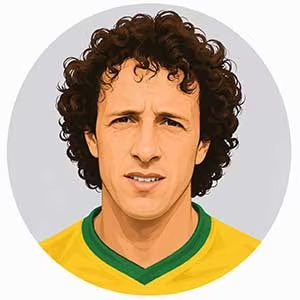
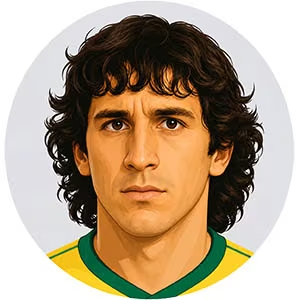
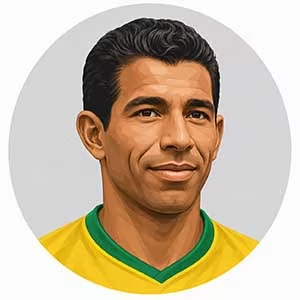
Brazil - Attacking MidfielderDirceu
Dirceu was a left-footed attacking midfielder who could also operate from the flank or deeper in midfield. At roughly 1.72 metres, he relied on agility, balance and timing rather than physical dominance. His outstanding weapon was his left foot: he struck powerfully from distance, delivered dangerous free kicks and corners, and could change the direction of an attack with long diagonal passes. He carried the ball efficiently but was not primarily a dribbler who needed repeated isolation against defenders. His football was more economical, combining movement, passing and shooting with the ability to arrive around the penalty area. He began with Coritiba, moved through Botafogo, Fluminense and Vasco da Gama, and reached his international peak while at Vasco in the 1978 World Cup, scoring three times in seven matches as Brazil finished third. After a season with América in Mexico, he joined Atlético Madrid in 1979 and became a popular figure there during three seasons. From 1982 he built an unusually long Italian chapter, beginning with Verona and continuing through Napoli, Ascoli, Como and Avellino. The constant changes later produced the nickname “the Gypsy”, but his performances suggest adaptability more than rootlessness: at Verona he immediately became important in a newly promoted team that finished fourth in Serie A. Dirceu represented Brazil at the 1974, 1978 and 1982 World Cups. In 1982 he became, alongside Falcão, part of the first modern Brazilian World Cup squad to select established players based in European football.
The limits of his game became clearer when matches denied him time to use his left foot or forced him into continuous physical confrontation. He could contribute from several midfield positions, but he was not a natural ball-winner and offered less resistance than stronger midfielders when opponents turned the game into repeated duels. Aggressive man-marking could reduce the time available for his passing and long shooting, while his relatively slight frame gave him fewer solutions when opponents prevented him from turning. He was also more effective when allowed to interpret space than when confined to a narrow tactical function. By 1982, despite arriving at the World Cup as an experienced European-based international, he started only the opening match against the Soviet Union and then lost his place as Brazil’s midfield settled around a different combination. Versatility prolonged his career, but it did not guarantee indispensability.
Psychologically, Dirceu’s extraordinary movement between countries and clubs is more revealing as evidence of adaptation than of instability. He left Brazil for Mexico, encountered an environment in which opponents subjected him to extremely aggressive and sometimes deliberately provocative marking, then moved again to Spain and later adapted repeatedly to different Italian teams. There is no strong evidence that this physical hostility turned him into a retaliatory player. Accounts of his career instead emphasise unusually sporting behaviour: he committed relatively few fouls, accumulated little disciplinary punishment and was remembered positively by teammates and clubs. That distinction is important. Rough treatment could reduce his technical effectiveness by denying him space, but the available evidence does not indicate that it routinely produced emotional escalation. His career also suggests low dependence on institutional comfort. At Verona he arrived as a signing the coach had not originally requested, yet rather than turning the situation into a public conflict he played 29 league matches and helped a newly promoted team challenge near the top of Serie A. He then repeated the process elsewhere, entering unfamiliar groups without requiring long-term security before contributing. Contemporary recollections describe him as cheerful, quick with a joke and generous, which fits a player who appears to have integrated socially across unusually many environments rather than withdrawing when circumstances changed. Major matches did not consistently raise his tension beyond control. His best World Cup came in 1978, when he scored twice against Peru and then produced the decisive goal against Italy; the size of the occasion appears to have increased his involvement rather than inhibited him. Equally revealing is what is missing from the record: there is little evidence of sustained feuds with coaches, referees or teammates, little disciplinary history suggesting retaliation, and no pattern of public grievance despite repeated transfers and occasional loss of status. That should not be converted into passivity. Dirceu continued searching for competitive football across Spain, Italy, the United States and lower divisions long after his international peak, repeatedly accepting the need to prove usefulness in a new environment. His persistence therefore looks less like attachment to status than attachment to playing itself. The strongest psychological signal is adaptability without emotional flattening: sociable, expressive and technically adventurous, yet able to move through very different competitive cultures without allowing hostility, demotion or unfamiliarity to become the dominant story of his career.