We use Google Analytics to understand how visitors use this site. Analytics cookies are only activated with your consent. For details, read our Privacy Policy.
Profile lensThe same player, read from a different angle.
Athletic79
Acceleration
70
Pace
74
Agility
75
Strength
76
Balance
84
Jumping
81
Stamina
86
Fitness
86
Technical76
Dribbling
75
Short Passing
80
Long Passing
73
Finishing
60
Shot Accuracy
62
Shot Power
83
Shooting Technique
60
Heading
75
Tackling
79
Crossing
63
Free Kick
65
Penalties
66
First Touch
79
Mental84
Composure
82
Aggression
88
Consistency
80
Creativity
66
Leadership
90
Work Rate
90
Tactical80
Vision
75
Off the Ball
62
Defensive Positioning
78
Teamwork
91
Anticipation
85
Marking
81
Player Traits
Attacking64
Crossing
63
Finishing
60
Heading Accuracy
75
Shot Accuracy
62
Off the Ball
62
Technique72
Dribbling
75
Free Kick
65
Short Passing
80
Long Passing
73
First Touch
79
Shot Technique
60
Movement76
Acceleration
70
Pace
74
Agility
75
Balance
84
Physicality82
Shot Power
83
Jumping
81
Stamina
86
Strength
76
Fitness
86
Defending79
Marking
81
Tackling
79
Def. Positioning
78
Mentality & Game Reading81
Aggression
88
Composure
82
Penalties
66
Vision
75
Leadership
90
Work Rate
90
Teamwork
91
Anticipation
85
Consistency
80
Creativity
66
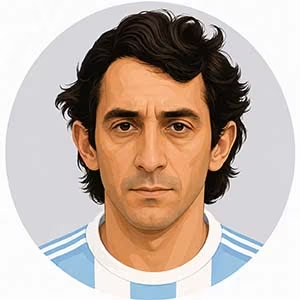
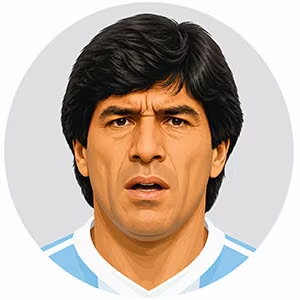
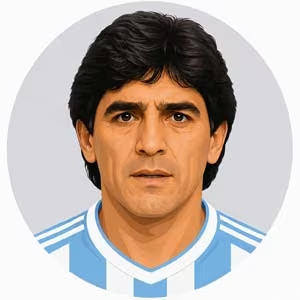
Argentina - Defensive MidfielderAstrada, Leonardo
Leonardo Astrada rarely needed to be the player carrying the ball into the final third to control a match. His influence was more visible in the spaces that disappeared because he had occupied them first. At River Plate during the 1990s, he became the midfielder who absorbed much of the defensive risk created by a technically ambitious team: screening central lanes, tracking second runs and positioning himself where possession was most likely to be lost. That work gave more creative teammates freedom to advance without forcing the defensive line into constant emergency. Astrada’s football was therefore built less around spectacular intervention than around reducing the number of situations in which spectacular intervention became necessary.
Primarily a defensive midfielder, Astrada combined positional discipline with useful passing and strong tactical awareness. He could recover possession, circulate securely and restart attacks without trying to become the principal organiser. His game was particularly valuable in River sides that contained multiple attacking personalities because he accepted an asymmetric division of labour: others could take more creative risks because Astrada remained responsible for preserving the centre. He was not a pure destroyer, however. His passing was clean enough to keep tempo stable after recovery, and he could advance when the structure allowed it. With River he won multiple Argentine league titles and the 1996 Copa Libertadores, spending almost his entire senior career at the club apart from a brief spell with Grêmio. His longevity inside several different River teams suggests that his usefulness did not depend on one coach or one exact midfield configuration.
The limitations came from that specialisation. Astrada was not an explosive box-to-box midfielder and did not possess the acceleration to dominate large spaces once the team became stretched. His passing was functional rather than highly progressive, so he could not replace a creative midfielder when the team needed invention against a compact defence. He was also not physically overwhelming enough to solve every duel through contact alone. His best football therefore required collective distances to remain manageable: if teammates advanced simultaneously and left him isolated, positional intelligence could not completely compensate for the size of the space he had to defend. Age amplified that problem because reduced mobility made recovery after an initial bypass increasingly difficult. His value was highest when structure remained coherent enough for anticipation to operate before emergency defending became necessary.
Psychologically, Astrada is best defined by **structure-first authority**. He became a captain and senior reference at River without building leadership around constant public confrontation or individual status. The observable pattern is that he accepted a role whose success was often measured by what teammates were able to do rather than by his own statistical visibility. That kind of responsibility requires a willingness to protect collective order even when personal recognition is limited. His later career as a coach also fits this cautiously, though it should not be retroactively used as proof of his playing psychology: Astrada consistently emphasised balance, compactness and collective responsibility. Evidence for strong referee conflict, retaliatory aggression, teammate-directed blame or major provocation episodes is insufficient and should remain unknown. Nor is there enough material to claim unusual emotional calm. The stronger behavioural conclusion is narrower: **Astrada’s leadership function was most coherent when it served the structure itself; he did not need the team’s attacking identity to revolve around him in order to exercise authority over how that identity remained protected**.