We use Google Analytics to understand how visitors use this site. Analytics cookies are only activated with your consent. For details, read our Privacy Policy.
Profile lensThe same player, read from a different angle.
Athletic81
Acceleration
81
Pace
82
Agility
80
Strength
78
Balance
80
Jumping
81
Stamina
88
Fitness
79
Technical80
Dribbling
80
Short Passing
81
Long Passing
88
Finishing
63
Shot Accuracy
63
Shot Power
74
Shooting Technique
70
Heading
75
Tackling
78
Crossing
90
Free Kick
72
Penalties
71
First Touch
78
Mental82
Composure
81
Aggression
82
Consistency
83
Creativity
68
Leadership
82
Work Rate
83
Tactical78
Vision
75
Off the Ball
75
Defensive Positioning
77
Teamwork
84
Anticipation
82
Marking
77
Attacking73
Crossing
90
Finishing
63
Heading Accuracy
75
Shot Accuracy
63
Off the Ball
75
Technique78
Dribbling
80
Free Kick
72
Short Passing
81
Long Passing
88
First Touch
78
Shot Technique
70
Movement81
Acceleration
81
Pace
82
Agility
80
Balance
80
Physicality80
Shot Power
74
Jumping
81
Stamina
88
Strength
78
Fitness
79
Defending77
Marking
77
Tackling
78
Def. Positioning
77
Mentality & Game Reading79
Aggression
82
Composure
81
Penalties
71
Vision
75
Leadership
82
Work Rate
83
Teamwork
84
Anticipation
82
Consistency
83
Creativity
68
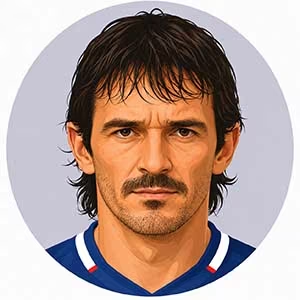
France - Right BackSagnol, Willy
On 9 July 2006, France and Italy reached the end of extra time in the World Cup final in Berlin with the score still 1–1. Willy Sagnol had spent the previous seven matches covering the entire right flank, defending aggressively and repeatedly delivering from deep or overlapping positions. In the shoot-out, after David Trezeguet had missed, Sagnol walked forward knowing another failure could virtually end France’s chances. He scored. France still lost, but the moment fitted his competitive identity: tension was present, disappointment was real, yet the immediate task remained executable. Sagnol was rarely emotionally blank; he was simply very good at separating feeling from action when the match demanded it.
Sagnol was a right-back whose game combined defensive intelligence, stamina and one of the best crossing techniques of his generation. At 1.82 metres, he had enough size to compete physically but relied more on positioning, timing and acceleration than brute force. He defended close to opposing wingers, stepped forward aggressively when the pass was predictable, and then turned recovery into immediate width. His most distinctive attacking weapon was the early cross: rather than always reaching the byline, Sagnol could deliver accurately from deeper areas, often before the defensive line had reorganised. He was technically secure, comfortable circulating possession and capable of moving inside when required, but his value came more from repeated high-quality service and tactical reliability than from dribbling. Saint-Étienne developed him before Monaco signed him in 1997. He won Ligue 1 there in 1999–2000 and moved to Bayern Munich that summer. The transfer transformed his career. Across eight full seasons he won five Bundesliga titles, four German Cups and the 2001 Champions League, starting the final against Valencia before being substituted at half-time. Bayern’s official records place him among the regulars immediately: he made 27 league appearances in his first title-winning season. Internationally, Sagnol earned 58 caps for France. He was an unused member of the 2002 World Cup squad, became more important at Euro 2004, and then played every match of the 2006 World Cup as France reached the final. His final tournament was Euro 2008. Repeated knee, back and Achilles problems then ended his career at only 31.
His effectiveness depended heavily on physical continuity and space to use his delivery. When opponents pinned him deep or denied the time required for early crosses, much of his attacking value disappeared. He was not a natural one-on-one dribbler who could create repeated advantages from a standing start, nor a central playmaker capable of controlling tempo once forced inside. His forward positioning could also expose the channel behind him if Bayern or France lost possession before midfield cover arrived. Later in his career, injuries became the decisive limitation. A serious knee problem in 2007 was followed by back trouble and then an Achilles injury that never healed properly; the latter forced retirement despite repeated medical attempts. His temperament created another cost. Sagnol could accept demanding structures for years, but when he believed coaches were misjudging his condition or status, patience could deteriorate quickly. In 2007, after returning from injury and failing to regain his place, he publicly requested a transfer rather than quietly absorbing the decision.
Psychologically, Sagnol is defined by the gap between his calm presentation and the intensity of his internal reactions. Contemporary German reporting repeatedly described him speaking quietly even when announcing that he wanted to leave Bayern, suggesting low theatricality rather than low frustration. The trigger was not criticism in general but perceived devaluation. In late 2007, after months injured, Sagnol disagreed with Ottmar Hitzfeld over whether he was ready to play and publicly stated that he wanted to leave during the winter. Bayern acknowledged that player and coach had fallen out. This matters because only two years earlier Sagnol had rejected serious interest from Italy and signed a new contract specifically because Munich had become a second home and because his relationships with officials and supporters mattered to him. Loyalty was therefore strong, but conditional on reciprocal trust. His international behaviour shows a similar independence. During qualification for the 2006 World Cup he publicly criticised France’s earlier direction and argued that the return of senior players had been essential; he was willing to speak bluntly when he believed the group was drifting. Yet inside the 2006 tournament he accepted a collective hierarchy in which senior players increasingly managed themselves, later praising Raymond Domenech for stepping back and allowing that responsibility. Authority did not need to dominate him if he trusted the structure. Physical provocation appears to have been a much weaker trigger. Sagnol played through highly confrontational Bundesliga and international matches without developing a pattern of retaliation or referee conflict, and in the World Cup final he converted his penalty despite the extraordinary emotional disruption surrounding the match. After defeat he spoke about regret and disappointment but also credited Italy for handling the shoot-out better, rather than externalising blame. His eventual retirement reveals another important behaviour: persistence had limits. After repeated medical interventions failed, Sagnol publicly accepted that the Achilles injury would not heal and ended his career rather than prolonging an impossible recovery. That was not resignation in the emotional sense; it was a pragmatic recognition of irreversible physical constraint. Sagnol therefore combined strong self-belief, high tactical discipline and low performative ego with a real sensitivity to being sidelined or mistrusted. He could remain composed under match pressure, but institutional frustration penetrated more deeply than physical confrontation ever did.


 All Time Bayern MunichClub